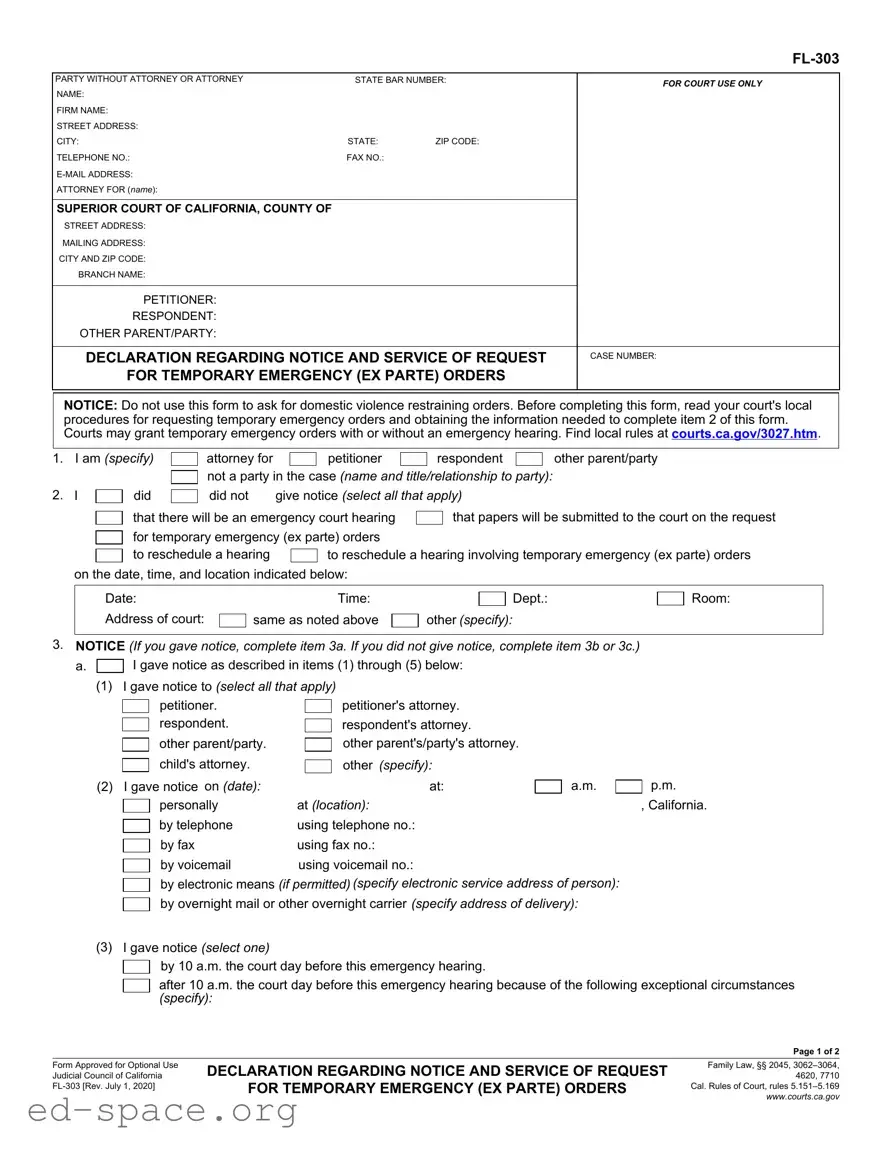
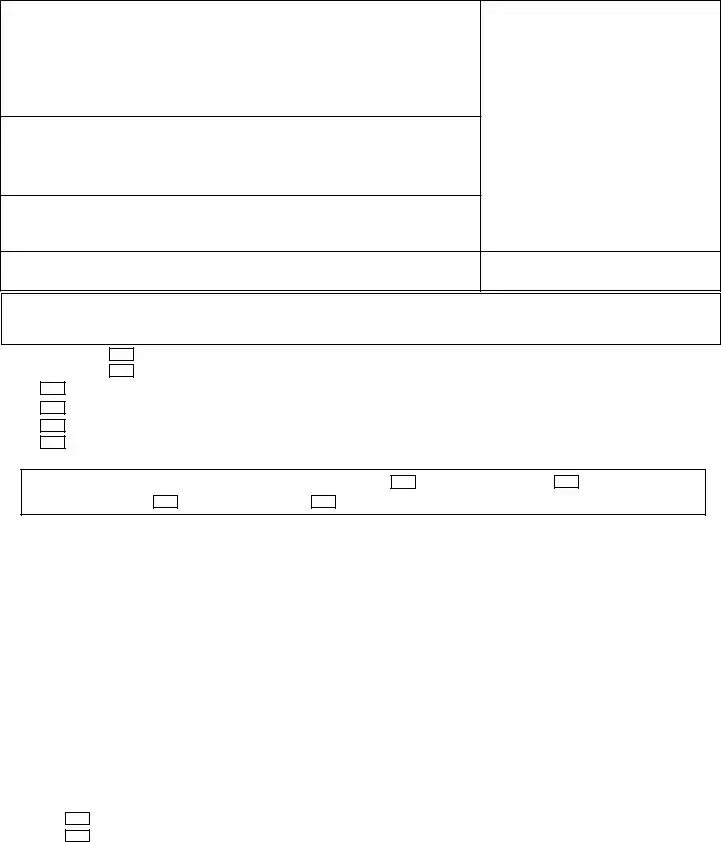
The FL-303 form, officially known as the Declaration Regarding Notice and Service of Request for Temporary Emergency (Ex Parte) Orders, is an essential document used in family law proceedings in California. This form is designed for individuals who are either parties to a case or their legal representatives seeking temporary emergency orders from the court. It requires the completion of several critical sections, including the identification of the parties involved and the specifics of the notice given regarding the emergency hearing. The form emphasizes the importance of adhering to local court procedures and outlines the necessity of notifying other parties about the hearing, unless exceptional circumstances justify a waiver of notice. It includes sections to specify how and when notice was provided, and it allows the requesting party to detail any exceptional circumstances that may have prevented notice. Additionally, the form requires a declaration under penalty of perjury, ensuring that all information provided is truthful and accurate. Understanding the FL-303 form is vital for anyone navigating the complexities of family law, particularly when immediate legal action is necessary to protect oneself or children involved in the case.
PARTY WITHOUT ATTORNEY OR ATTORNEY |
STATE BAR NUMBER: |
FOR COURT USE ONLY |
|
NAME: |
|
|
|
FIRM NAME: |
|
|
|
STREET ADDRESS: |
|
|
|
CITY: |
STATE: |
ZIP CODE: |
|
TELEPHONE NO.: |
FAX NO.: |
|
|
|
|
|
|
ATTORNEY FOR (name): |
|
|
|
SUPERIOR COURT OF CALIFORNIA, COUNTY OF |
|
STREET ADDRESS: |
|
MAILING ADDRESS: |
|
CITY AND ZIP CODE: |
|
BRANCH NAME: |
|
PETITIONER: |
|
RESPONDENT: |
|
OTHER PARENT/PARTY: |
|
DECLARATION REGARDING NOTICE AND SERVICE OF REQUEST |
CASE NUMBER: |
|
|
FOR TEMPORARY EMERGENCY (EX PARTE) ORDERS |
|
NOTICE: Do not use this form to ask for domestic violence restraining orders. Before completing this form, read your court's local procedures for requesting temporary emergency orders and obtaining the information needed to complete item 2 of this form. Courts may grant temporary emergency orders with or without an emergency hearing. Find local rules at courts.ca.gov/3027.htm.
1.I am (specify)
attorney for |
|
petitioner |
|
respondent |
|
other parent/party |
not a party in the case (name and title/relationship to party):
2. I
did |
|
did not |
give notice (select all that apply) |
||||
that there will be an emergency court hearing |
|
that papers will be submitted to the court on the request |
|||||
|
|||||||
for temporary emergency (ex parte) orders |
|
|
|||||
to reschedule a hearing |
|
|
to reschedule a hearing involving temporary emergency (ex parte) orders |
||||
|
|
||||||
on the date, time, and location indicated below:
Date:
Address of court:
Time:
same as noted above
Dept.:
other (specify):
Room:
3.NOTICE (If you gave notice, complete item 3a. If you did not give notice, complete item 3b or 3c.)
a. |
|
I gave notice as described in items (1) through (5) below: |
(1)I gave notice to (select all that apply)
|
|
petitioner. |
|
|
petitioner's attorney. |
|
|
|
|
|
|
respondent. |
|
|
respondent's attorney. |
|
|
|
|
|
|
|
|
|
|
|
|
||
|
|
other parent/party. |
|
|
other parent's/party's attorney. |
|
|
|
|
|
|
|
|
|
|
|
|
||
|
|
child's attorney. |
|
|
other (specify): |
|
a.m. |
|
p.m. |
|
|
|
|
|
|
||||
(2) I gave notice on (date): |
|
|
at: |
|
|
||||
|
|
|
|
||||||
|
|
|
|
||||||
|
|
personally |
at (location): |
|
|
|
, California. |
||
|
|
|
|
|
|||||
|
|
by telephone |
using telephone no.: |
|
|
|
|
||
|
|
|
|
|
|
||||
|
|
by fax |
using fax no.: |
|
|
|
|
||
|
|
|
|
|
|
||||
|
|
by voicemail |
using voicemail no.: |
|
|
|
|
||
|
|
|
|
|
|
||||
|
|
by electronic means (if permitted) (specify electronic service address of person): |
|
||||||
|
|
|
|||||||
|
|
by overnight mail or other overnight carrier (specify address of delivery): |
|
||||||
|
|
|
|||||||
(3) I gave notice (select one)
by 10 a.m. the court day before this emergency hearing.
after 10 a.m. the court day before this emergency hearing because of the following exceptional circumstances (specify):
|
|
Page 1 of 2 |
|
|
|
Form Approved for Optional Use |
DECLARATION REGARDING NOTICE AND SERVICE OF REQUEST |
Family Law, §§ 2045, |
Judicial Council of California |
4620, 7710 |
|
FOR TEMPORARY EMERGENCY (EX PARTE) ORDERS |
Cal. Rules of Court, rules |
|
|
||
|
|
www.courts.ca.gov |

PETITIONER:
RESPONDENT: OTHER PARENT/PARTY:
CASE NUMBER:
(4) I notified the person in 3a(1) that the following temporary emergency orders are being requested (specify):
b.
(5) |
The person in 3a(1) responded as follows: |
|
Attachment 3a(5) |
||||||
(6) |
I |
|
|
do |
|
do not believe that the person in 3a(1) will oppose the request for temporary emergency orders. |
|||
|
|
|
|||||||
|
|
|
Request for waiver of notice. Due to exceptional circumstances, I did not give notice about the request for temporary |
||||||
|
|
|
|||||||
|
|
|
emergency orders. I ask that the court waive notice to the other party to help prevent (specify) |
|
|
||||
(1) |
|
|
|
|
immediate danger or irreparable harm to myself (or my client) or to the children in the case. |
|
|
||
|
|
|
|
|
|
||||
(2) |
|
|
|
|
an immediate risk that the children in the case will be removed from the state of California. |
|
|
||
|
|
|
|
|
|
||||
(3) |
|
|
|
immediate loss or damage to property subject to disposition in the case. |
|
|
|||
|
|
|
|
|
|||||
(4) |
|
|
|
other exceptional circumstances (specify): |
|
|
|||
|
|
|
|
|
|||||
Facts showing exceptional circumstances in support of the request to waive notice include (specify):
Attachment 3b
c. |
|
|
|
Unable to provide notice. I did not give notice about the request for temporary emergency orders. I used my best efforts |
|||||||||||
|
|
|
|
|
to tell the opposing party when and where this hearing would take place but was unable to do so. The efforts I made to |
||||||||||
|
|
|
|
|
inform the other person were (specify below): |
|
|
|
|
|
|
Attachment 3c |
|||
|
|
|
|
|
|
|
|
|
|
|
|||||
4. |
|
|
|
SERVICE OF DOCUMENTS |
|
|
|
|
|
|
|
||||
|
|
|
|
|
|
|
|
|
|
||||||
a. The following documents were served on |
|
|
|
|
|
|
|
||||||||
|
|
|
|
|
petitioner |
|
petitioner's attorney |
|
other parent/party |
|
|
other parent's/party's attorney |
|||
|
|
|
|
|
|
|
|
|
|||||||
|
|
|
|
|
respondent |
|
respondent's attorney |
|
child's attorney |
|
other (specify): |
||||
|
|
|
|
|
|
|
|
||||||||
|
|
|
|
|
|
|
|
|
|
|
|
|
|
|
|
|
|
before the request was filed with the court: |
|
|
|
|
|
|
|
||||||
(1) |
|
|
A copy of Request for Order (form |
||||||||||||
|
|
||||||||||||||
|
|
|
|
|
|
Orders (form |
|
|
|
|
|
|
|
||
(2) |
|
|
A copy of a request to reschedule hearing and Order on Request to Reschedule Hearing (form |
||||||||||||
|
|
||||||||||||||
|
|
|
|
|
|
may be used for the request. |
|
|
|
|
|
|
|
||
(3) |
|
|
A copy of a request to reschedule hearing involving temporary emergency (ex parte) orders and Order on Request |
||||||||||||
|
|
||||||||||||||
|
|
|
|
|
|
to Reschedule Hearing (form |
|||||||||
(4) |
|
|
Other documents (specify): |
|
|
|
|
|
|
|
|||||
|
|
|
|
|
|
|
|
|
|||||||
b. Documents were served on (date): |
at: |
|
|
a.m. |
|||
|
|
personally |
at (location): |
|
, California. |
||
|
|
|
|||||
|
|
by fax on |
using fax no.: |
|
|
|
|
|
|
|
|
|
|
||
by electronic means (if permitted) (specify electronic service address of person served): by overnight mail or other overnight carrier (specify address of delivery):
c.Documents were not served on the opposing party due to the exceptional circumstances specified in
3b, above. |
|
3c, above. |
|
Attachment 4c. |
I declare under penalty of perjury under the laws of the State of California that the foregoing is true and correct. Date:
p.m.
(TYPE OR PRINT NAME)
(SIGNATURE)
DECLARATION REGARDING NOTICE AND SERVICE OF REQUEST |
|||||
|
FOR TEMPORARY EMERGENCY (EX PARTE) ORDERS |
||||
For your protection and privacy, please press the Clear |
|
|
|
|
|
This Form button after you have printed the form. |
Print this form |
|
Save this form |
|
|
|
|
|
|
|
|
Page 2 of 2
Clear this form
| Fact Name | Details |
|---|---|
| Form Title | FL-303 is titled "Declaration Regarding Notice and Service of Request for Temporary Emergency (Ex Parte) Orders." |
| Governing Laws | This form is governed by Family Code sections 2045, 3062–3064, and California Rules of Court rules 5.151–5.169. |
| Purpose | The form is used to declare notice regarding requests for temporary emergency orders in family law cases. |
| Notice Requirements | It includes sections for indicating whether notice was given and to whom, as well as reasons for not providing notice if applicable. |
| Filing Information | Parties must provide their contact information, including name, address, and phone number, along with the case number. |
| Emergency Hearing | The court may grant temporary emergency orders with or without an emergency hearing, depending on the circumstances. |
| Documentation | Documents served in conjunction with this form may include Request for Order (FL-300) and Temporary Emergency Orders (FL-305). |
Completing the FL-303 form is a crucial step in requesting temporary emergency orders in California. This form requires specific information about the parties involved, the notice provided, and the documents served. Follow these steps to ensure that you fill it out correctly.
Once the form is completed, it must be filed with the court. Ensure that you keep copies for your records and consider the next steps in your case, including any hearings that may be scheduled based on your request.
What is the FL-303 form used for?
The FL-303 form is a declaration regarding notice and service of a request for temporary emergency (ex parte) orders in family law cases. It helps parties communicate whether they provided notice to the other party about an upcoming court hearing. This form is crucial when seeking immediate court intervention without the usual notice period.
Who should fill out the FL-303 form?
This form should be filled out by any party involved in a family law case who is requesting temporary emergency orders. This includes attorneys representing a party or individuals representing themselves. It is important to accurately complete the form to ensure the court understands the notice given or reasons for not giving notice.
What information do I need to provide on the FL-303 form?
You will need to provide your name, contact information, and details about the parties involved in the case. Additionally, you must indicate whether you gave notice of the emergency hearing, how you provided that notice, and any exceptional circumstances if notice was not given. This information helps the court assess the situation and decide on the request for emergency orders.
What happens if I did not give notice?
If you did not give notice, you must explain why on the form. You can request that the court waive the notice requirement due to exceptional circumstances, such as immediate danger or risk of harm. Be prepared to provide specific facts that support your request. The court will review this information to determine whether to grant the emergency orders without notice.
How do I submit the FL-303 form?
You can submit the FL-303 form to the court where your family law case is filed. Make sure to check the local court rules for any specific submission guidelines. It’s a good idea to keep a copy of the completed form for your records. If you are unsure about the process, consider reaching out to the court clerk for assistance.
Incorrect Party Identification: Failing to clearly specify whether you are the petitioner, respondent, or another party can lead to confusion. Make sure to select the correct option in the designated area.
Missing Contact Information: Omitting your phone number, email address, or other contact details can hinder communication. Always double-check that this information is complete and accurate.
Not Following Local Procedures: Each court may have specific rules for filling out forms. Ignoring these guidelines can result in delays or rejections of your request. Review your court's local procedures before submission.
Improper Notice: Failing to provide notice to the other party or not documenting how notice was given can lead to complications. Ensure you follow the notice requirements carefully and complete the relevant sections.
Inaccurate Dates and Times: Providing incorrect dates or times for hearings can cause scheduling conflicts. Always verify that the information matches what is required by the court.
Incomplete Service Documentation: Not including all necessary documents that were served can be problematic. Make sure to list all relevant documents and the method of service accurately.
Failure to Specify Exceptional Circumstances: If you did not give notice due to exceptional circumstances, be specific about those circumstances. Vague explanations can weaken your case.
Neglecting Signature and Date: Forgetting to sign and date the form is a common mistake. Always review your form to ensure it is signed and dated before submission.
The FL-303 form, known as the Declaration Regarding Notice and Service of Request for Temporary Emergency (Ex Parte) Orders, is an essential document in family law proceedings. It serves to inform the court about the notice given to involved parties regarding emergency orders. Alongside this form, several other documents are commonly used to ensure a comprehensive approach to legal requests. Below is a list of these important forms, each serving a unique purpose.
Utilizing these forms in conjunction with the FL-303 ensures that all procedural requirements are met, allowing for a smoother legal process. Understanding each document's role can empower individuals navigating the complexities of family law, providing clarity and direction in challenging situations.
When filling out the FL-303 form, it is essential to ensure accuracy and clarity. Here are some important dos and don'ts to consider:
By following these guidelines, you can help ensure that your FL-303 form is completed correctly, which is vital for the court's understanding of your request.
This form is specifically designed for requests related to temporary emergency orders, not for domestic violence cases. It's important to use the correct form for each type of request to ensure proper handling by the court.
While notice is typically necessary, there are exceptions. If exceptional circumstances exist, you can request a waiver of notice. This allows you to proceed without notifying the other party if immediate danger or irreparable harm is present.
When filling out and using the FL-303 form, it is important to keep several key points in mind: