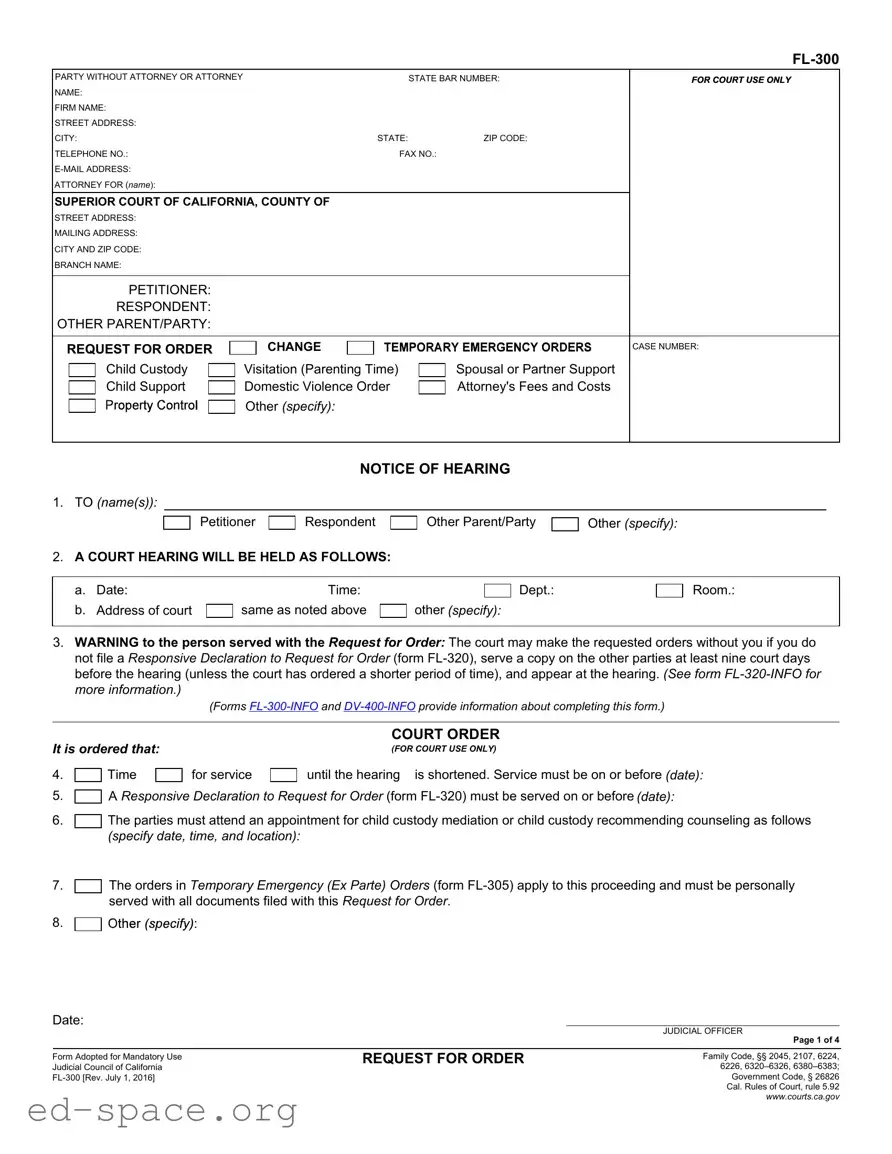
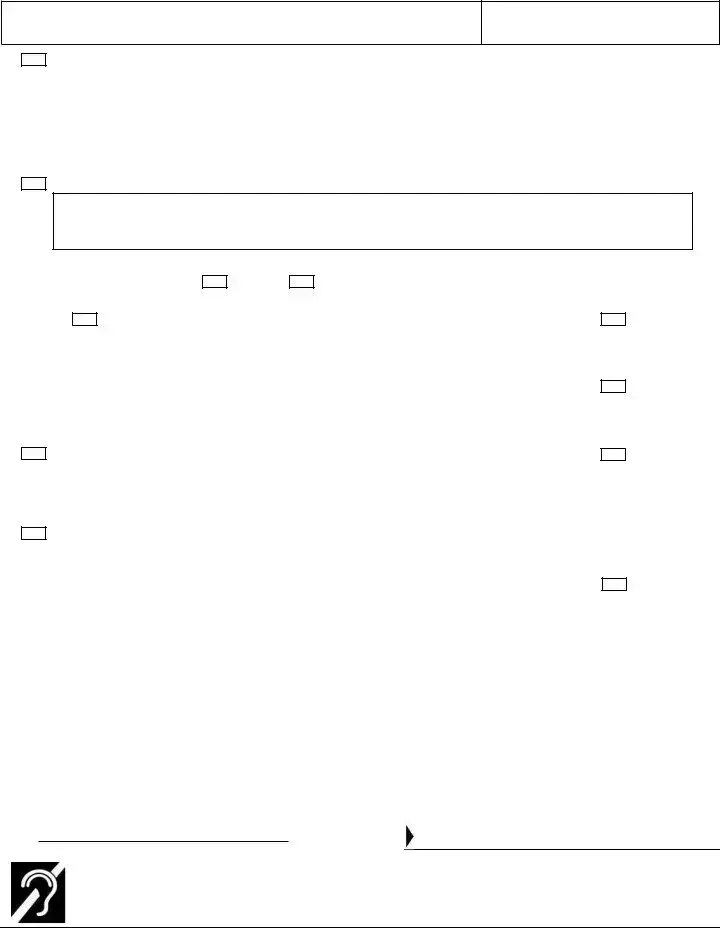
The FL-300 form, officially known as the Request for Order, serves as a vital tool for individuals navigating family law matters in California. This form allows parties to formally request the court to make specific orders regarding various issues, including child custody, visitation rights, spousal support, and child support. It is essential for both petitioners and respondents to understand the significance of this form, as it outlines the necessary steps to initiate a court hearing and provides critical information about the nature of the requests being made. The form includes sections for personal details, such as names and addresses, as well as the case number, which helps the court identify the relevant proceedings. Additionally, it contains a notice of hearing that informs the parties involved of when and where the court will convene to address the requests. Importantly, the FL-300 also emphasizes the need for timely responses and appearances at the hearing, warning that failure to comply may result in the court making decisions without input from the absent party. With its structured format, the FL-300 ensures that all necessary information is presented clearly, facilitating a smoother process in family law cases.
|
|
|
|
PARTY WITHOUT ATTORNEY OR ATTORNEY |
|
STATE BAR NUMBER: |
FOR COURT USE ONLY |
NAME: |
|
|
|
FIRM NAME: |
|
|
|
STREET ADDRESS: |
|
|
|
CITY: |
STATE: |
ZIP CODE: |
|
TELEPHONE NO.: |
FAX NO.: |
|
|
|
|
|
|
ATTORNEY FOR (name): |
|
|
|
SUPERIOR COURT OF CALIFORNIA, COUNTY OF |
|
|
|
STREET ADDRESS: |
|
|
|
MAILING ADDRESS: |
|
|
|
CITY AND ZIP CODE: |
|
|
|
BRANCH NAME: |
|
|
|
PETITIONER: |
|
|
|
RESPONDENT: |
|
|
|
OTHER PARENT/PARTY: |
|
|
|
REQUEST FOR ORDER |
CHANGE |
|
CASE NUMBER: |
|
|
||
Child Custody |
Visitation (Parenting Time) |
Spousal or Partner Support |
|
Child Support |
Domestic Violence Order |
Attorney's Fees and Costs |
|
|
Other (specify): |
|
|
NOTICE OF HEARING
1.TO (name(s)):
Petitioner Respondent
2.A COURT HEARING WILL BE HELD AS FOLLOWS:
Other Parent/Party
Other (specify):
a.Date:
b.Address of court
Time: same as noted above
Dept.:
other (specify):
Room.:
3.WARNING to the person served with the Request for Order: The court may make the requested orders without you if you do not file a Responsive Declaration to Request for Order (form
(Forms
It is ordered that:
4. Time
for service
COURT ORDER
(FOR COURT USE ONLY)
until the hearing is shortened. Service must be on or before (date):
5.
6.
7.
8.
A Responsive Declaration to Request for Order (form
The parties must attend an appointment for child custody mediation or child custody recommending counseling as follows (specify date, time, and location):
The orders in Temporary Emergency (Ex Parte) Orders (form
Date:
JUDICIAL OFFICER
Page 1 of 4
Form Adopted for Mandatory Use Judicial Council of California
REQUEST FOR ORDER
Family Code, §§ 2045, 2107, 6224, 6226,
PETITIONER:
RESPONDENT: OTHER PARENT/PARTY:
CASE NUMBER:
REQUEST FOR ORDER
Note: X
1.
RESTRAINING ORDER INFORMATION
One or more domestic violence restraining/protective orders are now in effect between (specify):
|
|
Petitioner |
|
Respondent |
|
Other Parent/Party (Attach a copy of the orders if you have one.) |
|
|
|
|
|
||||
The orders are from the following court or courts (specify county and state): |
|||||||
a. |
|
|
Criminal: County/state (specify): |
Case No. (if known): |
|||
|
|
||||||
b. |
|
|
Family: County/state (specify): |
Case No. (if known): |
|||
|
|
||||||
c. |
|
|
Juvenile: County/state (specify): |
Case No. (if known): |
|||
|
|
||||||
d. |
|
|
Other: County/state (specify): |
Case No. (if known): |
|||
|
|
||||||
2.
CHILD CUSTODY
VISITATION (PARENTING TIME)
a. I request that the court make orders about the following children (specify):
I request temporary emergency orders
Child's Name |
Date of Birth |
b. |
|
The orders I request for |
|
|
child custody |
|
|
visitation (parenting time) are: |
||||||||
|
|
|
||||||||||||||
|
|
(1) |
|
Specified in the attached forms: |
|
|
|
|
||||||||
|
|
|
|
|
|
|||||||||||
|
|
|
|
Form |
|
|
Form |
|
|
Form |
|
|||||
|
|
|
|
|
|
|
|
|||||||||
|
(2) |
|
Form |
|
|
|
Form |
|
|
Other (specify): |
||||||
|
|
|
|
|
|
|
||||||||||
|
|
As follows (specify): |
|
|
|
|
|
|
|
|
||||||
|
|
|
|
|
|
|
|
|
|
|||||||
Attachment 2a.
Form
Attachment 2b.
c. The orders that I request are in the best interest of the children because (specify):
Attachment 2c.
d.
This is a change from the current order for |
|
child custody |
|
visitation (parenting time). |
||
|
|
|||||
(1) |
|
The order for legal or physical custody was filed on (date): |
. |
|||
|
||||||
(2)
The visitation (parenting time) order was filed on (date): |
. The court ordered (specify): |
Attachment 2d.
REQUEST FOR ORDER |
|
|
Page 2 of 4
PETITIONER:
RESPONDENT: OTHER PARENT/PARTY:
CASE NUMBER:
3.
CHILD SUPPORT
(Note: An earnings assignment may be issued. See Income Withholding for Support (form
a. I request that the court order child support as follows: |
|
||
Child's name and age |
|
I request support for each child |
Monthly amount ($) requested |
|
based on the child support guideline. (if not by guideline) |
||
|
|
||
4.
b. |
|
|
|
|
(date): |
|
|
|
|
||
|
|
|
|
|
|
d. The court should make or change the support orders because (specify):
SPOUSAL OR DOMESTIC PARTNER SUPPORT
(Note: An Earnings Assignment Order For Spousal or Partner Support (form
a. |
|
Amount requested (monthly): $ |
|
|
||
|
|
|
||||
b. |
|
I want the court to |
|
change |
|
end the current support order filed on (date): |
|
|
|
||||
|
|
The court ordered $ |
|
per month for support. |
||
Attachment 3a.
Attachment 3d.
c. |
|
This request is to modify (change) spousal or partner support after entry of a judgment. |
|
|
|
|
|
||
|
|
I have completed and attached Spousal or Partner Support Declaration Attachment (form |
||
|
|
that addresses the same factors covered in form |
|
|
d. I have completed and filed a current Income and Expense Declaration (form |
||||
e. |
The court should should make, change, or end the support orders because (specify): |
|
Attachment 4e. |
|
|
||||
5.
PROPERTY CONTROL
a. The petitioner respondent other parent/party
control of the following property that we own or are buying
b. The |
|
petitioner |
|
respondent |
|
|
other parent/party |
|
|
|
|||||
and liens |
coming due while the order is in effect: |
|
|||||
I request temporary emergency orders be given exclusive temporary use, possession, and
lease or rent (specify):
be ordered to make the following payments on debts
Pay to: |
|
For: |
|
Amount: $ |
Due date: |
||
|
|
|
|
|
|
|
|
Pay to: |
|
For: |
|
Amount: $ |
Due date: |
||
|
|
|
|
|
|
|
|
Pay to: |
|
For: |
|
Amount: $ |
Due date: |
||
|
|
|
|
|
|
|
|
Pay to: |
|
For: |
|
Amount: $ |
Due date: |
||
|
|
|
|
|
|
|
|
c. This is a change from the current order for property control filed on (date):
d.Specify in Attachment 5d the reasons why the court should make or change the property control orders.
REQUEST FOR ORDER |
|
|
Page 3 of 4
PETITIONER:
RESPONDENT: OTHER PARENT/PARTY:
CASE NUMBER:
6.
7.
ATTORNEY'S FEES AND COSTS |
|
I request attorney's fees and costs, which total (specify amount): $ |
. I filed the following to support my request: |
a.A current Income and Expense Declaration (form
b.A Request for Attorney's Fees and Costs Attachment (form
c.A Supporting Declaration for Attorney's Fees and Costs Attachment (form
DOMESTIC VIOLENCE ORDER
•Do not use this form to ask for domestic violence restraining orders! Read form
•Read form
b. I request that the court
change
end the personal conduct,
protective orders made in Restraining Order After Hearing (form
c.
I request that the court make the following changes to the restraining orders (specify):
Attachment 7c.
8.
9.
d. I want the court to change or end the orders because (specify):
OTHER ORDERS REQUESTED (specify):
TIME FOR SERVICE / TIME UNTIL HEARING I urgently need: |
|
||
a. |
|
To serve the Request for Order no less than (number): |
court days before the hearing. |
|
|||
b. |
|
The hearing date and service of the the Request for Order to be sooner. |
|
|
|||
c. I need the order because (specify):
Attachment 7d.
Attachment 8.
Attachment 9c.
10. |
|
FACTS TO SUPPORT the orders I request are listed below. The facts that I write in support and attach to this request |
||
|
||||
|
|
cannot be longer than 10 pages, unless the court gives me permission. |
|
Attachment 10. |
|
|
|
||
I declare under penalty of perjury under the laws of the State of California that the information provided in this form and all attachments is true and correct.
Date:
(TYPE OR PRINT NAME)
(SIGNATURE OF APPLICANT)
Requests for Accommodations
Assistive listening systems,
REQUEST FOR ORDER |
Page 4 of 4
| Fact Name | Description |
|---|---|
| Form Purpose | The FL-300 form is used to request a court order in family law matters, including child custody, support, and domestic violence issues. |
| Governing Laws | This form is governed by California Family Code sections 2045, 2107, 6224, 6226, 6320–6326, 6380–6383, and Government Code section 26826. |
| Required Attachments | When filing, you may need to attach other forms such as FL-150 for income declaration or FL-320 for responsive declaration. |
| Hearing Notification | The form includes a section to notify parties of the hearing date, time, and location, ensuring they can attend. |
| Service Requirements | Parties must serve the Request for Order at least nine court days before the hearing unless a shorter period is ordered by the court. |
| Judicial Officer's Role | A judicial officer will review the requests and may issue orders based on the information provided in the form. |
| Emergency Orders | Temporary emergency orders can be requested and must be served along with the FL-300 form if applicable. |
Filling out the FL-300 form is a critical step in initiating a request for court orders related to family law matters. The process requires careful attention to detail, as each section must be completed accurately to ensure that the court can consider the request appropriately. Below are the steps to guide you through the completion of the form.
After completing the FL-300 form, the next steps involve filing it with the appropriate court and ensuring that all parties receive proper notice of the hearing. It is essential to adhere to any deadlines for service and to prepare for the hearing by gathering supporting evidence and documentation.
What is the FL-300 form used for?
The FL-300 form, also known as the Request for Order, is used in California family law cases. It allows individuals to ask the court for specific orders related to child custody, visitation, child support, spousal support, and other family law matters. By filing this form, a person can formally request changes to existing court orders or establish new ones.
Who can file an FL-300 form?
Any party involved in a family law case can file an FL-300 form. This includes parents seeking modifications to child custody or support orders, as well as spouses requesting changes to spousal support. It is important that the person filing the form is either the petitioner or respondent in the case. If someone is unsure about their status, they may want to consult with a legal professional.
What information do I need to provide on the FL-300 form?
When completing the FL-300 form, you will need to provide your name, contact information, and details about the case, including the names of the parties involved and the case number. You will also specify the type of orders you are requesting, such as child custody or support, and provide reasons for your request. Additionally, if you are seeking changes to existing orders, you should include information about the current orders and why changes are necessary.
What happens after I file the FL-300 form?
After filing the FL-300 form, a court hearing will be scheduled. You will need to serve a copy of the form to the other parties involved in the case. It is essential to do this at least nine court days before the hearing, unless the court has specified a shorter timeframe. If you do not respond or appear at the hearing, the court may make decisions without your input, so attending the hearing is crucial.
Can I request an emergency order using the FL-300 form?
Yes, the FL-300 form allows for requests for temporary emergency orders, also known as ex parte orders. If you believe that immediate action is necessary, you can indicate this on the form. However, you will need to provide a compelling reason for the urgency and follow specific procedures for serving the request promptly. It is advisable to seek legal guidance when requesting emergency orders to ensure compliance with the court's requirements.
Incomplete Information: Failing to fill in all required fields can lead to delays. Ensure every section, including names and addresses, is complete.
Missing Signatures: Not signing the form can result in the court rejecting it. Always check for required signatures before submission.
Incorrect Dates: Entering wrong dates for hearings or previous orders can cause confusion. Double-check all dates for accuracy.
Neglecting Attachments: Forgetting to include necessary attachments, such as income declarations or prior orders, can lead to complications. Review the checklist and include all required documents.
Improper Service: Not serving the other party properly or within the required timeframe can jeopardize your request. Follow the guidelines for service meticulously.
The FL-300 form is a Request for Order used in family law cases in California. It is often accompanied by several other forms and documents that help clarify the requests being made to the court. Below is a list of commonly used forms along with brief descriptions of each.
Each of these forms serves a specific purpose and is essential for ensuring that the court has all necessary information to make informed decisions. Properly completing and submitting these documents can help streamline the legal process and support your case effectively.
The FL-300 form, also known as the Request for Order, serves a specific purpose in family law cases. It is similar to several other legal documents that facilitate communication and requests in family court. Here are four documents that share similarities with the FL-300 form:
Understanding these documents can help individuals navigate the complexities of family law more effectively. Each form plays a vital role in ensuring that all parties have a fair opportunity to present their case and that the court can make informed decisions.
When filling out the FL-300 form, it's important to follow certain guidelines to ensure your submission is accurate and complete. Below is a list of things you should and shouldn't do.
Understanding the FL-300 form is crucial for those navigating family law matters in California. However, several misconceptions often arise about this form. Here are six common misunderstandings:
Clarifying these misconceptions can help individuals better navigate the complexities of family law and ensure they are adequately prepared for the legal processes involved.
Filling out the FL-300 form can seem daunting, but understanding its key components can make the process smoother. Here are some important takeaways:
By keeping these takeaways in mind, individuals can navigate the process of using the FL-300 form more effectively, ensuring that their requests are clearly communicated to the court.