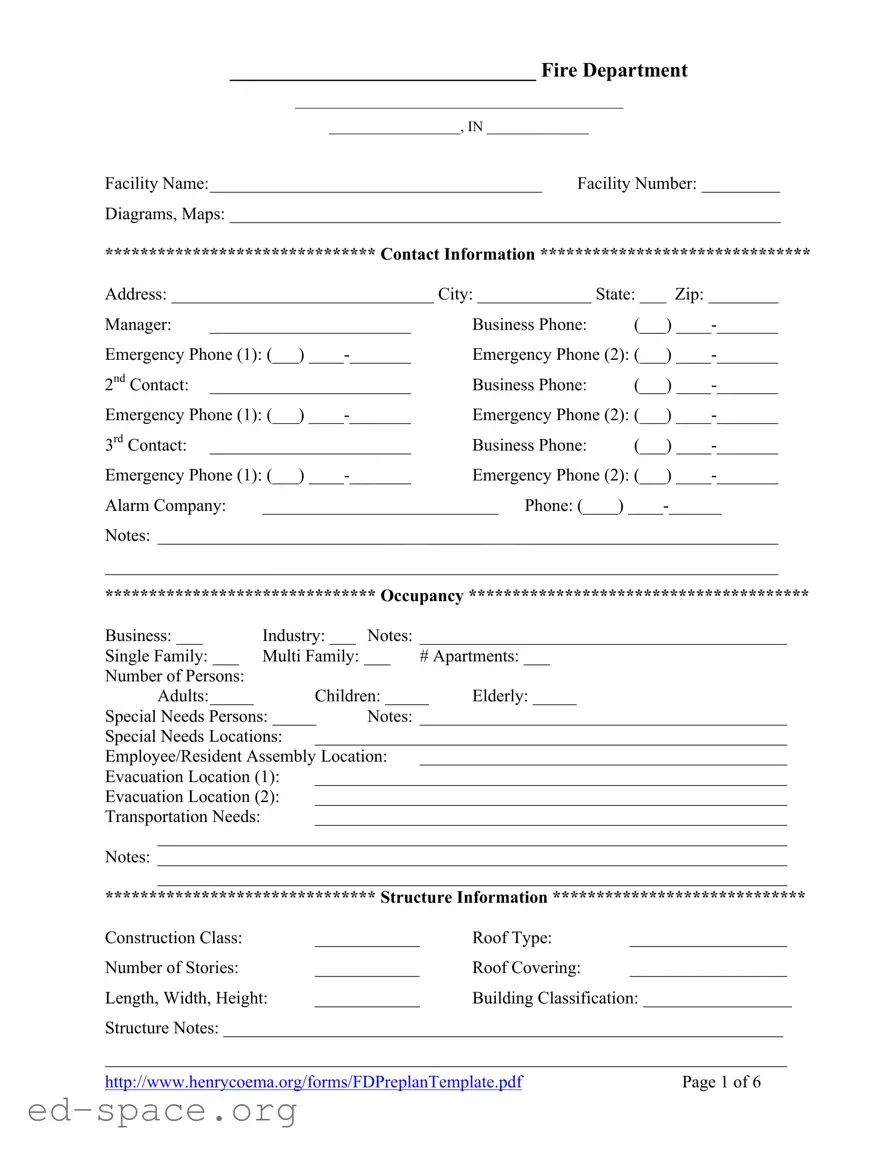
The Fire Department Pre Plan form serves as a crucial tool for ensuring safety and preparedness in emergency situations. This form collects essential information about a facility, including its name, address, and contact details for key personnel. It also provides critical data regarding the structure itself, such as construction class, number of stories, and roof type. Notably, the form includes diagrams and maps that illustrate fire access points and emergency exits, which are vital for quick and efficient response during a fire. Additionally, it outlines the occupancy details, highlighting the number of residents and any special needs individuals, ensuring that first responders can effectively plan for evacuation and assistance. Water supply information, including the location and status of hydrants, is also documented, along with any protective measures in place, such as sprinklers and shutoff systems. Furthermore, the form addresses hazardous materials present on-site, detailing their quantities and potential risks. By compiling all this information, the Fire Department Pre Plan form enhances communication and coordination between facility managers and emergency responders, ultimately contributing to a safer environment for everyone.
______________________________ Fire Department
_____________________________________________
__________________, IN ______________
Facility Name:______________________________________ Facility Number: _________
Diagrams, Maps: _______________________________________________________________
******************************* Contact Information *******************************
Address: ______________________________ City: _____________ State: ___ Zip: ________
Manager: |
_______________________ |
Business Phone: |
(___) |
Emergency Phone (1): (___) |
Emergency Phone (2): (___) |
||
2nd Contact: |
_______________________ |
Business Phone: |
(___) |
Emergency Phone (1): (___) |
Emergency Phone (2): (___) |
||
3rd Contact: |
_______________________ |
Business Phone: |
(___) |
Emergency Phone (1): (___) |
Emergency Phone (2): (___) |
||
Alarm Company: ___________________________ Phone: (____)
Notes: _______________________________________________________________________
_____________________________________________________________________________
******************************* Occupancy ***************************************
Business: ___ |
Industry: ___ |
Notes: __________________________________________ |
|||
Single Family: ___ |
Multi Family: ___ |
# Apartments: ___ |
|||
Number of Persons: |
|
|
|
|
|
Adults:_____ |
|
Children: _____ |
Elderly: _____ |
||
Special Needs Persons: _____ |
Notes: __________________________________________ |
||||
Special Needs Locations: |
______________________________________________________ |
||||
Employee/Resident Assembly Location: |
__________________________________________ |
||||
Evacuation Location (1): |
______________________________________________________ |
||||
Evacuation Location (2): |
______________________________________________________ |
||||
Transportation Needs: |
|
______________________________________________________ |
|||
________________________________________________________________________
Notes: ________________________________________________________________________
________________________________________________________________________
******************************* Structure Information *****************************
Construction Class: |
____________ |
Roof Type: |
__________________ |
Number of Stories: |
____________ |
Roof Covering: |
__________________ |
Length, Width, Height: |
____________ |
Building Classification: _________________ |
|
Structure Notes: ________________________________________________________________
______________________________________________________________________________
http://www.henrycoema.org/forms/FDPreplanTemplate.pdf |
Page 1 of 6 |
******************************* Fire Access Information ***************************
Main Access: |
____________________________________________________________ |
Secondary Access: |
____________________________________________________________ |
Roof Access: |
____________________________________________________________ |
Attic Access: |
____________________________________________________________ |
Basement: |
____________________________________________________________ |
Lowest Access: |
____________________________________________________________ |
Lock Box: |
____________________________________________________________ |
Alarm Panel: |
____________________________________________________________ |
Annunciator Panel: |
____________________________________________________________ |
Notes: _______________________________________________________________________
_____________________________________________________________________________
******************************* Response Information ******************************
Primary Staging: |
____________________________________________________________ |
Secondary Staging: |
____________________________________________________________ |
******************************* Water Supply Information**************************
Volume (GPM) |
________ |
Main Size: |
_____ |
Status: ______________ |
Notes: _______________________________________________________________________
_____________________________________________________________________________
Volume (GPM) |
________ |
Main Size: |
_____ |
Status: ______________ |
Notes: _______________________________________________________________________
_____________________________________________________________________________
Volume (GPM) ________ Main Size: _____ Status: ______________
Notes: _______________________________________________________________________
_____________________________________________________________________________
http://www.henrycoema.org/forms/FDPreplanTemplate.pdf |
Page 2 of 6 |
Alt
Volume (GPM) ________ Main Size: _____ Status: ______________
Notes: _______________________________________________________________________
_____________________________________________________________________________
Alt
Volume (GPM) ________ Main Size: _____ Status: ______________
Notes: _______________________________________________________________________
_____________________________________________________________________________
******************************* Protection Information *****************************
|
Yes/No |
Special Notes |
Sprinklers: |
_____ |
_______________________________________________ |
Spare Heads: |
_____ |
_______________________________________________ |
FD Connection: |
_____ |
_______________________________________________ |
Stand Pipe: |
_____ |
_______________________________________________ |
Gas Shutoff: |
_____ |
_______________________________________________ |
Electrical Shutoff: |
_____ |
_______________________________________________ |
Water Shutoff: |
_____ |
_______________________________________________ |
Notes: _______________________________________________________________________
_____________________________________________________________________________
_____________________________________________________________________________
_____________________________________________________________________________
_____________________________________________________________________________
_____________________________________________________________________________
_____________________________________________________________________________
_____________________________________________________________________________
_____________________________________________________________________________
_____________________________________________________________________________
_____________________________________________________________________________
http://www.henrycoema.org/forms/FDPreplanTemplate.pdf |
Page 3 of 6 |
******************************* HAZMAT ****************************************
Chemical Name: |
___________________________________________________________ |
|||
Location: |
|
___________________________________________________________ |
||
Quantity: |
_____________ Gallons/Pounds |
|
||
Flammable: |
____ |
Toxic: ____ |
Corrosive: ____ |
Oxidizer: ____ |
UN #: _____ |
Guide # _____ |
|
|
|
NFPA 704: |
Fire __ Health __ Reactivity __ Special _________ |
|||
Chemical Name: |
___________________________________________________________ |
|||
Location: |
|
___________________________________________________________ |
||
Quantity: |
_____________ Gallons/Pounds |
|
||
Flammable: |
____ |
Toxic: ____ |
Corrosive: ____ |
Oxidizer: ____ |
UN #: _____ |
Guide # _____ |
|
|
|
NFPA 704: |
Fire __ Health __ Reactivity __ Special _________ |
|||
Chemical Name: |
___________________________________________________________ |
|||
Location: |
|
___________________________________________________________ |
||
Quantity: |
_____________ Gallons/Pounds |
|
||
Flammable: |
____ |
Toxic: ____ |
Corrosive: ____ |
Oxidizer: ____ |
UN #: _____ |
Guide # _____ |
|
|
|
NFPA 704: |
Fire __ Health __ Reactivity __ Special _________ |
|||
Chemical Name: |
___________________________________________________________ |
|||
Location: |
|
___________________________________________________________ |
||
Quantity: |
_____________ Gallons/Pounds |
|
||
Flammable: |
____ |
Toxic: ____ |
Corrosive: ____ |
Oxidizer: ____ |
UN #: _____ |
Guide # _____ |
|
|
|
NFPA 704: |
Fire __ Health __ Reactivity __ Special _________ |
|||
Copy this sheet and attach as many as necessary
http://www.henrycoema.org/forms/FDPreplanTemplate.pdf |
Page 4 of 6 |

Basic Site Plan
http://www.henrycoema.org/forms/FDPreplanTemplate.pdf |
Page 5 of 6 |
Basic Floor Plan, |
____ Floor |
|
|
|
|
Make as many copies as necessary
http://www.henrycoema.org/forms/FDPreplanTemplate.pdf |
Page 6 of 6 |
| Fact Name | Description |
|---|---|
| Purpose | The Fire Department Pre Plan form helps firefighters prepare for emergency responses at specific facilities. |
| Facility Information | Includes details like facility name, number, and diagrams/maps for better navigation during emergencies. |
| Contact Details | Captures essential contact information for the facility manager and additional contacts, ensuring quick communication. |
| Occupancy Details | Records occupancy types, including single-family and multi-family units, along with the number of residents and special needs individuals. |
| Structure Information | Gathers data on construction class, roof type, and building dimensions to assess potential hazards. |
| Fire Access | Identifies main and secondary access points, roof and attic access, and lock box locations for efficient fire response. |
| Water Supply | Details on hydrants and alternative water supplies, including their volume and status, are crucial for firefighting efforts. |
| Protection Features | Indicates the presence of sprinklers, standpipes, and shutoff valves, enhancing safety measures during a fire response. |
| HAZMAT Information | Records hazardous materials on-site, including quantities and properties, to inform firefighters of potential risks. |
| Governing Laws | In Indiana, the use of this form is guided by local fire codes and regulations to ensure compliance with safety standards. |
Filling out the Fire Department Pre Plan form is an important step in ensuring safety and preparedness for your facility. Follow these steps carefully to provide all necessary information accurately.
What is the purpose of the Fire Department Pre Plan form?
The Fire Department Pre Plan form is designed to provide essential information about a facility to emergency responders. It helps firefighters and other emergency personnel understand the layout, hazards, and specific needs of a building before they arrive on the scene. This preparation can significantly enhance response times and effectiveness during emergencies, ensuring the safety of both occupants and responders.
What information is required on the form?
The form requires various details, including the facility name, contact information, occupancy type, and structural information. Additionally, it includes sections for fire access points, water supply details, protection systems, and any hazardous materials present. Each section is crucial for creating a comprehensive picture of the facility, which aids in emergency planning and response.
How often should the Fire Department Pre Plan form be updated?
Who is responsible for completing the form?
Where should the completed form be submitted?
The completed Fire Department Pre Plan form should be submitted to the local fire department. Each jurisdiction may have its own procedures for submission, so it’s essential to check with local fire officials for specific instructions. Some departments may allow electronic submissions, while others may require a physical copy.
What should be done with the form once it is completed?
Once the Fire Department Pre Plan form is completed and submitted, it should be stored in an accessible location at the facility. It's also beneficial to keep a copy on hand for training purposes and to ensure that staff members are familiar with the emergency procedures outlined in the plan. Regular training sessions can help reinforce the information contained in the form and prepare everyone for a potential emergency.
Incomplete Contact Information: Failing to provide complete contact details for all relevant personnel can lead to communication issues during emergencies. Ensure that all fields for business and emergency contacts are filled out accurately.
Neglecting Special Needs: Omitting information about special needs persons can hinder evacuation efforts. It is crucial to identify and document any individuals requiring assistance during emergencies.
Insufficient Water Supply Details: Not detailing the water supply information, such as hydrant locations and their statuses, may delay firefighting efforts. Make sure to include all relevant hydrant data and alternative water sources.
Overlooking Evacuation Routes: Failing to specify clear evacuation locations can create confusion. Clearly outline primary and secondary evacuation routes to ensure safe exits during an emergency.
Ignoring Structure Information: Inaccurate or incomplete structure information, such as the number of stories or construction class, can affect fire response strategies. Provide detailed and accurate descriptions of the facility's structure.
Not Updating the Form: Using outdated information can lead to ineffective emergency responses. Regularly review and update the Pre Plan form to reflect any changes in personnel, structure, or hazards.
The Fire Department Pre Plan form is an essential document used to prepare for emergencies at a facility. It provides critical information about the building, its occupants, and emergency response protocols. Alongside this form, several other documents are commonly utilized to ensure a comprehensive emergency response strategy. Below is a list of these related forms and documents.
These documents collectively enhance the effectiveness of emergency preparedness and response efforts. They ensure that all stakeholders are informed and ready to act in the event of an emergency, ultimately promoting safety and minimizing risk.
When filling out the Fire Department Pre Plan form, there are several important things to keep in mind to ensure accuracy and effectiveness. Below is a list of what you should and shouldn't do:
This is not true. All facilities, regardless of size, benefit from having a Pre Plan. It ensures that first responders are familiar with the layout and specific hazards of the building.
In reality, the Pre Plan should be updated regularly. Changes in occupancy, structure, or hazards necessitate revisions to keep the information current and useful.
While the facility manager plays a key role, input from various staff members is valuable. Different perspectives can highlight unique aspects of the facility that may be critical in an emergency.
The Pre Plan is designed to address various emergencies, including medical incidents and hazardous material spills. It provides a comprehensive overview of safety measures and resources.
While it may seem daunting, the form is structured to guide users through the necessary information step by step. Assistance is often available from local fire departments to help with completion.
This is incorrect. Fire departments actively use the information provided in the Pre Plan during training and actual responses. It serves as a vital resource for ensuring safety.
Although specific legal requirements may vary by jurisdiction, many areas encourage or mandate the completion of Pre Plans to enhance safety and preparedness. It is always best to check local regulations.
Filling out the Fire Department Pre Plan form is essential for ensuring safety and preparedness in case of an emergency. Here are some key takeaways to consider:
By following these guidelines, you can help ensure that the Fire Department Pre Plan form serves its purpose effectively, enhancing safety and preparedness for everyone involved.