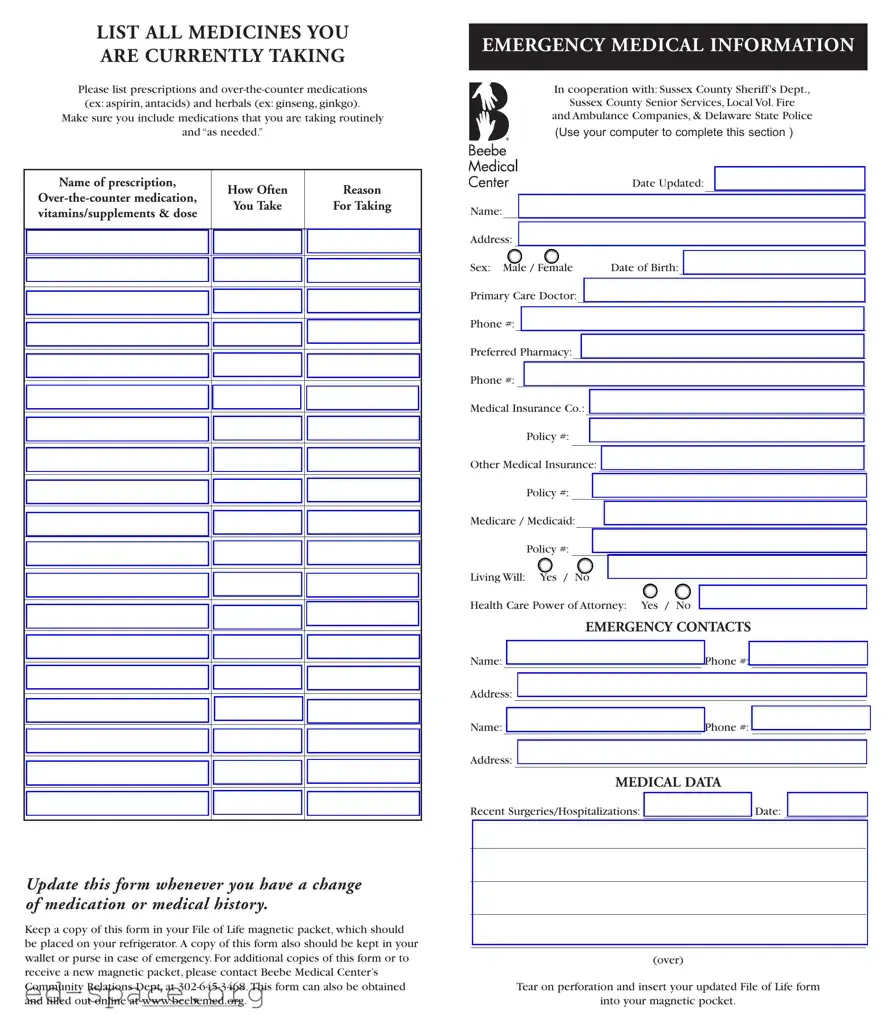
The File of Life form serves as a crucial tool for individuals to communicate essential medical information during emergencies. This form includes a comprehensive list of medications, both prescription and over-the-counter, that a person is currently taking. Users are encouraged to detail the frequency and purpose of each medication, ensuring that emergency responders have access to vital health data. Additionally, the form collects emergency medical information such as personal details, primary care physician contacts, and insurance information. It also prompts users to identify their emergency contacts, which can be critical in urgent situations. Furthermore, the File of Life includes sections for medical conditions, recent surgeries, and allergies, allowing for a holistic view of a person's health status. Regular updates to the form are essential, particularly after any changes in medication or medical history. To ensure accessibility, individuals should keep a copy of the form in a magnetic packet on their refrigerator and another in their wallet or purse. This proactive approach can significantly enhance the quality of care received during emergencies.
LIST ALL MEDICINES YOU
ARE CURRENTLY TAKING
Please list prescriptions and
Make sure you include medications that you are taking routinely
and “as needed.”
Name of prescription, |
|
How Often |
Reason |
|
|
||||
|
You Take |
For Taking |
||
vitamins/supplements & dose |
|
|||
|
|
|
||
|
|
|
|
|
|
|
|
|
|
|
|
|
|
|
|
|
|
|
|
|
|
|
|
|
|
|
|
|
|
|
|
|
|
|
|
|
|
|
|
|
|
|
|
|
|
|
|
|
|
|
|
|
|
|
|
|
|
|
|
|
|
|
|
|
|
|
|
|
|
|
|
|
|
|
|
|
|
|
|
|
|
|
|
|
|
|
|
|
|
|
|
|
|
|
|
|
|
|
|
|
|
|
|
|
|
|
|
|
|
|
|
|
|
|
|
|
|
|
|
|
|
|
|
|
|
|
|
|
|
|
|
|
|
|
|
|
|
|
|
|
|
|
|
|
|
|
|
|
|
|
|
|
|
|
|
|
|
|
|
|
|
|
|
|
|
|
|
|
|
|
|
|
|
|
|
|
|
|
|
|
|
|
|
|
|
|
|
|
|
|
|
|
|
|
|
|
|
|
|
|
|
|
|
|
|
|
|
|
|
|
|
|
|
|
|
|
|
|
|
|
|
|
|
|
|
|
|
|
|
|
|
|
|
|
|
|
|
|
|
|
|
|
|
|
|
|
|
|
|
|
|
|
|
|
|
|
|
|
|
|
|
|
|
|
|
|
|
|
|
EMERGENCY MEDICAL INFORMATION
In cooperation with: Sussex County Sheriff’s Dept.,
Sussex County Senior Services, Local Vol. Fire
and Ambulance Companies, & Delaware State Police
(Use your computer to complete this section )
Date Updated:
Name:
Address:
Sex: Male / Female |
Date of Birth: |
Primary Care Doctor:
Phone #:
Preferred Pharmacy:
Phone #:
Medical Insurance Co.:
Policy #:
Other Medical Insurance:
Policy #:
Medicare / Medicaid:
Policy #:
Living Will: Yes / No
Health Care Power of Attorney: Yes / No
EMERGENCY CONTACTS
Name: Phone #:
Address:
Name: |
|
|
|
Phone #: |
|
|
|
|
|
Address:
MEDICAL DATA
Recent Surgeries/Hospitalizations: |
|
Date: |
|
|
|
Update this form whenever you have a change of medication or medical history.
Keep a copy of this form in your File of Life magnetic packet, which should be placed on your refrigerator. A copy of this form also should be kept in your wallet or purse in case of emergency. For additional copies of this form or to receive a new magnetic packet, please contact Beebe Medical Center’s Community Relations Dept. at
(over)
Tear on perforation and insert your updated File of Life form
into your magnetic pocket.

MEDICAL CONDITIONS
(check all that apply)
|
HEART DISEASE |
LUNG DISEASE |
KIDNEY |
||||
|
|
|
|
|
|
DISEASE |
|
|
|
|
CHF/Heart Failure |
|
COPD/Emphysema |
|
Failure |
|
|
|
|
|
|
|
|
|
|
|
High Blood Pressure |
|
Asthma |
|
Insufficiency |
|
|
|
|
|
|||
|
|
|
|
|
|
|
|
|
|
|
Low Blood Pressure |
|
Fibrosis |
|
Dialysis |
|
|
|
High Cholesterol |
|
Pneumonia |
|
Kidney Stones |
|
|
|
|
|
|||
|
|
|
|
|
|
|
|
|
|
|
Irregular Heart Beat |
|
Bronchitis |
|
Infections |
|
|
|
|
|
|||
|
|
|
Pacemaker |
|
Shortness of Breath |
|
|
|
|
|
|
|
|
|
|
|
|
|
Heart Attack |
|
Coughing |
|
|
|
|
|
|
|
|
||
|
|
|
|
|
|
||
|
|
|
|
|
|
|
|
|
|
|
Angina or Chest Pain |
|
Lung Pain |
|
|
|
|
|
|
|
|
||
|
|
|
|
|
|
||
|
|
|
|
|
|
|
|
|
|
|
Heart Surgery/ |
|
|
|
|
|
|
|
|
|
|
|
|
|
|
|
|
|
|
|
|
|
|
|
ByPass/Stent |
|
|
|
|
|
|
|
|
|
|
|
|
|
|
|
|
|
|
|
|
STOMACH |
NEUROLOGICAL |
MALIGNANCY/ |
DISEASE |
DISEASE |
CANCER |
Bowel Obstruction |
Stroke |
Lung |
Bleeding |
Bleeding in Brain |
Liver |
Diverticulitis |
Seizures |
Breast |
Hiatal Hernia |
Multiple Sclerosis |
Stomach |
|
|
GERD/Reflux |
|
|
Parkinson |
|
|
Leukemia |
|
|
Diarrhea |
|
Headaches |
|
|
Colon |
|
|
|
|
|
|
|
|
|
|
|
|
Blood in Stools |
|
Alzheimers or |
|
|
Skin |
|
|
|
|
|
|
||||
|
|
|
|
|
|
|
|
|
|
|
|
|
|
|
|
|
|
|
|
|
|
|
|
|
|
|
|
Memory Loss |
Other: |
ENDOCRINE |
OTHER |
|
DISEASE |
|
|
Diabetes |
Arthritis |
Vision |
Thyroid: |
Back Problem |
Problems |
High |
HIV |
Other |
Low |
Sickle Cell |
|
Weight Gain
Weight Loss
ALLERGIES
(check all that apply)
|
|
|
Aspirin |
|
|
Laytex |
|
|
Tetracycline |
|
|
|
|
|
|
|
|
|
|
|
|
|
Barbiturates |
|
|
Lidocaine |
|
|
|
|
|
|
|
|
|
|
|||
|
|
|
|
|
|
|
|
|
|
|
|
|
Codeine |
|
|
Morphine |
|
|
No Known Allergy |
|
|
|
|
|
|
|
|||
|
|
|
|
|
|
|
|||
|
|
|
|
|
|
|
|
|
|
|
|
|
Demerol |
|
|
Novocain |
|
|
Other: |
|
|
|
|
|
|
|
|||
|
|
|
Insect Stings |
|
|
Penicillin |
|
|
|
|
|
|
|
|
|
|
|
|
|
|
|
|
Horse Serum or |
|
|
Sulfa |
|
|
|
|
|
|
|
|
|
|
|
|
|
|
|
|
|
|
|
|
|
|
|
|
|
|
Vaccines |
|
|
|
|
|
|
|
|
|
|
|
|
|
|
|
|
Update this form whenever you have a change of medication or medical history.
Keep a copy of this form in your File of Life magnetic packet, which should be placed on your refrigerator. A copy of this form also should be kept in your wallet or purse in case of emergency. For additional copies of this form or
to receive a new magnetic packet, please contact Beebe Medical Center’s Community Relations Dept. at
UNIVERSAL MEDICATION FORM
(Use pencil on this form to allow for easy changing)
Date Updated:
Name:
Address:
Sex: Male / Female |
Date of Birth: |
|
|
|
|
|
|
Primary Care Doctor:
Phone #:
Preferred Pharmacy:
Phone #:
Medical Insurance Co.:
Policy #:
Other Medical Insurance:
Policy #:
Medicare / Medicaid:
Policy #:
MEDICINE ALLERGIES/REACTIONS (describe reaction)
Drug:Reaction:
| Fact Name | Description |
|---|---|
| Purpose | The File of Life form is designed to provide essential medical information in emergencies. |
| Medication List | Users must list all current medications, including prescriptions, over-the-counter drugs, and supplements. |
| Emergency Contacts | The form requires users to include emergency contacts with names and phone numbers. |
| Medical Conditions | Users can check all relevant medical conditions, such as heart disease or diabetes. |
| Allergies | The form includes a section for users to list known allergies and reactions. |
| Update Frequency | It is important to update the form whenever there are changes in medication or medical history. |
| Storage | The completed form should be kept in a magnetic packet on the refrigerator and in a wallet or purse. |
| Accessing the Form | The File of Life form can be obtained online at www.beebemed.org or by contacting Beebe Medical Center. |
| Governing Law | In Delaware, the File of Life program operates under local health regulations and community service laws. |
Completing the File Of Life form is essential for ensuring that your medical information is readily available in case of an emergency. Follow these steps carefully to fill out the form accurately.
Once you have completed the form, it is crucial to update it whenever there is a change in your medications or medical history. Keeping this information current can be vital in emergencies.
What is the File of Life form?
The File of Life form is a vital document designed to keep important medical information readily available during emergencies. It includes details about your medications, medical history, emergency contacts, and insurance information. This form is typically kept in a magnetic packet on your refrigerator, ensuring that first responders can easily access it when needed.
How do I fill out the File of Life form?
To complete the File of Life form, you will need to provide information about your current medications, medical conditions, and emergency contacts. Start by listing all prescriptions, over-the-counter medications, and supplements you take, along with their dosages and reasons for taking them. Next, fill in your personal details, including your name, address, date of birth, and insurance information. Finally, include any emergency contacts and medical history, such as recent surgeries or hospitalizations.
Why is it important to keep the File of Life form updated?
Keeping the File of Life form updated is crucial because your medical information can change frequently. Changes in medications, health conditions, or emergency contacts should be reflected on the form to ensure that first responders have the most accurate and relevant information during an emergency. Regular updates can save time and potentially save lives.
Where should I keep my File of Life form?
The completed File of Life form should be placed in a magnetic packet on your refrigerator. This location is recommended because emergency responders often check the fridge for important medical information. Additionally, it’s wise to keep a copy of the form in your wallet or purse for easy access in case of emergencies outside your home.
Who should I contact if I need additional copies of the File of Life form?
If you require more copies of the File of Life form or need a new magnetic packet, you can contact Beebe Medical Center’s Community Relations Department at 302-645-3468. They can provide you with additional resources and assistance.
What should I do if my medical conditions change?
If your medical conditions change, it’s important to update your File of Life form immediately. This includes adding new medications, changing dosages, or noting any new diagnoses. Keeping this information current ensures that healthcare providers have the most accurate data to work with during emergencies.
Can I fill out the File of Life form online?
Yes, you can fill out the File of Life form online. Visit www.beebemed.org to access the form. This feature allows for easy updates and ensures that you have a digital copy available if needed.
What kind of medical data is included in the File of Life form?
The File of Life form includes a variety of medical data such as recent surgeries, hospitalizations, allergies, and chronic conditions. It also contains information about your primary care doctor, preferred pharmacy, and insurance details. This comprehensive data helps emergency responders understand your medical needs quickly.
Is there a cost associated with obtaining the File of Life form?
No, there is typically no cost associated with obtaining the File of Life form. It is provided as a community service to help individuals keep their medical information organized and accessible in emergencies. Contact Beebe Medical Center for more information on obtaining the form.
Incompleteness: Failing to list all medications, including prescriptions, over-the-counter drugs, and herbal supplements can lead to serious medical errors. It is crucial to provide a comprehensive list.
Outdated Information: Not updating the form regularly can result in emergency responders having incorrect information. Always ensure the form reflects your current medications and medical history.
Missing Emergency Contacts: Omitting important contacts can hinder communication during an emergency. Always include at least two reliable contacts with their phone numbers and addresses.
Neglecting Medical Conditions: Not checking all applicable medical conditions can lead to inadequate treatment. Be thorough when indicating any health issues.
Ignoring Allergies: Failing to disclose allergies can pose significant risks during medical emergencies. Ensure that all known allergies are clearly marked on the form.
Not Keeping Copies Accessible: Keeping only one copy of the form can be a mistake. Always have a copy in your refrigerator and another in your wallet or purse.
Incorrect Contact Information: Providing inaccurate phone numbers or addresses for your primary care doctor or pharmacy can delay necessary medical care. Double-check this information before submitting the form.
Forgetting to Indicate Living Will Status: Not specifying whether you have a living will can complicate medical decisions in emergencies. Clearly state your preferences.
Using Inappropriate Writing Tools: Filling out the form with pen instead of pencil can make updates difficult. Use pencil for easy corrections as needed.
The File of Life form is a crucial document for individuals seeking to provide essential medical information in emergencies. It ensures that first responders have access to vital details about medications, medical conditions, and emergency contacts. Alongside this form, several other documents can enhance preparedness and facilitate effective communication during critical situations.
Having these documents readily available can significantly improve the quality of care received during emergencies. It is advisable to keep them organized and accessible, ensuring that both individuals and their loved ones are prepared for any unforeseen medical events.
The File Of Life form is an essential document that provides critical medical information during emergencies. It shares similarities with several other important documents designed to ensure that individuals receive appropriate care. Here are five documents that are similar to the File Of Life form:
Each of these documents plays a vital role in ensuring that individuals receive the right care during emergencies, just like the File Of Life form. Keeping them updated and accessible can make a significant difference in critical situations.
When filling out the File Of Life form, it is essential to provide accurate and complete information. Below are guidelines on what to do and what to avoid during this process.
Understanding the File of Life form is crucial for ensuring that medical responders have immediate access to your vital health information during emergencies. However, several misconceptions can lead to confusion about its purpose and usage. Here are nine common misconceptions:
By addressing these misconceptions, individuals can better understand the importance of the File of Life form and ensure they are prepared for any medical emergencies.
Filling out and using the File Of Life form is crucial for ensuring that emergency responders have immediate access to vital medical information. Here are key takeaways about this important document:
For additional copies or to obtain a new magnetic packet, contact Beebe Medical Center’s Community Relations Department at 302-645-3468 or visit their website at www.beebemed.org.