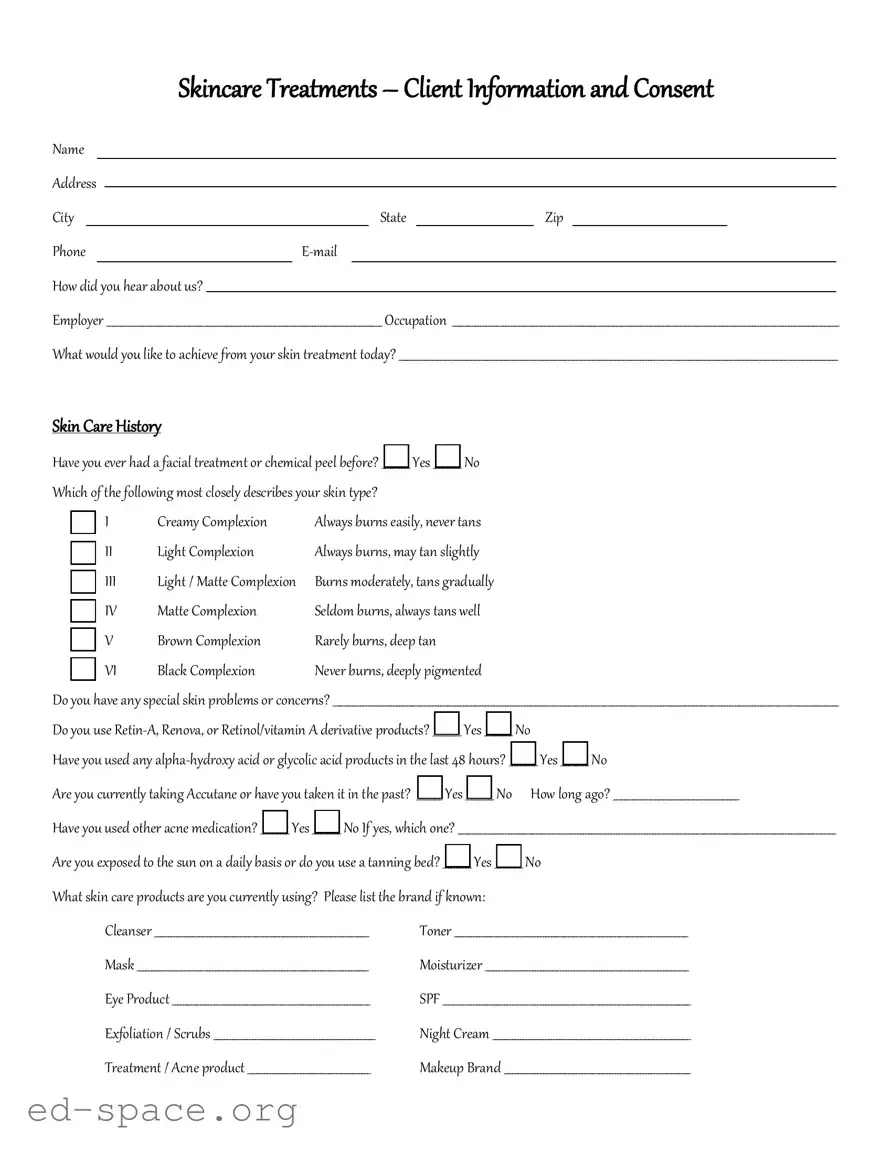
The Facial Consent form is an essential document designed to ensure that clients understand the procedures involved in facial treatments and agree to them willingly. This form typically outlines the specific services being provided, such as cleansing, exfoliation, and the application of masks or serums. It also addresses potential risks and side effects associated with these treatments, allowing clients to make informed decisions about their skincare. Additionally, the form often includes a section for clients to disclose any allergies or skin sensitivities, which is crucial for their safety. By signing the Facial Consent form, clients acknowledge that they have received all necessary information and consent to proceed with the treatment, thereby establishing a clear understanding between the service provider and the client. This process not only protects clients but also helps practitioners adhere to best practices in the beauty and wellness industry.

Skincare Treatments – Client Information and Consent
Name
Address
City |
|
|
|
|
State |
|
|
Zip |
|
|
||
Phone |
|
|
|
|
|
|
|
|
||||
How did you hear about us? |
|
|
|
|
|
|
|
|
|
|
||
Employer ___________________________________________________________________________________________________ Occupation |
___________________________________________________________________________________________________________________________________________ |
|||||||||||
What would you like to achieve from your skin treatment today? ______________________________________________________________________________________________________________________________________________________________
Skin Care History
Have you ever had a facial treatment or chemical peel before? __________ Yes __________ No
Which of the following most closely describes your skin type?
I |
Creamy Complexion |
Always burns easily, never tans |
II |
Light Complexion |
Always burns, may tan slightly |
III |
Light / Matte Complexion |
Burns moderately, tans gradually |
IV |
Matte Complexion |
Seldom burns, always tans well |
V |
Brown Complexion |
Rarely burns, deep tan |
VI |
Black Complexion |
Never burns, deeply pigmented |
Do you have any special skin problems or concerns? ______________________________________________________________________________________________________________________________________________________________________________________
Do you use
Have you used any
Are you currently taking Accutane or have you taken it in the past? _________ Yes __________ No How long ago? _____________________________________________
Have you used other acne medication? __________ Yes __________ No If yes, which one? ________________________________________________________________________________________________________________________________________
Are you exposed to the sun on a daily basis or do you use a tanning bed? __________ Yes __________ No
What skin care products are you currently using? Please list the brand if known:
Cleanser _____________________________________________________________________________ |
Toner ____________________________________________________________________________________ |
Mask ___________________________________________________________________________________ |
Moisturizer _________________________________________________________________________ |
Eye Product _______________________________________________________________________ |
SPF _________________________________________________________________________________________ |
Exfoliation / Scrubs __________________________________________________________ |
Night Cream _______________________________________________________________________ |
Treatment / Acne product ____________________________________________ |
Makeup Brand ___________________________________________________________________ |

Please circle any areas of concern you have regarding your skin: |
|
||
|
Breakouts / Acne |
Blackheads / Whiteheads |
Excessive Oil / Shine |
|
Rosacea |
Broken Capillaries |
Redness / Ruddiness |
|
Sun spot / Brown spots |
Uneven Skin Tone |
Sun Damage |
|
Wrinkles / Fine Lines |
Dull / Dry Skin |
Flaky Skin |
|
Dehydrated Skin |
Sensitive Skin |
|
Eyes: |
Dark Circles |
Puffiness |
Fine lines |
Please circle if you have ever had an allergic reaction to any of the following: |
|
||
|
Cosmetics |
Medicine |
Food |
|
Animals |
Sunscreens |
Pollen |
|
AHAs |
Fragrance |
Shellfish |
|
Latex |
Collagen |
Other: ___________________________________________________________________________________________________ |
Have you ever had Botox, Restylane, or other injections? ______________________________________________________________________________________________________________________________________________________________________________
Ladies only:
Are you taking hormonal contraceptives? __________ Yes __________ No
Are you pregnant or trying to become pregnant? __________ Yes __________ No Are you nursing? __________ Yes __________ No
Experiencing any menopause problems? ____________________________________________________________________________________________________________________________________________________________________________________________________________
Are you undergoing any hormone replacement therapy or cancer treatments? ____________________________________________________________________________________________________________________________________
I understand this consent form and have answered each question truthfully. I understand that withholding information from my skin care therapist may result in contraindications or skin irritation from treatments received. The skin care treatments I receive at Belle Waxing and Skincare are voluntary and I release Belle Waxing and Skincare from liability and assume full responsibility thereof.
Signature |
|
Date |
| Fact Name | Description |
|---|---|
| Purpose | The Facial Consent form is used to obtain permission from clients for facial treatments. |
| Client Awareness | Clients must be informed about the procedures and potential risks involved. |
| Legal Requirement | In many states, obtaining written consent is a legal requirement before performing treatments. |
| State-Specific Forms | Some states have specific forms that must be used to comply with local regulations. |
| Governing Laws | Each state may have different governing laws regarding consent, such as California's Business and Professions Code. |
| Minors | For clients under 18, a parent or guardian must provide consent. |
| Storage | Consent forms should be securely stored to protect client privacy. |
| Duration | Consent is typically valid for a specified period, often one year, but this can vary by state. |
| Revocation | Clients have the right to revoke consent at any time, and this should be documented. |
Once you have the Facial Consent form in front of you, it is important to complete it accurately. This form is necessary for your upcoming facial treatment, and it helps ensure that you are fully informed about the procedure. Following these steps will guide you through the process of filling out the form correctly.
After completing the form, make sure to return it to the designated staff member. They will review it to ensure everything is in order before your treatment begins.
What is a Facial Consent form?
A Facial Consent form is a document that clients sign before receiving facial treatments. It outlines the procedures involved, potential risks, and the client's agreement to proceed with the treatment. This form ensures that clients are informed and understand what to expect during their session.
Why is it important to sign a Facial Consent form?
Signing the Facial Consent form is crucial for both the client and the service provider. It protects the client by ensuring they are aware of any risks associated with the treatment. For the service provider, it provides legal protection by documenting that the client has acknowledged and accepted these risks.
What information is typically included in a Facial Consent form?
The form usually includes details about the treatment being performed, any potential side effects, and contraindications. It may also ask for the client’s medical history, including allergies or skin conditions, to ensure the treatment is safe for them.
Can I refuse to sign the Facial Consent form?
Yes, you have the right to refuse to sign the Facial Consent form. However, without your signature, the service provider may not be able to perform the treatment. It is important to discuss any concerns you have with the provider before making a decision.
What should I do if I have questions about the Facial Consent form?
If you have questions, it is best to ask the service provider directly. They can explain any terms or sections of the form that you find unclear. Understanding the content of the form is essential before you agree to the treatment.
Is my personal information on the Facial Consent form kept confidential?
Yes, personal information collected in the Facial Consent form is typically kept confidential. Service providers are required to protect your privacy and handle your information according to applicable laws and regulations.
What happens if I experience side effects after signing the Facial Consent form?
If you experience side effects after your treatment, it is important to contact your service provider immediately. They can provide guidance on how to manage any reactions and address your concerns. The consent form acknowledges the potential for side effects, but your health and safety remain a priority.
Not reading the entire form before signing. It’s important to understand every section.
Failing to disclose relevant medical history. This can affect treatment outcomes.
Overlooking the section about allergies. This information is crucial for safety.
Providing incomplete contact information. Ensure all details are accurate for follow-ups.
Ignoring the consent for photography. If you don’t want photos taken, make it clear.
Not asking questions about the procedure. Clarifying doubts can prevent misunderstandings.
Rushing through the process. Take your time to ensure everything is filled out correctly.
The Facial Consent form is an important document that ensures clients understand and agree to the procedures involved in facial treatments. Alongside this form, several other documents are commonly used to provide additional information and protection for both the service provider and the client. Below is a list of related forms that may be necessary.
These documents work together to ensure a smooth and safe experience for both clients and providers. Having them in place can help prevent misunderstandings and protect all parties involved.
When filling out a Facial Consent form, it is important to follow certain guidelines to ensure clarity and accuracy. Below are some things you should and shouldn't do:
Following these guidelines will help ensure a safe and effective treatment experience.
Facial consent forms are essential in the beauty and skincare industry. However, several misconceptions surround them. Here are ten common misunderstandings:
Many believe these forms are not necessary, but they are crucial for ensuring that clients understand the treatment and any associated risks.
Some think that once they sign the form, they cannot seek clarification. In reality, clients are encouraged to ask questions before and after signing.
Not all facial consent forms are identical. Different treatments may require different forms, tailored to specific procedures.
Returning clients may also need to sign a new form, especially if there are changes in treatment or health status.
While they do offer legal protection to providers, these forms also ensure that clients are informed about their treatment.
Clients often think that signing the form means agreeing to all treatments offered. In fact, it only covers the specific treatment discussed.
These forms serve an important purpose. They help document client preferences and any potential allergies or conditions.
Clients can update their consent forms anytime, especially if their health status changes or they have new concerns.
Even non-invasive treatments require consent. This ensures clients understand what to expect during their facial.
While they may not hold the same weight as a contract, they do provide documentation that can be important in case of disputes.
When filling out and using the Facial Consent form, consider the following key takeaways:
Taking these steps can help ensure a smooth experience with the facial treatment process.