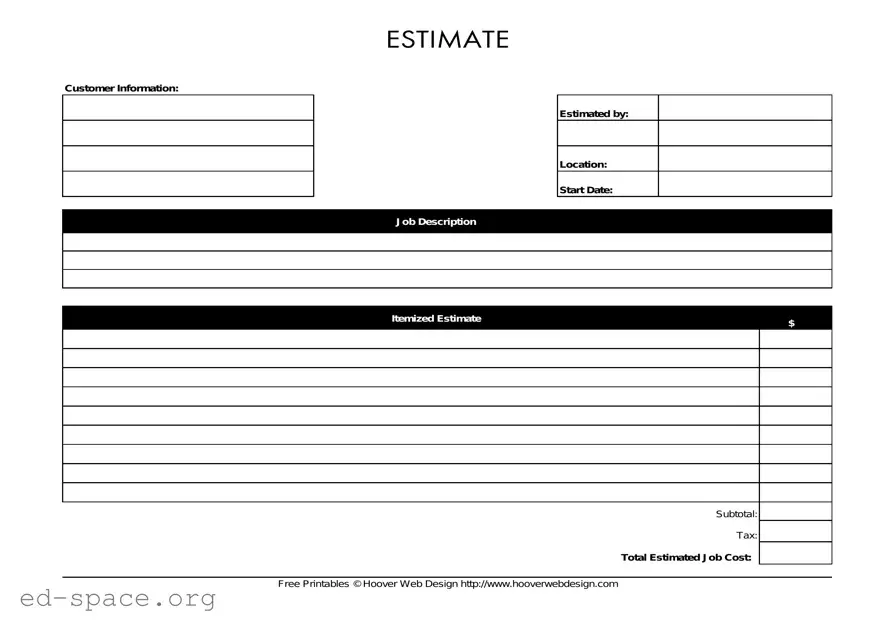
The Estimate form serves as a crucial tool for individuals and businesses alike, streamlining the process of budgeting and financial planning. This form typically outlines the anticipated costs associated with a project or service, providing a clear breakdown of expenses. It includes sections for itemized costs, labor, materials, and any additional fees that may arise. By offering a detailed overview, the Estimate form helps clients understand the financial implications of their decisions before committing to a project. Moreover, it fosters transparency between service providers and clients, ensuring that both parties are aligned on expectations. Whether used in construction, consulting, or any service-oriented industry, the Estimate form is essential for effective communication and financial accountability.
ESTIMATE
Customer Information:
Estimated by:
Location:
Start Date:
Job Description
Itemized Estimate |
$ |
|
Subtotal:
Tax:
Total Estimated Job Cost:
Free Printables © Hoover Web Design http://www.hooverwebdesign.com
| Fact Name | Details |
|---|---|
| Purpose | The Estimate form is used to provide an approximation of costs for a project or service. |
| State-Specific Forms | Some states require specific versions of the Estimate form to comply with local regulations. |
| Governing Laws | The governing laws for the Estimate form can vary by state, often outlined in state construction or contract law. |
| Submission Requirements | Typically, the form must be submitted before work begins, along with any necessary documentation. |
Filling out the Estimate form is a straightforward process that helps ensure you provide all necessary information for accurate evaluation. By following the steps outlined below, you can complete the form efficiently and effectively.
What is the purpose of the Estimate form?
The Estimate form is designed to provide individuals and businesses with a clear and detailed projection of costs associated with a specific project or service. By completing this form, users can obtain an accurate estimate that helps in budgeting and decision-making. It serves as a valuable tool for understanding potential financial commitments before proceeding with any work.
Who should fill out the Estimate form?
Anyone considering a project or service that requires a cost estimate should fill out the Estimate form. This includes homeowners planning renovations, businesses seeking service contracts, or individuals looking for specialized services. It is important for all parties involved to have a clear understanding of potential expenses, making this form beneficial for a wide audience.
What information is required to complete the Estimate form?
To complete the Estimate form, users typically need to provide details such as project specifications, desired timelines, and any specific requirements or preferences. Additionally, contact information is necessary to facilitate communication regarding the estimate. Providing comprehensive and accurate information will result in a more precise estimate.
How long does it take to receive an estimate after submitting the form?
The time frame for receiving an estimate can vary based on the complexity of the project and the volume of requests. Generally, users can expect to receive an estimate within a few business days. If there are any delays, the service provider will typically reach out to inform the user of the status of their request.
Can I make changes to my Estimate form after submission?
Yes, users can usually make changes to their Estimate form after submission. It is advisable to contact the service provider directly to discuss any modifications. Clear communication is essential, as changes may impact the accuracy of the estimate and the overall timeline for receiving it.
What should I do if I have questions about the estimate I received?
If you have questions regarding the estimate, it is important to reach out to the service provider for clarification. They can provide insights into the breakdown of costs and any assumptions made during the estimation process. Open dialogue can help ensure that all concerns are addressed and that you have a thorough understanding of the estimate.
Incomplete Information: Many individuals fail to provide all necessary details. Missing data can lead to inaccurate estimates and delays in processing.
Incorrect Contact Information: Providing wrong phone numbers or email addresses can prevent effective communication. This mistake can lead to missed opportunities or misunderstandings.
Overlooking Required Signatures: Some people forget to sign the form or overlook the need for additional signatures. Without proper authorization, the estimate may not be valid.
Misunderstanding Terms: Individuals often misinterpret the terms and conditions associated with the estimate. This can lead to confusion and disputes later on.
Not Double-Checking Calculations: Errors in calculations can occur easily. Failing to verify numbers may result in inflated or deflated estimates.
Ignoring Submission Guidelines: Each estimate form may have specific submission requirements. Ignoring these can lead to rejection or processing delays.
When preparing an Estimate form, several other documents may be necessary to support the process. These documents help clarify details, provide necessary information, and ensure all parties are on the same page. Below is a list of commonly used forms and documents that accompany the Estimate form.
These documents work together with the Estimate form to create a comprehensive understanding of the project. Having them prepared and organized can streamline communication and enhance the overall efficiency of the process.
The Estimate form serves a specific purpose in various contexts, particularly in project management and financial planning. Several other documents share similarities with the Estimate form, each playing a crucial role in the overall process of budgeting and forecasting. Below is a list of six documents that are similar to the Estimate form, along with explanations of how they relate to one another.
When filling out the Estimate form, it's important to follow certain guidelines to ensure accuracy and efficiency. Here’s a list of things you should and shouldn't do:
Following these guidelines will help ensure that your Estimate form is processed smoothly and efficiently.
Here are ten common misconceptions about the Estimate form, along with explanations to clarify them:
This is not true. Estimate forms can be useful for projects of any size, helping to provide a clear overview of costs and resources needed.
Estimates can be revised. Changes in project scope or unexpected costs may lead to adjustments, and it’s important to communicate these updates.
An estimate is an educated guess. It provides a ballpark figure, but actual costs may vary based on numerous factors.
While it’s important to provide as much information as possible, some sections may be optional depending on the nature of the project.
Anyone involved in a project can use an estimate form. This includes homeowners, businesses, and freelancers.
Estimates provide a projected cost, while invoices reflect the actual amount due after work is completed.
Most estimate forms are designed to be user-friendly. They often include clear instructions to help guide you through the process.
It’s perfectly acceptable to ask for clarification. Communication is key to ensuring everyone is on the same page.
Submitting an estimate is simply a step in the planning process. It does not bind you to proceed with the project.
They can also be used for existing projects when changes or additional work are needed.
When filling out and using the Estimate form, it is important to keep the following key takeaways in mind: