In today’s workplace, maintaining a safe and productive environment is paramount for both employers and employees. One critical tool in achieving this goal is the Employee Drug Test Consent form. This document serves as an essential agreement between an employer and an employee, outlining the conditions under which drug testing will occur. It typically includes details about the types of substances that will be tested, the methods of testing, and the circumstances that may trigger a test, such as pre-employment screenings or random checks. Additionally, the form often specifies the rights of the employee, including their right to refuse testing and the potential consequences of such a refusal. Clear communication about the testing process, as well as the purpose behind it, helps to foster trust and transparency in the workplace. Understanding the implications of signing this consent form is vital for employees, as it not only affects their employment status but also their personal rights and privacy. By ensuring that all parties are informed and in agreement, the Employee Drug Test Consent form plays a crucial role in promoting a healthy work environment while respecting individual rights.
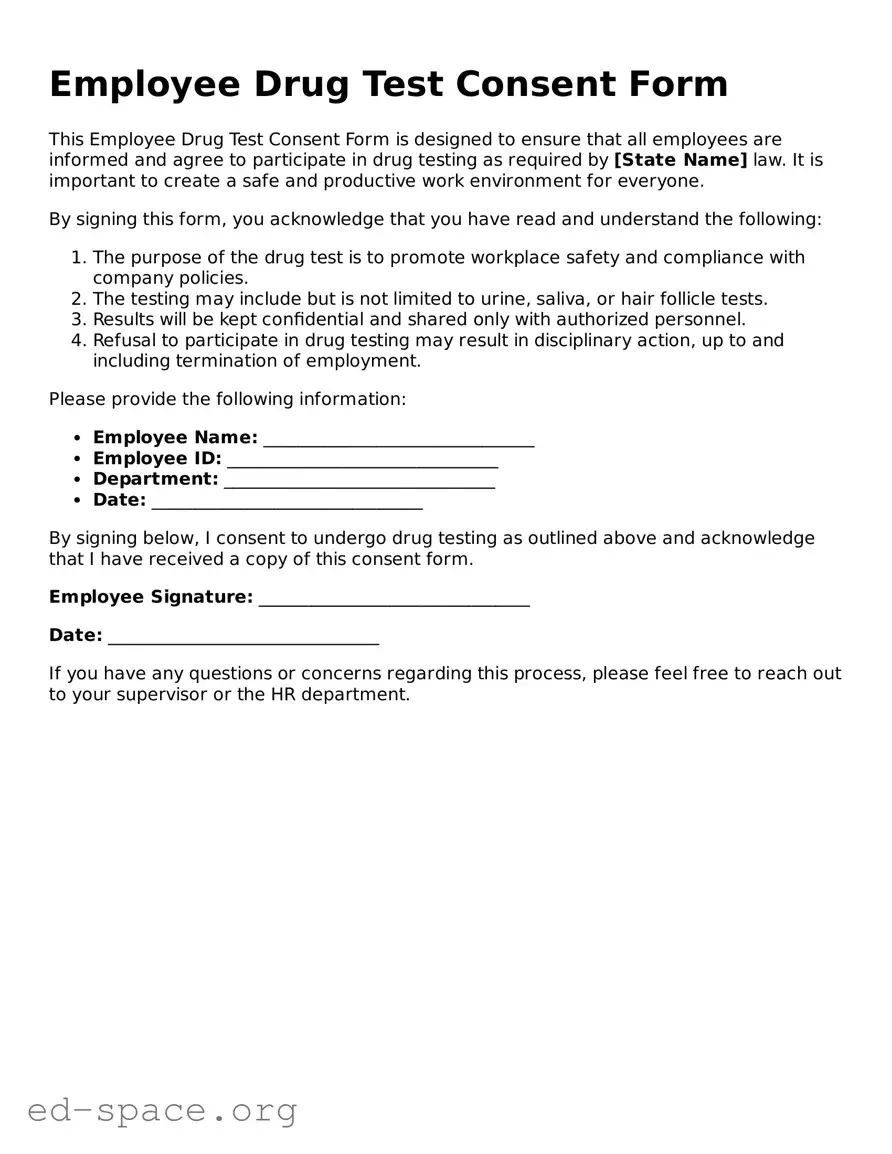
Employee Drug Test Consent Form
This Employee Drug Test Consent Form is designed to ensure that all employees are informed and agree to participate in drug testing as required by [State Name] law. It is important to create a safe and productive work environment for everyone.
By signing this form, you acknowledge that you have read and understand the following:
Please provide the following information:
By signing below, I consent to undergo drug testing as outlined above and acknowledge that I have received a copy of this consent form.
Employee Signature: _______________________________
Date: _______________________________
If you have any questions or concerns regarding this process, please feel free to reach out to your supervisor or the HR department.
| Fact Name | Description |
|---|---|
| Purpose | The Employee Drug Test Consent form is used to obtain permission from employees to conduct drug testing as part of workplace policies. |
| Legal Requirement | In many states, obtaining consent is a legal requirement before conducting drug tests to ensure compliance with privacy laws. |
| State-Specific Laws | Each state has its own laws governing drug testing, which can include specific requirements for consent forms. For example, California's law mandates that employees must be informed of the testing process. |
| Information Included | The form typically includes details about the types of tests, the substances being tested for, and the consequences of refusing to test. |
| Employee Rights | Employees have the right to understand how their test results will be used and to whom they will be disclosed. |
| Confidentiality | Results from drug tests must be kept confidential and shared only with authorized personnel, as mandated by law. |
| Voluntary vs. Mandatory Testing | Some employers may conduct voluntary testing, while others have mandatory policies, often outlined in employee handbooks or contracts. |
After obtaining the Employee Drug Test Consent form, you will need to complete it accurately to ensure compliance with company policies. This form typically requires personal information and your acknowledgment of the testing process. Follow the steps outlined below to fill out the form correctly.
What is an Employee Drug Test Consent form?
The Employee Drug Test Consent form is a document that an employee signs to provide permission for their employer to conduct drug testing. This form outlines the employee's agreement to undergo testing, the substances that may be tested for, and the procedures involved in the testing process.
Why is a Drug Test Consent form necessary?
This form is necessary to ensure that employees are aware of and agree to the drug testing policy of the employer. It protects both the employer and employee by establishing clear expectations and consent prior to testing. It also helps to comply with legal requirements and workplace safety standards.
What information is typically included in the form?
The form usually includes the employee's name, the date of the test, the substances to be tested for, and the testing procedures. It may also outline the consequences of refusing to take the test and any potential disciplinary actions for positive test results.
Can an employee refuse to sign the consent form?
An employee can refuse to sign the consent form; however, doing so may result in disciplinary action, including termination. Employers often include drug testing as part of their workplace policies, and refusal may be viewed as non-compliance with those policies.
What happens if an employee tests positive for drugs?
If an employee tests positive, the employer typically follows a specific protocol outlined in their drug testing policy. This may include a review of the test results, an opportunity for the employee to explain, and potential disciplinary action, which could range from a warning to termination, depending on the company's policies.
How is the confidentiality of test results maintained?
Employers are generally required to keep drug test results confidential. The results should only be shared with authorized personnel involved in the decision-making process. Many companies have policies in place to protect the privacy of the employee's medical information.
Are there any legal protections for employees regarding drug testing?
Yes, employees have certain legal protections regarding drug testing. These protections can vary by state. Employers must comply with federal and state laws, which may include providing notice of testing, maintaining confidentiality, and ensuring that testing is conducted fairly and without discrimination.
Can an employer change their drug testing policy?
Employers can change their drug testing policies, but they must communicate any changes to employees. This communication should include updates to the consent form, ensuring that employees are informed and can provide updated consent if necessary.
How often can an employee be tested?
The frequency of drug testing can vary by employer and may depend on the specific workplace policies. Some employers may conduct random testing, while others may test employees only after an incident or for cause. The details should be clearly outlined in the employer’s drug testing policy.
What are the consequences of not complying with drug testing?
Consequences for not complying with drug testing can include disciplinary actions such as warnings, suspension, or termination of employment. Employers have the right to enforce their drug testing policies to maintain a safe and productive work environment.
Not Reading the Entire Form: Many individuals rush through the form and overlook important sections. Taking the time to read every part ensures that you understand your rights and responsibilities.
Missing Signature: Forgetting to sign the form is a common mistake. A signature is typically required to validate your consent. Without it, the form may be considered incomplete.
Incorrect Personal Information: Providing inaccurate details such as your name, address, or employee ID can lead to confusion. Always double-check your information for accuracy.
Failing to Ask Questions: If you don’t understand any part of the form, it’s crucial to ask for clarification. Ignoring confusion can lead to misunderstandings about the testing process.
Not Keeping a Copy: After submitting the form, some forget to keep a copy for their records. Retaining a copy can be helpful for future reference or in case of disputes.
Ignoring Instructions: Each form may have specific instructions regarding completion and submission. Overlooking these can result in delays or complications in the testing process.
When an Employee Drug Test Consent form is utilized, several other documents may accompany it to ensure a comprehensive approach to workplace safety and compliance. Each of these forms serves a specific purpose in the drug testing process, helping to clarify policies and protect both the employer and employee.
Incorporating these documents alongside the Employee Drug Test Consent form fosters transparency and fairness in the drug testing process. Each form plays a vital role in protecting the rights of employees while ensuring a safe and compliant workplace environment.
The Employee Drug Test Consent form is a crucial document in the workplace, particularly for companies that require drug testing as part of their hiring or employment policies. Several other documents share similarities with this consent form, often serving to protect both the employer and the employee while ensuring compliance with legal standards. Below is a list of nine documents that are similar to the Employee Drug Test Consent form, along with a brief explanation of how they are alike.
When filling out the Employee Drug Test Consent form, it is important to follow certain guidelines to ensure accuracy and compliance. Below are seven things you should and shouldn't do.
Understanding the Employee Drug Test Consent form is essential for both employers and employees. However, there are several misconceptions surrounding it. Here’s a list of common misunderstandings:
This is not true. Drug testing policies can vary by company and position. Some employers may only require testing for specific roles or under certain circumstances.
Not necessarily. The consent form typically applies to a specific test or situation, not to ongoing testing.
Employers usually test for specific substances outlined in their policy. The list of substances tested should be clearly stated in the company’s drug testing policy.
While you can refuse to sign, this may impact your employment. Many employers require a signed consent form as part of their hiring or ongoing employment process.
This is misleading. Most tests only detect recent use and not past drug use. The detection window varies depending on the substance.
Confidentiality is generally maintained. Test results are usually shared only with authorized personnel, not the entire company.
Drug tests can also screen for prescription medications and alcohol, depending on the employer’s policy.
Some employers may conduct random tests without prior notice. However, for scheduled tests, notification is typically given.
This is incorrect. Signing the form does not waive your rights. You still have rights regarding privacy and the handling of your test results.
Being informed about these misconceptions can help employees understand their rights and responsibilities regarding drug testing in the workplace.
Filling out and using the Employee Drug Test Consent form is an important process for both employers and employees. Here are some key takeaways to consider:
By keeping these points in mind, both employers and employees can navigate the drug testing process more smoothly.