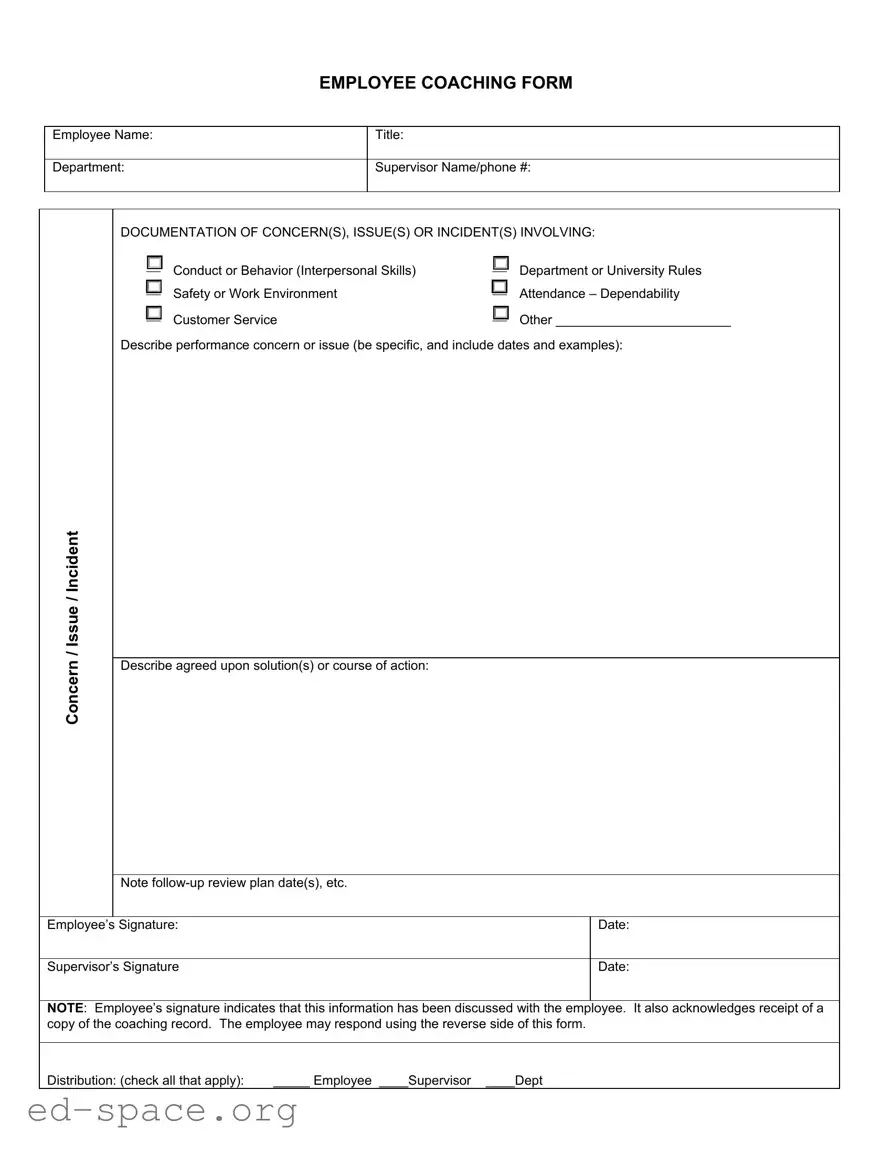
The Employee Coaching form serves as a vital tool in fostering a constructive dialogue between supervisors and employees. This form is designed to address various concerns, whether they relate to conduct, adherence to departmental rules, safety issues, attendance, or customer service. It begins by capturing essential details, including the employee's name, department, title, and supervisor's contact information. The form then prompts the supervisor to document specific incidents or behaviors that have raised concerns, encouraging clarity and specificity with dates and examples. Following this, it outlines the agreed-upon solutions or actions that will be taken to address the issues at hand. Importantly, the form includes a section for a follow-up review plan, ensuring that progress is monitored over time. Both the employee and supervisor sign the form, which signifies that the discussion has occurred and that the employee has received a copy of the record. Additionally, employees have the opportunity to provide their own responses on the reverse side, fostering a two-way communication channel. The distribution section allows for clear record-keeping, ensuring that all relevant parties are informed and engaged in the coaching process.

EMPLOYEE COACHING FORM
Employee Name:
Department:
Title:
Supervisor Name/phone #:
CONCERN / ISSUE / INCIDENT
DOCUMENTATION OF CONCERN(S), ISSUE(S) OR INCIDENT(S) INVOLVING:
⎯ Conduct or Behavior (Interpersonal Skills) |
⎯ Department or University Rules |
||
⎯ |
Safety or Work Environment |
⎯ |
Attendance – Dependability |
⎯ |
Customer Service |
⎯ |
Other ________________________ |
Describe performance concern or issue (be specific, and include dates and examples):
Describe agreed upon solution(s) or course of action:
Note
Employee’s Signature:
Supervisor’s Signature
Date:
Date:
NOTE: Employee’s signature indicates that this information has been discussed with the employee. It also acknowledges receipt of a copy of the coaching record. The employee may respond using the reverse side of this form.
Distribution: (check all that apply): |
_____ Employee ____Supervisor ____Dept |
| Fact Name | Description |
|---|---|
| Purpose of the Form | The Employee Coaching Form is designed to document performance concerns, issues, or incidents involving an employee. It serves as a structured way to address and improve workplace behavior and performance. |
| Content Overview | This form includes sections for the employee's name, department, title, and supervisor's contact information. It also details the specific concerns or issues, proposed solutions, and a follow-up review plan. |
| Signatures Required | Both the employee and the supervisor must sign the form. The employee's signature confirms that the discussion took place and acknowledges receipt of the coaching record. |
| Distribution of Copies | Copies of the completed form are distributed to the employee, supervisor, and department. This ensures that all relevant parties are informed of the coaching session and its outcomes. |
| Legal Considerations | In some states, employment law may govern the use of coaching forms. For example, in California, employers must adhere to the Fair Employment and Housing Act, which emphasizes the importance of documenting performance issues fairly and consistently. |
Completing the Employee Coaching form requires careful attention to detail. This form serves as a record of performance-related discussions and agreements between an employee and their supervisor. Follow the steps below to ensure accurate completion.
What is the purpose of the Employee Coaching form?
The Employee Coaching form serves as a structured way to document performance concerns, incidents, or issues involving an employee. It helps supervisors address specific behaviors or situations that may need improvement. By outlining the concern clearly, both the employee and supervisor can work together to create a plan for improvement. This form is essential for ensuring that there is a record of the discussion and agreed-upon actions, which can help in future evaluations and follow-ups.
Who needs to sign the Employee Coaching form?
Both the employee and the supervisor must sign the Employee Coaching form. The employee's signature indicates that they have discussed the concerns with their supervisor and received a copy of the coaching record. This acknowledgment is crucial as it ensures transparency in the process. Additionally, the supervisor's signature confirms that they have documented the coaching session and the agreed-upon course of action. It is important to note that the employee has the opportunity to respond on the reverse side of the form, allowing for a complete record of the discussion.
What should be included in the documentation of concerns?
When documenting concerns on the Employee Coaching form, it is vital to be specific and detailed. Include the nature of the concern, whether it relates to conduct, attendance, safety, or customer service. Provide concrete examples, including dates and incidents, to illustrate the issue clearly. This specificity helps both the supervisor and employee understand the situation and the context, which can lead to more effective solutions. The documentation should also outline any agreed-upon actions or solutions to address the concern.
What happens after the form is completed?
Once the Employee Coaching form is completed and signed, it is distributed to all relevant parties. This typically includes the employee, the supervisor, and the department. Follow-up review plans should also be established, with specific dates noted for future discussions. This follow-up is critical for assessing progress and ensuring that the employee is on track with the agreed-upon improvements. Keeping communication open and ongoing can significantly enhance the effectiveness of the coaching process.
Leaving Sections Blank: One common mistake is not filling out all required fields. Make sure to provide the employee's name, department, title, and supervisor's contact information. Missing this information can lead to confusion later.
Vague Descriptions: When describing the performance concern, be specific. Avoid general statements. Instead of saying "poor behavior," provide concrete examples and dates. This clarity helps everyone understand the issue better.
Not Documenting Solutions: It's essential to outline agreed-upon solutions or actions. Failing to do so can lead to misunderstandings about what steps will be taken to address the issue.
Ignoring Follow-Up Plans: A follow-up review is crucial for tracking progress. If you skip this step, it may result in unresolved issues lingering longer than necessary.
Not Getting Signatures: Both the employee and supervisor should sign the form. This acknowledgment is important for confirming that the discussion took place. Neglecting this can lead to disputes later.
Incorrect Distribution: Ensure that you check all appropriate boxes for distribution. Failing to do so can mean that the right people are not informed about the coaching record.
In addition to the Employee Coaching form, several other documents are commonly utilized to ensure effective communication and documentation within the workplace. Each of these forms serves a unique purpose in managing employee performance and development.
Using these forms in conjunction with the Employee Coaching form can enhance communication, clarify expectations, and promote accountability in the workplace. Proper documentation ensures that both employees and supervisors are aligned on performance goals and development plans.
The Employee Coaching form serves as a valuable tool for documenting performance issues and solutions. It shares similarities with several other important documents in the workplace. Here are four documents that are comparable:
When filling out the Employee Coaching form, it's important to approach the task thoughtfully. Here are four key things to keep in mind:
Conversely, here are four things to avoid when completing the form:
Misconceptions about the Employee Coaching form can lead to misunderstandings and hinder effective communication between employees and supervisors. Below are seven common misconceptions:
Understanding these misconceptions can help create a more productive coaching process, fostering a culture of growth and improvement within the workplace.
When filling out and using the Employee Coaching form, it is essential to keep several key points in mind to ensure effective communication and documentation.
By adhering to these guidelines, both employees and supervisors can foster a constructive dialogue that promotes growth and accountability in the workplace.