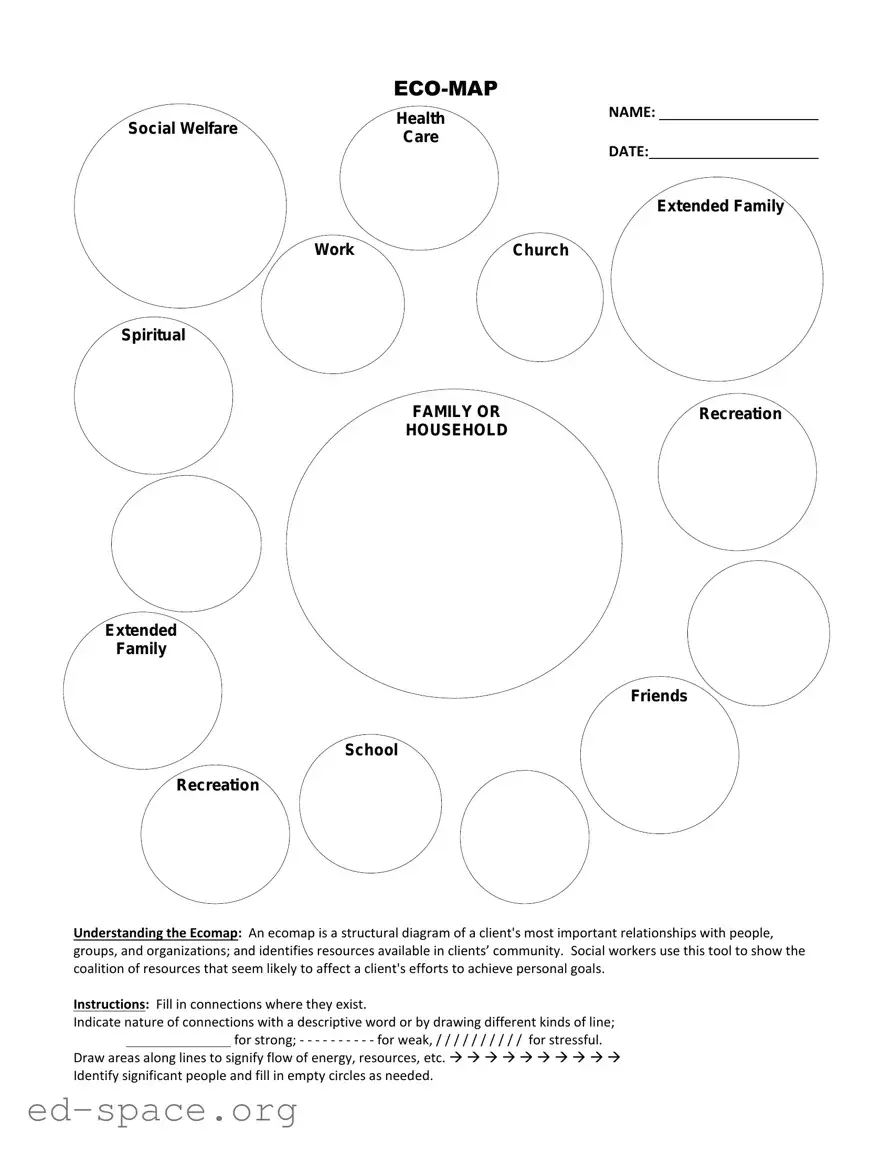
The Eco Map form serves as a vital tool for individuals and organizations aiming to visualize and analyze the intricate web of relationships and resources surrounding a person or family. By mapping out connections to various social, community, and institutional supports, this form provides a comprehensive overview of the environmental influences that impact an individual’s well-being. Key aspects of the Eco Map include identifying support systems, such as family, friends, and community organizations, as well as recognizing potential stressors or barriers that may hinder access to these resources. The form encourages users to reflect on their interactions with these entities, fostering a deeper understanding of their social environment. Additionally, the Eco Map can highlight gaps in support, prompting proactive measures to enhance one’s network. Ultimately, this visual representation not only aids in assessment but also serves as a springboard for developing targeted interventions and strategies to improve overall quality of life.

Social Welfare
Spiritual
Extended
Family
Recreation
Health
Care
WorkChurch
FAMILY OR
HOUSEHOLD
School
NAME:
DATE:
Extended Family
Recreation
Friends
Understanding the Ecomap: An ecomap is a structural diagram of a client's most important relationships with people, groups, and organizations; and identifies resources available in clients’ community. Social workers use this tool to show the coalition of resources that seem likely to affect a client's efforts to achieve personal goals.
Instructions: Fill in connections where they exist.
Indicate nature of connections with a descriptive word or by drawing different kinds of line; for strong; - - - - - - - - - - for weak, / / / / / / / / / / for stressful.
Draw areas along lines to signify flow of energy, resources, etc.
Identify significant people and fill in empty circles as needed.
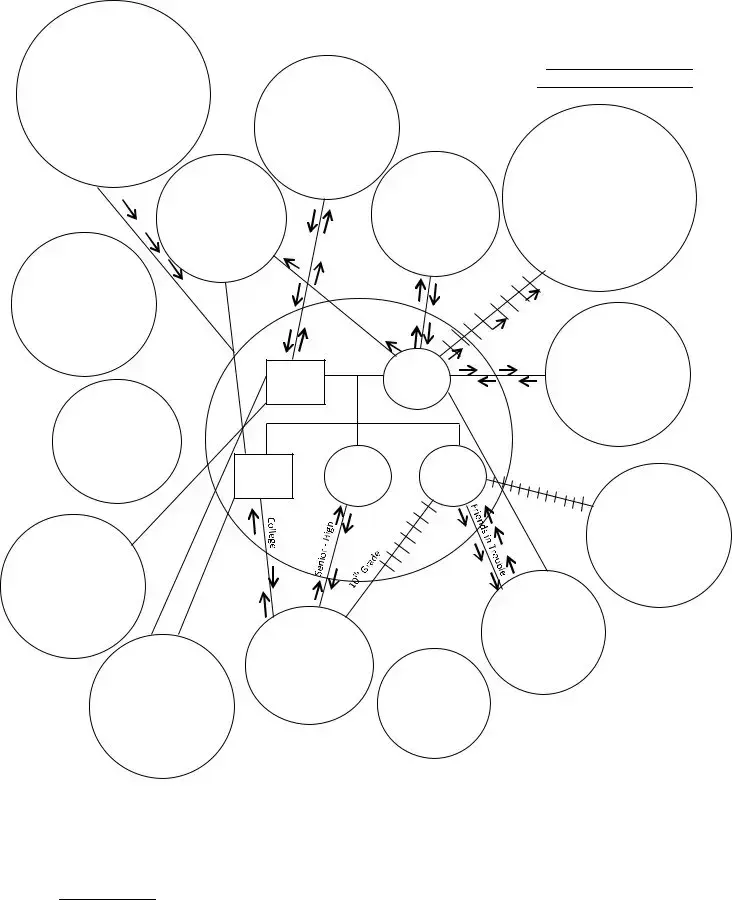
Social Welfare
Family has been referred to counseling around Joan.
Medicare and A Disabled
SAMPLE
Health
Care
City Hospital Clinic John – MS for 10 years
NAME:
DATE:
Extended Family
Work |
Church |
Birth’s mother |
|
|
demanding – I’ll |
Both – part time |
|
need financial & |
|
emotional support |
|
|
|
Spiritual
|
|
FAMILY OR |
Recreation |
|
|
HOUSEHOLD |
|||
|
|
|||
|
|
BETH |
Beth involved in |
|
JOHN |
gardening & |
|||
40 |
||||
42 |
|
garden club. |
||
|
|
|||
JOHN |
GWEN |
JOAN |
19 |
17 |
15 |
|
|
Court & |
Extended |
|
Probation Officer |
Family |
|
(Mia Thompson) |
Father’s in |
|
Friends |
Arkansas very |
|
|
|
|
|
little contact |
School |
Joan popular with |
|
|
|
Recreation |
|
“rough crowd” |
|
|
|
John very |
|
|
involved in |
|
|
sports. |
|
|
Father used to be |
|
|
Understanding the Ecomap: An ecomap is a structural diagram of a client's most important relationships with people, groups, and organizations; and identifies resources available in clients’ community. Social workers use this tool to show the coalition of resources that seem likely to affect a client's efforts to achieve personal goals.
Instructions: Fill in connections where they exist.
Indicate nature of connections with a descriptive word or by drawing different kinds of line; for strong; - - - - - - - - - - for weak, / / / / / / / / / / for stressful.
Draw areas along lines to signify flow of energy, resources, etc.
Identify significant people and fill in empty circles as needed.
| Fact Name | Description |
|---|---|
| Purpose | The Eco Map form is designed to help individuals visualize their social environment and relationships. |
| Usage | This form is commonly used in social work, counseling, and community development. |
| Components | It typically includes sections for family, friends, work, and community resources. |
| Benefits | Completing an Eco Map can identify support systems and areas needing improvement. |
| Customization | Users can tailor the Eco Map to fit their unique circumstances and relationships. |
| State-Specific Forms | Some states may have specific guidelines or variations for Eco Maps based on local laws. |
| Governing Laws | In certain states, social work practices and documentation are governed by state-specific regulations, such as the Social Work Practice Act. |
Filling out the Eco Map form is a straightforward process. Once you have completed the form, you will be able to visualize your connections and resources in a clear way. Follow these steps to ensure you fill it out correctly.
Once you have completed the Eco Map form, you can use it as a valuable tool to better understand your support system and how different areas of your life interact with each other.
What is the Eco Map form?
The Eco Map form is a tool designed to help individuals and families visualize their social and environmental connections. It maps out relationships with various support systems, such as family, friends, community resources, and institutions. By using this form, users can better understand their support networks and identify areas where they may need additional assistance or resources.
Who should fill out the Eco Map form?
The Eco Map form is beneficial for anyone looking to assess their social environment. This includes individuals, families, or even professionals working with clients. It can be particularly useful for social workers, therapists, or educators who want to gain insight into their clients' support systems and help them build stronger connections.
How do I complete the Eco Map form?
Completing the Eco Map form involves drawing a diagram that represents your relationships and connections. Start by placing yourself or your family in the center. Then, draw circles around this central point to represent various connections, such as family members, friends, and community resources. Label each circle and use lines to show the strength of each relationship. You can use different colors or styles of lines to indicate positive or negative relationships.
What should I do with the completed Eco Map?
Incomplete Information: Many individuals fail to provide all the necessary details, leaving sections blank. This can lead to misunderstandings about their situation.
Incorrect Contact Information: Some people mistakenly enter wrong phone numbers or email addresses, making it difficult for service providers to reach them.
Misunderstanding the Purpose: A common mistake is not fully grasping what the Eco Map is meant to achieve. This can result in irrelevant information being shared.
Neglecting to Update: Failing to revise the Eco Map after significant life changes can lead to outdated information being used, which may not reflect current needs.
Overlooking Support Systems: Some individuals do not include all their support networks, such as friends, family, or community resources, which are crucial for a complete picture.
Using Jargon or Abbreviations: Avoiding clear language can confuse those reviewing the Eco Map. Using common terms ensures everyone understands the information provided.
Forgetting to Sign: A simple yet frequent error is not signing the form. This can delay processing or render the form invalid.
Ignoring Instructions: Some people overlook the guidelines provided for filling out the Eco Map. Following these instructions can greatly improve the accuracy of the information.
The Eco Map form is a valuable tool for visualizing the relationships and resources surrounding an individual or family. However, it often works best in conjunction with other documents that provide a fuller picture of a person's situation. Below is a list of other forms and documents that are frequently used alongside the Eco Map form, each serving a specific purpose in the assessment and planning process.
By utilizing these forms and documents alongside the Eco Map, practitioners can create a holistic view of a person's or family's circumstances. This comprehensive approach enhances the effectiveness of interventions and promotes better outcomes.
The Eco Map form is a useful tool for visualizing relationships and resources in a person's life. Here are ten documents that share similarities with the Eco Map form:
When filling out the Eco Map form, there are several important considerations to keep in mind. Here is a list of things you should and shouldn't do:
The Eco Map form is a valuable tool for understanding relationships and resources within a person's environment. However, several misconceptions often arise regarding its purpose and use. Below is a list of common misunderstandings:
When filling out and using the Eco Map form, it’s important to keep several key points in mind. This form serves as a valuable tool for understanding relationships and resources in your environment. Here are some essential takeaways:
Using the Eco Map effectively can lead to greater self-awareness and improved relationships. Take the time to fill it out thoughtfully, and it can serve as a powerful guide in your personal growth journey.