The Drop Ball Certificate form serves as a crucial document for companies involved in the manufacturing and distribution of impact-resistant eyewear. This form is essential for ensuring compliance with federal regulations, specifically 21 CFR 801.410, which outlines the standards for impact resistance in optical devices. By signing this certificate, manufacturers affirm that their products have undergone rigorous testing to verify their impact-resistant properties. It is important to note that while the form guarantees that the listed items are impact resistant, it does not imply that they are unbreakable or shatterproof. The form also stipulates that a record of testing must be maintained for three years from the date of shipment, ensuring that documentation is readily available should the FDA request it. Key details required on the form include the company name, address, and the authorized representative's signature, which adds a layer of accountability. This certification plays a vital role in the safety and reliability of eyewear products, helping to protect consumers from potential hazards associated with inadequate eye protection.
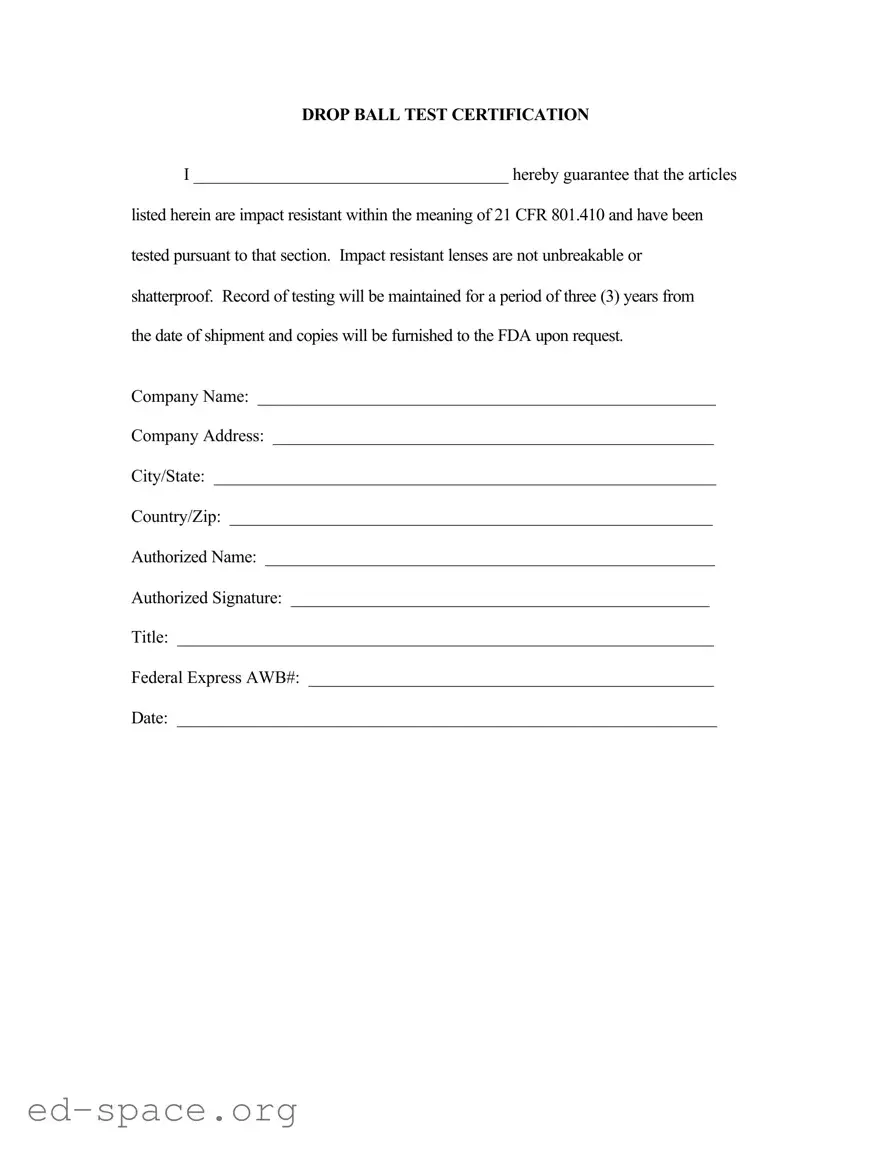
DROP BALL TEST CERTIFICATION
I _____________________________________ hereby guarantee that the articles
listed herein are impact resistant within the meaning of 21 CFR 801.410 and have been tested pursuant to that section. Impact resistant lenses are not unbreakable or shatterproof. Record of testing will be maintained for a period of three (3) years from the date of shipment and copies will be furnished to the FDA upon request.
Company Name: _____________________________________________________
Company Address: ___________________________________________________
City/State: __________________________________________________________
Country/Zip: ________________________________________________________
Authorized Name: ____________________________________________________
Authorized Signature: _________________________________________________
Title: ______________________________________________________________
Federal Express AWB#: _______________________________________________
Date: ______________________________________________________________
| Fact Name | Details |
|---|---|
| Purpose | The Drop Ball Certificate form certifies that certain articles are impact resistant as per federal regulations. |
| Governing Law | The form is governed by 21 CFR 801.410, which outlines the standards for impact resistance. |
| Impact Resistance Definition | Impact resistant lenses are defined as not being unbreakable or shatterproof, highlighting the need for proper testing. |
| Testing Records | Companies must maintain testing records for three years from the date of shipment, ensuring accountability. |
| FDA Compliance | Copies of the testing records must be provided to the FDA upon request, ensuring compliance with federal standards. |
| Authorized Signature | The form requires an authorized signature to validate the certification, emphasizing the importance of accountability. |
| Company Information | Companies must provide their name and address, ensuring that the certification can be traced back to the manufacturer. |
| Shipping Details | The form includes a Federal Express AWB number, which aids in tracking the shipment of the certified articles. |
Completing the Drop Ball Certificate form is an important step in ensuring compliance with safety standards. This form requires specific information about your company and the products being certified. Please follow the steps carefully to ensure all required details are accurately provided.
What is the Drop Ball Certificate form?
The Drop Ball Certificate form is a document used to certify that certain articles, typically impact-resistant lenses, meet specific safety standards as defined by 21 CFR 801.410. It ensures that the products have been tested for impact resistance and provides a record of that testing.
Who needs to complete the Drop Ball Certificate form?
Manufacturers or distributors of impact-resistant lenses are required to complete this form. It serves as a guarantee that the products meet the necessary safety standards and have undergone appropriate testing.
What information is required on the Drop Ball Certificate form?
The form requires the company name, address, city/state, country/zip, the name of the authorized person, their signature, title, Federal Express AWB number, and the date of certification. This information verifies the identity of the company and the individual responsible for the certification.
How long is the testing record maintained?
The record of testing must be maintained for three years from the date of shipment. This ensures that there is a documented history of compliance that can be provided to the FDA if requested.
What does "impact resistant" mean in the context of this form?
Impact resistant refers to the ability of the lenses to withstand certain impacts without breaking. However, it is important to note that impact-resistant lenses are not unbreakable or shatterproof. This distinction is crucial for understanding the limitations of the product.
What should I do if I need copies of the testing records?
If you require copies of the testing records, you can request them from the company that issued the Drop Ball Certificate. They are obligated to provide this information to the FDA and, by extension, to you if needed.
Is there a specific format for the Drop Ball Certificate form?
While the form must include specific information, there is no mandated format. However, it is essential to ensure that all required fields are filled out clearly and accurately to avoid any compliance issues.
Incomplete Information: Many individuals fail to provide all necessary details, such as the company name, address, or authorized signature. Omitting any of these can lead to delays or rejection of the certificate.
Incorrect Test References: Some people mistakenly reference testing standards that do not align with the requirements of 21 CFR 801.410. Ensure the testing conducted matches the specified regulations to avoid compliance issues.
Failure to Maintain Records: Individuals often overlook the requirement to maintain testing records for three years. Not having these records can result in complications if the FDA requests documentation.
Missing Date: A common mistake is neglecting to include the date of certification. This date is crucial for tracking compliance and ensuring that all parties are aware of the certification timeline.
When dealing with the Drop Ball Certificate form, several other documents often accompany it to ensure compliance with regulations and provide necessary information. These documents serve various purposes, from verifying product quality to maintaining records for regulatory bodies. Below is a list of some commonly used forms and documents that work in conjunction with the Drop Ball Certificate.
By understanding the various forms and documents associated with the Drop Ball Certificate, businesses can ensure they are well-prepared for compliance and can effectively communicate with customers and regulatory agencies. Each document plays a vital role in establishing credibility and maintaining quality standards.
The Drop Ball Certificate form serves a specific purpose in certifying the impact resistance of certain articles. Several other documents share similarities with it in terms of function and content. Here are seven such documents:
When filling out the Drop Ball Certificate form, it is essential to follow specific guidelines to ensure accuracy and compliance. Here are some important dos and don'ts to keep in mind:
By following these guidelines, you can help ensure that your Drop Ball Certificate form is filled out correctly and meets all necessary requirements.
Here are four common misconceptions about the Drop Ball Certificate form:
This is incorrect. The form states that the lenses are impact resistant, but it explicitly mentions that they are not unbreakable or shatterproof.
In reality, the records of testing must be maintained for only three years from the date of shipment. After this period, they are not required to be kept.
This is false. Copies of the testing records must be provided to the FDA upon request, ensuring compliance with regulations.
Only an authorized individual from the company can sign this certificate. This ensures that the guarantee is legitimate and backed by the company.
When filling out the Drop Ball Certificate form, it is essential to ensure accuracy and compliance with regulatory standards. Here are some key takeaways to consider: