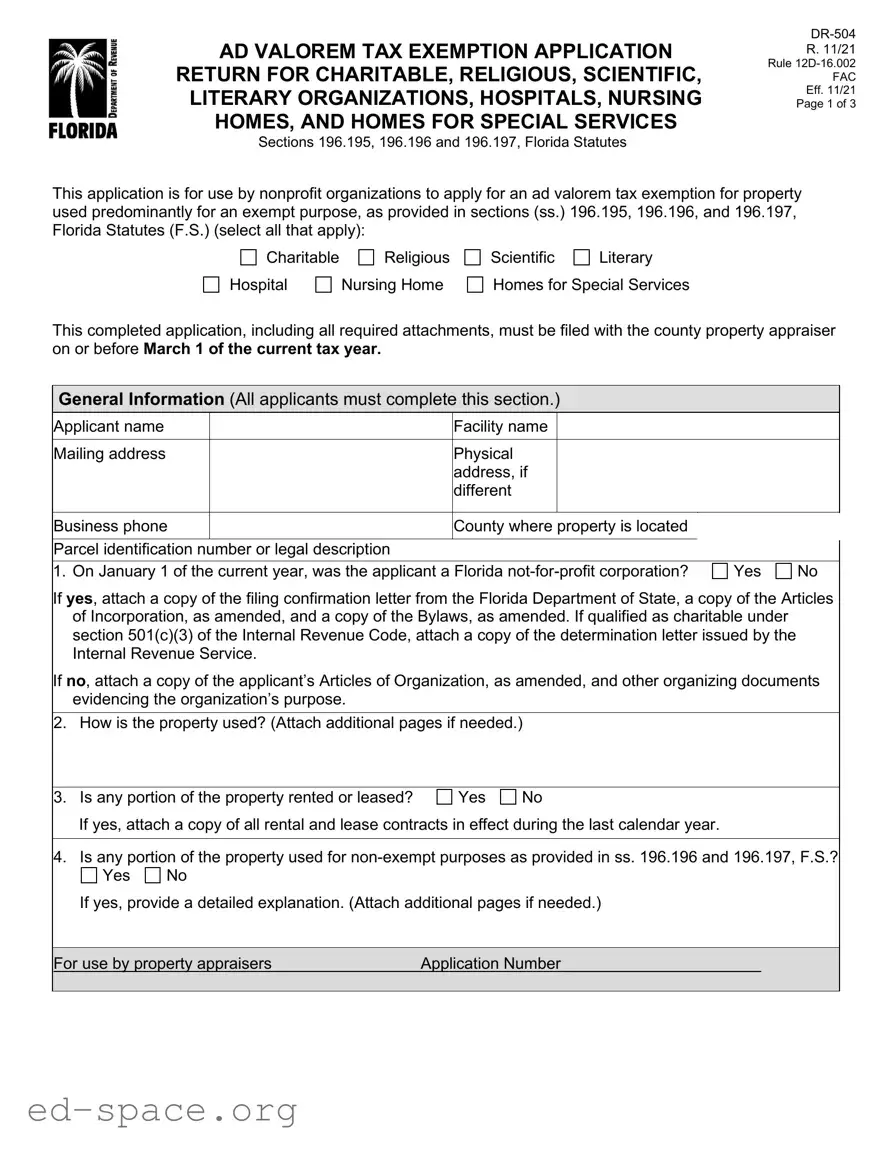
The DR 504 Florida form serves as a vital tool for nonprofit organizations seeking an ad valorem tax exemption for properties used predominantly for charitable, religious, scientific, literary, or healthcare purposes. This application is specifically designed for various types of organizations, including hospitals, nursing homes, and homes for special services. To qualify, organizations must demonstrate that their property is utilized primarily for exempt activities as outlined in Florida Statutes. The form requires detailed information about the organization, including its status as a Florida not-for-profit corporation, financial records, and the specific use of the property in question. Applicants must also provide documentation such as Articles of Incorporation and IRS determination letters, where applicable. The deadline for submission is March 1 of the current tax year, making timely and accurate completion essential. Understanding the requirements and ensuring all necessary attachments are included can greatly enhance the chances of receiving the exemption. For organizations navigating this process, local property appraisers can offer guidance and assistance.

AD VALOREM TAX EXEMPTION APPLICATION
AND RETURN FOR CHARITABLE, RELIGIOUS, SCIENTIFIC, LITERARY ORGANIZATIONS, HOSPITALS, NURSING
HOMES, AND HOMES FOR SPECIAL SERVICES
R. 11/21
Rule
FAC
Eff. 11/21
Page 1 of 3
Sections 196.195, 196.196 and 196.197, Florida Statutes
This application is for use by nonprofit organizations to apply for an ad valorem tax exemption for property used predominantly for an exempt purpose, as provided in sections (ss.) 196.195, 196.196, and 196.197, Florida Statutes (F.S.) (select all that apply):
Charitable Religious
Hospital |
Nursing Home |
Scientific Literary
Homes for Special Services
This completed application, including all required attachments, must be filed with the county property appraiser on or before March 1 of the current tax year.
General Information (All applicants must complete this section.)
Applicant name |
|
Facility name |
|
|
|
|
|
|
|
|
|
Mailing address |
|
Physical |
|
|
|
|
|
address, if |
|
|
|
|
|
different |
|
|
|
|
|
|
|
|
|
Business phone |
|
County where property is located |
|
|
|
|
|
|
|
|
|
Parcel identification number or legal description |
|
|
|
|
|
|
|
|
|
||
|
|
|
|||
1. On January 1 of the current year, was the applicant a Florida |
Yes |
No |
|||
If yes, attach a copy of the filing confirmation letter from the Florida Department of State, a copy of the Articles of Incorporation, as amended, and a copy of the Bylaws, as amended. If qualified as charitable under section 501(c)(3) of the Internal Revenue Code, attach a copy of the determination letter issued by the Internal Revenue Service.
If no, attach a copy of the applicant’s Articles of Organization, as amended, and other organizing documents evidencing the organization’s purpose.
2. How is the property used? (Attach additional pages if needed.)
3. Is any portion of the property rented or leased?
Yes
No
If yes, attach a copy of all rental and lease contracts in effect during the last calendar year.
4.Is any portion of the property used for
Yes No
If yes, provide a detailed explanation. (Attach additional pages if needed.)
For use by property appraisers |
Application Number ______________________ |
|
|
|
|
Eff. 11/21
Page 2 of 3
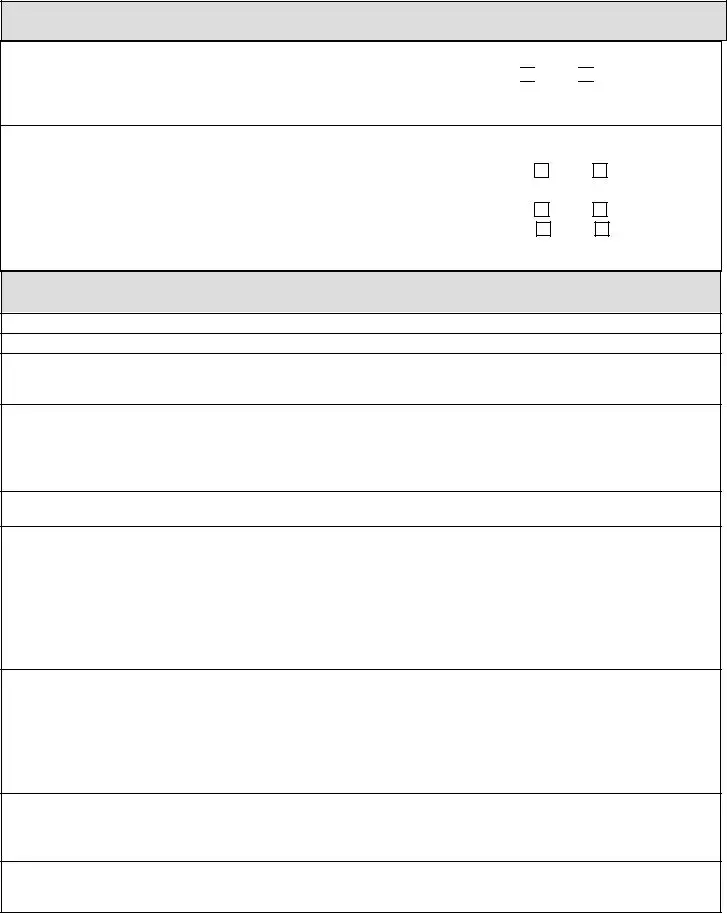
Hospitals, Nursing Homes, and Homes for Special Services
1. On January 1 of the current year, was the applicant qualified as charitable under section 501(c)(3) of the
Internal Revenue Code, as determined by the Internal Revenue Service? Yes No
If yes, attach a copy of the determination letter from the Internal Revenue Service, a copy of the Articles of Incorporation, as amended, and a copy of the Bylaws, as amended.
2.On January 1 of the current year, did the organization hold a valid license issued by the Agency for Health Care Administration under
Chapter 395, F.S. – Hospital or Ambulatory Surgical Center |
Yes |
No |
Chapter 400, F.S. – Nursing Home, Home for Special Services and Related
Health Care Facility, or |
Yes |
No |
Part I, Chapter 429, F.S. – Assisted Living Facility? |
Yes |
No |
If yes, attach a copy of the license issued by the Agency for Health Care Administration.
Attachments (All applicants must attach the following information to this application.) On each attachment, include your name, address, and an indication that the information is an attachment to this application.
1.Provide a copy of the organization’s most recent financial statement.
2.Provide a copy of the organization’s most recent federal tax return (if filed).
3.Provide the following fiscal and other records showing in reasonable detail the financial condition, record of operation, and exempt and nonexempt uses of the property, where appropriate, for the immediately preceding fiscal year:
a.A schedule of payments or advances, directly or indirectly, by way of salaries, fees, loans, gifts, bonuses, gratuities, drawing accounts, commissions or other compensation (except reimbursements for reasonable
•any officer, director, trustee, member, or stockholder, or
•any person, company, or other entity directly or indirectly controlled by the applicant.
b.An explanation for the guarantee of any loan to or obligation of any officer, director, trustee, member, or stockholder of the applicant or any entity directly or indirectly controlled by the applicant.
c.Any contractual arrangement by the applicant or any officer, director, trustee, member, or stockholder of the applicant regarding the
•rendition of services;
•provision of goods or supplies;
•management of the applicant;
•construction or renovation of the property;
•procurement of the real, personal, or intangible property; and
•other similar financial interest in the affairs of the applicant.
d.A schedule of payments or amounts for
•salaries for operation;
•services received;
•supplies and materials;
•reserves for repair, replacement, and depreciation of the property;
•any mortgage, lien, and other encumbrances; and
•other purposes (explain).
e.A schedule of charges for services rendered by the applicant. If the charges for services rendered exceed the value of the services rendered, information on whether the excess is used to pay maintenance and operational expenses furthering its exempt purpose or to provide services to persons unable to pay for the services.
f.An affirmative statement that no part of the property, or no part of the proceeds of the sale, lease, or other disposition of the property, will inure to the benefit of its members, directors, or officers, or to any person or firm operating for a profit or for a nonexempt purpose.

Eff. 11/21
Page 3 of 3
Signature (ALL applicants must complete this section.)
Florida law requires property appraisers to determine whether an organization uses the identified property for exempt purposes before granting an ad valorem tax exemption. Property appraisers will notify you if additional information or documentation is needed to determine eligibility for the exemption requested.
I certify all information on this application, including any attachments, is true, correct, and in effect on January 1 of the tax year.
Signature |
Title |
Date |
Need Help? |
|
In Florida, local governments are responsible for administering property tax. The best |
|
|
resource for assistance is the property appraiser in the county where the property is |
|
|
located. Find websites for county property appraisers at: |
FloridaRevenue.com/Property/Pages/LocalOfficials.aspx
| Fact Name | Fact Description |
|---|---|
| Purpose | The DR-504 form is used by nonprofit organizations to apply for an ad valorem tax exemption for property used for exempt purposes. |
| Governing Laws | This form is governed by sections 196.195, 196.196, and 196.197 of the Florida Statutes. |
| Eligibility | Eligible organizations include charitable, religious, scientific, literary organizations, hospitals, nursing homes, and homes for special services. |
| Filing Deadline | The completed application must be filed with the county property appraiser by March 1 of the current tax year. |
| Not-for-Profit Status | Applicants must confirm their status as a Florida not-for-profit corporation as of January 1 of the current year. |
| IRS Determination | If applicable, applicants must attach a copy of the IRS determination letter confirming their 501(c)(3) status. |
| Property Use | Applicants must describe how the property is used and indicate if any portion is rented or leased. |
| Non-Exempt Use | Any non-exempt use of the property must be explained in detail, with additional pages attached if necessary. |
| Attachments Required | Applicants must include recent financial statements, federal tax returns, and various financial records with their application. |
| Signature Requirement | All applicants must sign the form, certifying that the information provided is true and correct as of January 1 of the tax year. |
Filling out the DR-504 form is an essential step for nonprofit organizations seeking an ad valorem tax exemption in Florida. This process involves providing detailed information about the organization and the property in question. Make sure to gather all necessary documents before starting, as this will streamline the process and ensure accuracy.
After submitting the completed form and all required attachments to the county property appraiser by the March 1 deadline, the property appraiser will review your application. They may contact you for additional information or documentation to assess your eligibility for the tax exemption. Stay in touch with the property appraiser's office for any updates or requests during this process.
What is the DR 504 Florida form?
The DR 504 form is an application used by nonprofit organizations in Florida to apply for an ad valorem tax exemption. This exemption applies to properties used predominantly for charitable, religious, scientific, literary, hospital, nursing home, or homes for special services purposes, as defined by Florida law.
Who can use the DR 504 form?
Nonprofit organizations that meet specific criteria can use this form. Eligible organizations include those classified as charitable, religious, scientific, literary, hospitals, nursing homes, and homes for special services. Each applicant must demonstrate that their property is primarily used for exempt purposes.
When is the deadline to submit the DR 504 form?
The completed application must be filed with the county property appraiser by March 1 of the current tax year. Timely submission is crucial to ensure consideration for the tax exemption.
What documents must accompany the DR 504 form?
Applicants must attach several documents, including a financial statement, the most recent federal tax return (if filed), and records that detail the financial condition and operations of the organization. Additional documentation may be required based on the specific use of the property.
Is it necessary to provide proof of nonprofit status?
Yes, applicants must provide proof of their nonprofit status. This includes a copy of the filing confirmation letter from the Florida Department of State, Articles of Incorporation, and, if applicable, a determination letter from the IRS confirming 501(c)(3) status.
What happens if part of the property is rented or leased?
If any portion of the property is rented or leased, the applicant must attach copies of all rental and lease contracts that were in effect during the last calendar year. This information is essential for determining the eligibility for the tax exemption.
Can the property be used for non-exempt purposes?
If any part of the property is used for non-exempt purposes, the applicant must provide a detailed explanation in the application. This transparency is vital for the property appraiser's assessment of eligibility.
What if the organization operates multiple properties?
Organizations operating multiple properties must submit a separate DR 504 form for each property. Each application should clearly demonstrate how the specific property meets the criteria for tax exemption.
How will I know if my application is approved?
The property appraiser will notify applicants regarding the status of their application. If additional information is needed, the appraiser will reach out to request the necessary documentation to determine eligibility.
Where can I get help with the DR 504 form?
For assistance, applicants should contact the property appraiser in the county where the property is located. Local resources can provide guidance and answer any specific questions related to the application process.
Incomplete Information: Failing to fill out all sections of the form can lead to delays or denials. Ensure every required field is completed.
Missing Attachments: Not including necessary documents, such as financial statements or IRS determination letters, can result in an incomplete application.
Incorrect Entity Status: Misrepresenting the organization's status as a Florida not-for-profit corporation can jeopardize the application. Verify the status before submission.
Failure to Explain Property Use: Not providing a detailed explanation of how the property is used can lead to confusion. Clearly outline the property's purpose and activities.
Ignoring Rental Agreements: If any part of the property is rented or leased, failing to attach all relevant contracts can result in disqualification.
Omitting Non-Exempt Use Details: If any part of the property is used for non-exempt purposes, a detailed explanation is required. Do not overlook this requirement.
Neglecting Signature Requirements: All applicants must sign the application. An unsigned form will not be accepted.
Incorrect Filing Deadline: Submitting the application after the March 1 deadline will result in automatic denial. Keep track of important dates.
Insufficient Documentation for Financials: Not providing detailed financial records can raise red flags. Ensure all financial information is clear and thorough.
The DR-504 Florida form is essential for nonprofit organizations seeking an ad valorem tax exemption. However, several other forms and documents complement this application, providing necessary information and supporting evidence. Below is a list of these documents, each with a brief description.
Gathering these documents is vital for a successful application process. Each piece of information contributes to demonstrating that the organization meets the requirements for an ad valorem tax exemption in Florida.
When filling out the DR 504 Florida form, it is essential to follow specific guidelines to ensure a smooth application process. Here are ten things to do and avoid:
Understanding the DR 504 Florida form is crucial for nonprofit organizations seeking tax exemptions. However, several misconceptions can lead to confusion. Here are ten common misunderstandings about this form:
By addressing these misconceptions, nonprofit organizations can better navigate the DR 504 application process and increase their chances of securing the tax exemptions they seek.
Key Takeaways for Filling Out and Using the DR-504 Florida Form: