Homepage Blank Docketing Statement Civil Pennsylvania PDF Form
Article Guide

The Docketing Statement Civil Pennsylvania form is a crucial document in the appeals process, specifically designed for family and domestic relations cases. This form must be completed and submitted to the Prothonotary of the Superior Court, along with necessary attachments, to ensure that an appeal is properly recorded and processed. It includes essential information such as case identification details, the parties involved, and the timeline of events surrounding the appeal. Timeliness is a key factor; the form requires dates for the judgment or order being appealed, as well as when the notice of appeal was filed. It also prompts the filer to indicate whether reconsideration was requested in the lower court. Additionally, the form distinguishes between various types of cases, including custody, divorce, and support issues, allowing for a more organized approach to handling appeals. By adhering to the guidelines set forth in this document, individuals can navigate the complexities of the legal system more effectively and ensure their appeals are heard in a timely manner.
Document Preview

Form Specifications

Fact Name Details
Governing Law This form is governed by Pennsylvania Rule of Appellate Procedure (Pa.R.A.P.) 3517.
Purpose The Docketing Statement Civil is specifically for Family and Domestic Relations appeals.
Filing Requirement It must be completed and submitted to the Prothonotary of the Superior Court by the specified deadline.
Recipient Notification A copy of the completed form must also be provided to the appellee involved in the appeal.

Docketing Statement Civil Pennsylvania: Usage Guidelines

Completing the Docketing Statement Civil Pennsylvania form is an essential step in initiating an appeal in family and domestic relations cases. After filling out the form, you will submit it to the Prothonotary of the Superior Court along with any required attachments. It is also important to provide a copy to the appellee. This ensures that all parties are informed and that the appeal process can proceed smoothly.

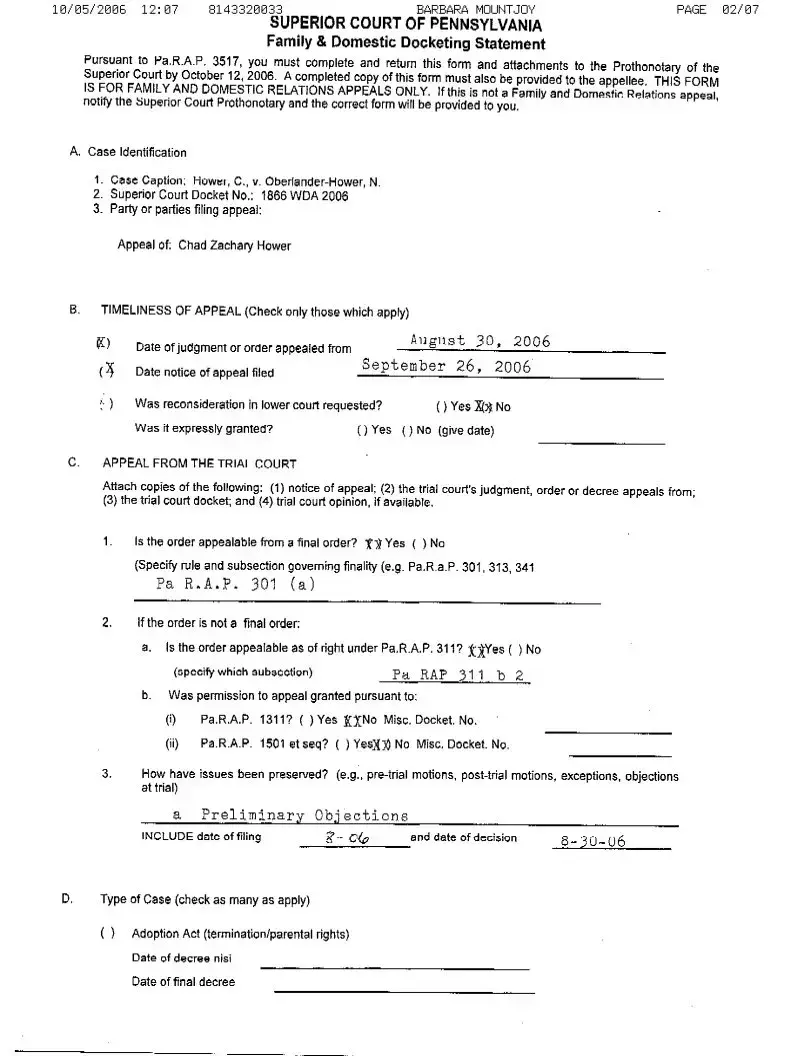
  1. Begin with the Case Identification section. Fill in the case caption, such as "Howei, C., v. Oberlander-Hower, N." Include the Superior Court Docket Number, for example, "1866 WDA 2006." Identify the party filing the appeal, e.g., "Appeal of Chad Zachary Hower."
  2. Move to the Timeliness of Appeal section. Check the applicable boxes regarding the date of the judgment or order being appealed. For example, enter "August 30, 2006" for the date of judgment. Also, provide the date the notice of appeal was filed, such as "September 26, 2006." Indicate whether reconsideration was requested in the lower court and if it was granted.
  3. In the Appeal from the Trial Court section, answer the questions about the appealability of the order. Specify if the order is appealable from a final order and provide the relevant rule and subsection if applicable. If the order is not final, indicate if it is appealable as of right and whether permission to appeal was granted.
  4. Next, detail how issues have been preserved in the Preservation of Issues section. Mention any pre-trial motions or objections made during the trial, including the date of filing for any preliminary objections.
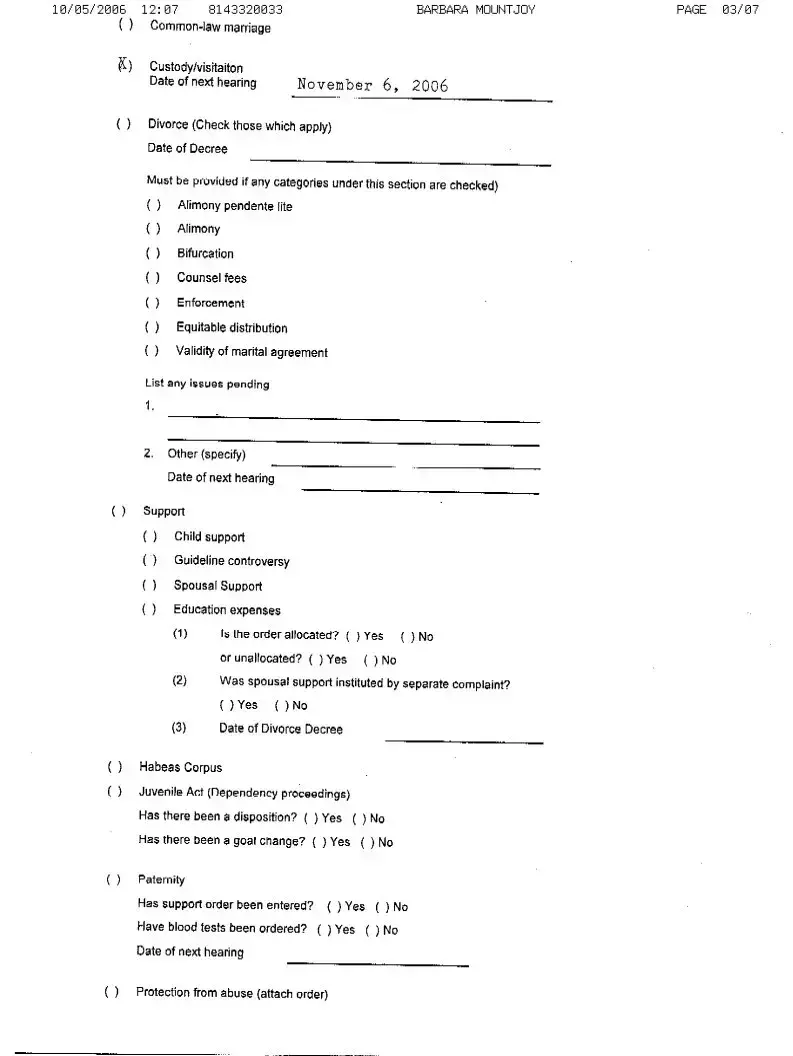
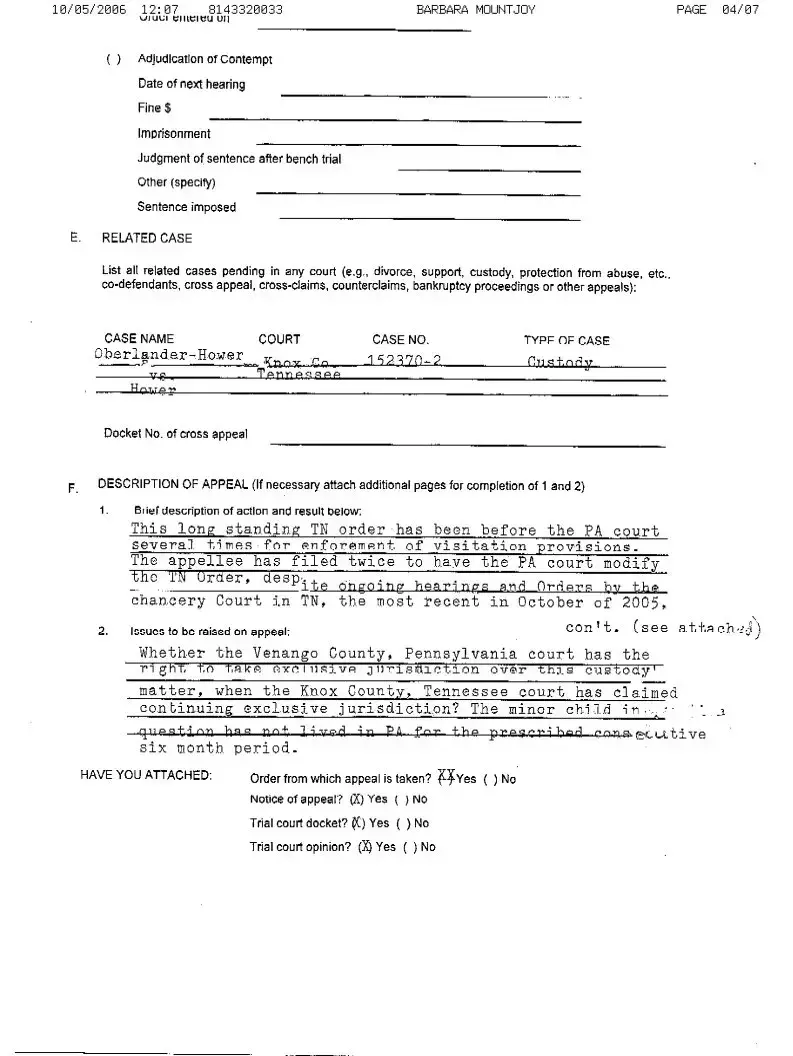
  5. Proceed to the Type of Case section. Check all boxes that apply, such as Adoption Act, Custody/Visitation, Divorce, Support, or Protection from Abuse. Provide any necessary dates, such as the date of the decree or the next hearing.
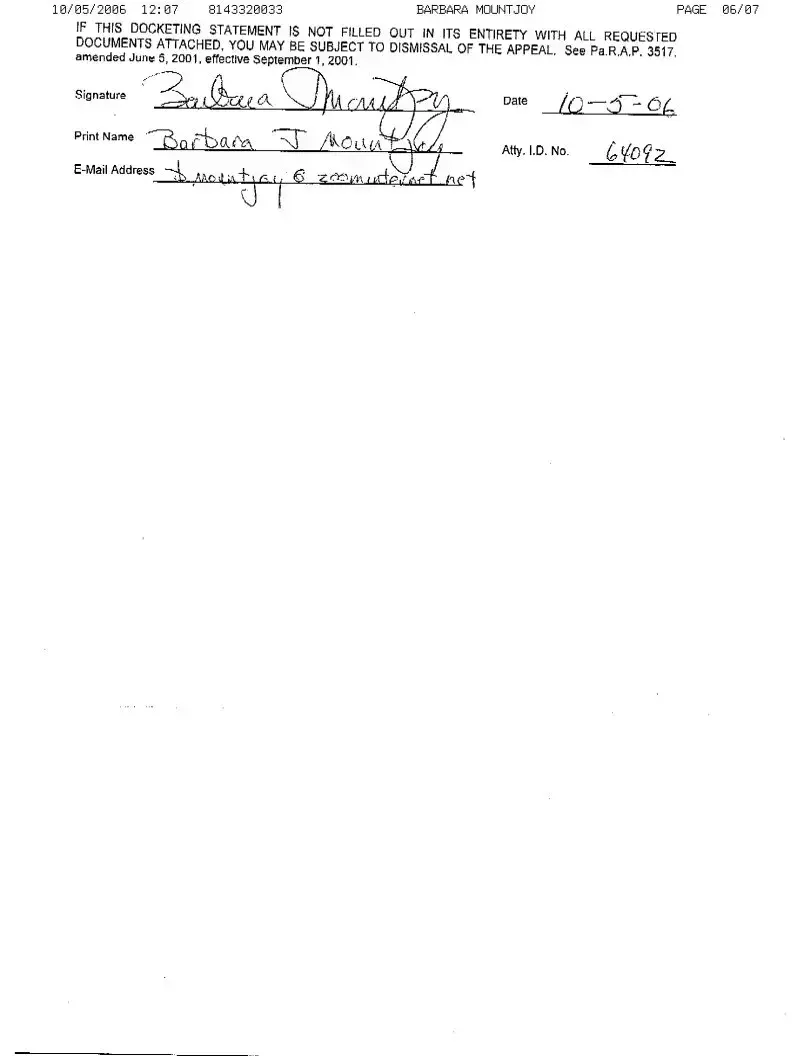
  6. Finally, review the entire form for accuracy. Ensure that all sections are completed and that the information provided is correct. After completing the form, sign and date it as required.

Your Questions, Answered

What is the purpose of the Docketing Statement Civil Pennsylvania form?

The Docketing Statement Civil Pennsylvania form serves as a crucial document in family and domestic relations appeals. It is designed to provide the Superior Court with essential information regarding the case, including the parties involved, the nature of the appeal, and the relevant dates. By completing this form, appellants ensure that the court has a clear understanding of the case's context, which aids in the efficient processing of appeals. It is important to remember that this form is specifically for family and domestic relations cases; if the appeal falls outside this category, a different form must be used.

What information must be included in the Docketing Statement?

The form requires several key pieces of information. First, the case caption, which identifies the parties involved, is essential. Next, the Superior Court docket number must be included, along with the name of the party filing the appeal. Additionally, the form asks for details regarding the timeliness of the appeal, including the date of the judgment or order being appealed and whether any reconsideration was requested in the lower court. Attachments such as the notice of appeal, the trial court's judgment, and any relevant opinions must also be submitted to provide the court with a complete picture of the case.

How does one determine if the appeal is timely?

Timeliness is a critical factor in the appeal process. To determine if the appeal is timely, the appellant must check the date of the judgment or order being appealed and compare it to the date the notice of appeal was filed. According to the rules, the notice of appeal must be filed within a specific time frame following the entry of the judgment or order. If the appellant requested reconsideration in the lower court, this may affect the timeline, so it is essential to indicate whether reconsideration was requested and if it was granted. Careful attention to these details can prevent unnecessary complications in the appeal process.

What should I do if I realize I have used the wrong form?

If you discover that you have used the incorrect form for your appeal, it is important to act promptly. Notify the Prothonotary of the Superior Court immediately to inform them of the error. They will guide you on the correct form to use for your specific situation. It is crucial to address this as soon as possible to avoid delays in the processing of your appeal. Ensuring that the correct documentation is submitted can significantly impact the success of your case.

Common mistakes

  1. Incomplete Case Caption: Many individuals fail to provide a complete case caption. This includes not listing all parties involved in the case, which is crucial for proper identification.

  2. Missing Superior Court Docket Number: Some people overlook the necessity of including the Superior Court Docket Number. This number is essential for tracking the case and ensuring it is filed correctly.

  3. Incorrect Timeliness of Appeal: A common mistake is failing to accurately check the boxes related to the timeliness of the appeal. This can lead to confusion about whether the appeal is filed within the required timeframe.

  4. Neglecting to Attach Required Documents: Applicants often forget to attach necessary documents such as the notice of appeal and the trial court's judgment. These attachments are vital for the review process.

  5. Failure to Specify Finality of Orders: Individuals may not specify the rule and subsection governing the finality of the order. This omission can complicate the appeal process and delay proceedings.

  6. Ignoring Permission to Appeal Requirements: Some filers do not indicate whether permission to appeal was granted when required. This can result in the appeal being dismissed due to procedural errors.

  7. Omitting Case Type Information: Many individuals neglect to check all applicable case types. This oversight can lead to misclassification of the appeal and may affect the handling of the case.

Documents used along the form

When navigating the legal process in Pennsylvania, particularly in family and domestic relations cases, several forms and documents may accompany the Docketing Statement Civil Pennsylvania form. Each of these documents serves a specific purpose and plays a crucial role in the appeal process. Understanding these forms can help ensure that you are adequately prepared for your case.

  • Notice of Appeal: This document formally notifies the court and other parties that a party intends to appeal a decision made by a lower court. It is essential for initiating the appeal process.
  • Trial Court Judgment or Order: This is the official decision made by the trial court that the appealing party is contesting. A copy must be attached to the Docketing Statement.
  • Trial Court Docket: This record contains all the filings and orders related to the case in the trial court. It provides a timeline of events and is necessary for the appellate court's review.
  • Trial Court Opinion: If available, this document explains the trial court's reasoning behind its decision. It can be helpful for understanding the basis of the appeal.
  • Preliminary Objections: These are objections raised by a party in response to a complaint or motion filed in the trial court. They can be relevant for preserving issues for appeal.
  • Supporting Affidavits: These are sworn statements that provide evidence to support the claims made in the appeal. They may be required to substantiate certain arguments.
  • Appellee's Brief: This document is filed by the opposing party (appellee) in response to the appellant's brief. It presents the appellee's arguments against the appeal.

Each of these documents plays a vital role in the appeal process and contributes to a clearer understanding of the case. Properly completing and submitting these forms can significantly impact the outcome of the appeal. It is important to approach this process with care and attention to detail.

Similar forms

The Docketing Statement Civil Pennsylvania form serves a specific purpose in the legal process, particularly for family and domestic relations appeals. Several other documents share similarities with this form in terms of their function and required information. Below is a list of those documents, along with a brief explanation of how they relate to the Docketing Statement.

  • Notice of Appeal: This document formally notifies the court and the opposing party of a party's intention to appeal a decision. Like the Docketing Statement, it requires details about the case and the parties involved.
  • Trial Court Judgment: This document contains the decision made by the trial court. It is crucial for the Docketing Statement as it provides the basis for the appeal, similar to how the Docketing Statement outlines the case's specifics.
  • Trial Court Docket: This is a record of all the proceedings and filings in a case. The Docketing Statement also requires a summary of relevant case information, making both documents essential for tracking the case's history.
  • Trial Court Opinion: If available, this document explains the reasoning behind the trial court's decision. The Docketing Statement may reference this opinion, as it helps the appellate court understand the context of the appeal.
  • Family and Domestic Docketing Statement: Specifically for family law cases, this document serves a similar function to the Docketing Statement but focuses on family and domestic relations. Both forms require similar information tailored to their respective contexts.
  • Preliminary Objections: This document is filed to challenge the legal sufficiency of the opposing party's claims. Both it and the Docketing Statement may involve issues that arise during the appeal process, highlighting the need for clarity in legal arguments.
  • Permission to Appeal Motion: When a party seeks permission to appeal a non-final order, this motion is necessary. It is similar to the Docketing Statement in that it must provide detailed information about the case and the reasons for the appeal.
  • Case Management Order: This document outlines the timeline and requirements for the progression of a case. Like the Docketing Statement, it is essential for ensuring that all parties are informed and adhere to deadlines throughout the appeal process.

Dos and Don'ts

When filling out the Docketing Statement Civil Pennsylvania form, there are several important dos and don'ts to keep in mind. Following these guidelines can help ensure that your submission is complete and accurate, making the process smoother for everyone involved.

  • Do read the instructions carefully before starting. Understanding the requirements will save you time and effort.
  • Do provide all necessary information, including case caption, docket number, and party details. Omitting details can delay your appeal.
  • Do check the timeliness of your appeal. Ensure you are within the required deadlines for filing.
  • Do attach copies of all required documents, such as the notice of appeal and trial court judgment. Missing documents can lead to complications.
  • Do double-check for any spelling or typographical errors. Accuracy is crucial in legal documents.
  • Don't forget to provide a completed copy to the appellee. This is a necessary step in the appeal process.
  • Don't use the form for cases outside family and domestic relations. If your case doesn’t fit, contact the Prothonotary for the correct form.
  • Don't leave any sections blank. If a question doesn’t apply, indicate that clearly instead of skipping it.
  • Don't rely solely on memory. Gather all relevant documents and information beforehand to ensure completeness.
  • Don't hesitate to ask for help if you’re unsure about any part of the form. Seeking clarification can prevent mistakes.

By following these guidelines, you can navigate the process of completing the Docketing Statement with confidence. Remember, attention to detail is key!

Misconceptions

Misconceptions about the Docketing Statement Civil Pennsylvania form can lead to confusion and potential errors in the appeal process. Here are seven common misconceptions, along with clarifications for each.

  • This form is for all types of appeals. This form is specifically designed for Family and Domestic Relations appeals only. If the appeal does not fall under this category, a different form must be used.
  • Timeliness of the appeal is not important. The form requires specific dates related to the judgment and the filing of the notice of appeal. Timeliness is crucial for the appeal to be considered valid.
  • Only attorneys can file the Docketing Statement. While it is common for attorneys to handle this process, individuals representing themselves may also complete and submit the form.
  • All required documents are optional. The form specifies that certain documents, such as the trial court's judgment and notice of appeal, must be attached. Failing to include these can result in delays or rejection of the appeal.
  • Filing the form is the only step in the appeal process. Completing and filing the Docketing Statement is just one part of the appeal process. Other steps, such as serving the appellee, are also necessary.
  • Once submitted, the form cannot be changed. If errors are discovered after submission, it is possible to notify the court and correct them, although this may involve additional steps.
  • The Docketing Statement is not subject to deadlines. There are strict deadlines for submitting the form and required attachments. Missing these deadlines can jeopardize the appeal.

Key takeaways

When filling out and utilizing the Docketing Statement Civil Pennsylvania form, several key considerations must be kept in mind to ensure compliance and efficiency in the appeals process.

  • Purpose of the Form: This form is specifically designed for Family and Domestic Relations appeals. Ensure that your case falls under this category before proceeding.
  • Timeliness: The completed form must be submitted to the Prothonotary of the Superior Court by the specified deadline. For example, in the case referenced, the due date was October 12, 2006.
  • Case Identification: Accurate information regarding the case caption and Superior Court Docket Number is essential. This information must be clearly stated at the beginning of the form.
  • Appeal Details: Indicate the date of the judgment or order being appealed. This date is crucial for determining the timeliness of the appeal.
  • Required Attachments: Four specific documents must be attached to the form: notice of appeal, trial court judgment, trial court docket, and trial court opinion, if available.
  • Finality of Order: Determine whether the order being appealed is final. If it is not, additional steps may be required to establish the basis for the appeal.
  • Preservation of Issues: Clearly outline how the issues for appeal have been preserved, including any relevant pre-trial or post-trial motions.
  • Type of Case: Check all applicable types of cases, such as custody, divorce, or support, to ensure that the appeal is categorized correctly.
  • Contact Information: Provide accurate contact details for all parties involved, ensuring that the appellee receives a completed copy of the form as required.

Adhering to these guidelines will facilitate a smoother process in filing and managing appeals within the Pennsylvania legal system.