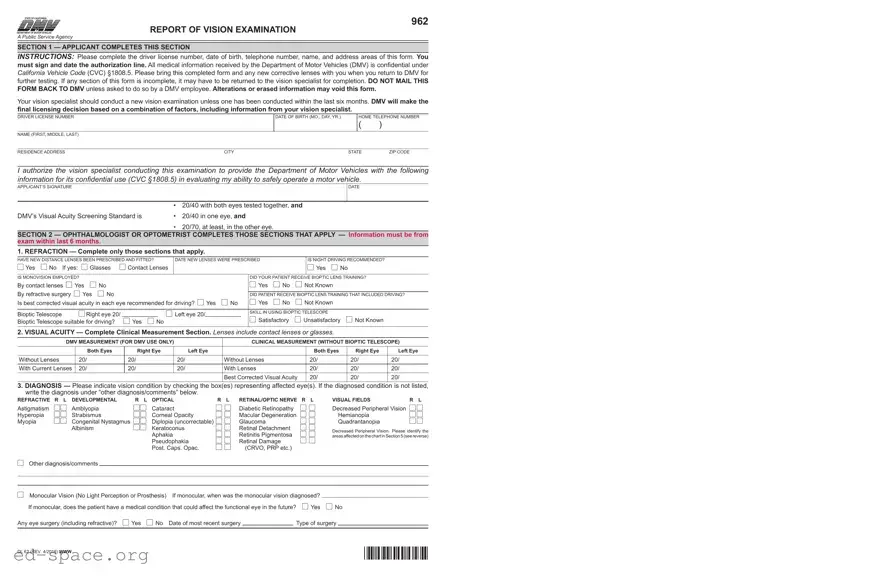
The DMV Vision form plays a crucial role in ensuring that drivers meet the necessary visual standards for safe operation of a vehicle. This form is divided into two main sections: one for the applicant and another for the vision specialist, typically an ophthalmologist or optometrist. The applicant must provide personal information, including their driver license number, date of birth, and contact details. Importantly, the applicant must also sign the form, authorizing the vision specialist to share relevant information with the DMV, which is treated confidentially under California law. The vision specialist's section requires detailed clinical measurements, including visual acuity assessments with and without corrective lenses, and may involve specific tests for conditions like night vision and visual field loss. The form also addresses the necessity of new corrective lenses, if applicable, and outlines the frequency of required vision examinations. If the vision specialist identifies any visual abnormalities or conditions affecting the applicant’s ability to drive safely, these must be documented. Overall, the DMV Vision form is a vital tool that helps maintain road safety by ensuring that all drivers possess the visual capabilities needed for safe driving.
STATE OF CALIFORNIA
DEPARTMENT OF MOTOR VEHICLES®
A Public Service Agency
962
REPORT OF VISION EXAMINATION
SECTION 1 — APPLICANT COMPLETES THIS SECTION
INSTRUCTIONS: Please complete the driver license number, date of birth, telephone number, name, and address areas of this form. You must sign and date the authorization line. All medical information received by the Department of Motor Vehicles (DMV) is conidential under
California Vehicle Code (CVC) §1808.5. Please bring this completed form and any new corrective lenses with you when you return to DMV for further testing. If any section of this form is incomplete, it may have to be returned to the vision specialist for completion. DO NOT MAIL THIS FORM BACK TO DMV unless asked to do so by a DMV employee. Alterations or erased information may void this form.
Your vision specialist should conduct a new vision examination unless one has been conducted within the last six months. DMV will make the inal licensing decision based on a combination of factors, including information from your vision specialist.
DRIVER LICENSE NUMBER
NAME (FIRST, MIDDLE, LAST)
DATE OF BIRTH (MO., DAY, YR.)
HOME TELEPHONE NUMBER
()
RESIDENCE ADDRESS |
CITY |
STATE |
ZIP CODE |
I authorize the vision specialist conducting this examination to provide the Department of Motor Vehicles with the following
information for its conidential use (CVC §1808.5) in evaluating my ability to safely operate a motor vehicle.
APPLICANT’S SIGNATURE
DATE
|
• |
20/40 with both eyes tested together, and |
DMV’s Visual Acuity Screening Standard is |
• |
20/40 in one eye, and |
• 20/70, at least, in the other eye.
SECTION 2 — OPHTHALMOLOGIST OR OPTOMETRIST COMPLETES THOSE SECTIONS THAT APPLY — Information must be from exam within last 6 months.
1. REFRACTION — Complete only those sections that apply.
HAVE NEW DISTANCE LENSES BEEN PRESCRIBED AND FITTED?
Yes |
No If yes: |
Glasses |
Contact Lenses |
DATE NEW LENSES WERE PRESCRIBED
IS NIGHT DRIVING RECOMMENDED?
Yes No
IS MONOVISION EMPLOYED? |
|
|
|
|
|
|
DID YOUR PATIENT RECEIVE BIOPTIC LENS TRAINING? |
||||
By contact lenses |
Yes |
No |
|
|
|
|
|
Yes |
No |
Not Known |
|
By refractive surgery |
Yes |
No |
|
|
|
|
|
|
|||
|
|
|
|
|
DID PATIENT RECEIVE BIOPTIC LENS TRAINING THAT INCLUDED DRIVING? |
||||||
Is best corrected visual acuity in each eye recommended for driving? |
Yes |
No |
Yes |
No |
Not Known |
|
|||||
|
|
|
|
|
|
|
|
|
|
||
Bioptic Telescope |
Right eye 20/ ___________ |
Left eye 20/___________ |
SKILL IN USING BIOPTIC TELESCOPE |
|
|||||||
|
|
|
|
||||||||
Bioptic Telescope suitable for driving? |
Yes |
No |
|
|
|
Satisfactory |
Unsatisfactory |
Not Known |
|||
|
|
|
|
|
|
|
|||||
|
|
|
|
|
|
|
|
|
|
|
|
2. VISUAL ACUITY — Complete Clinical Measurement Section. Lenses include contact lenses or glasses.
DMV MEASUREMENT (FOR DMV USE ONLY) |
|
CLINICAL MEASUREMENT (WITHOUT BIOPTIC TELESCOPE) |
||||||
|
|
|
|
|
|
|
|
|
|
Both Eyes |
Right Eye |
|
Left Eye |
|
Both Eyes |
Right Eye |
Left Eye |
|
|
|
|
|
|
|
|
|
Without Lenses |
20/ |
20/ |
|
20/ |
Without Lenses |
20/ |
20/ |
20/ |
|
|
|
|
|
|
|
|
|
With Current Lenses |
20/ |
20/ |
|
20/ |
With Lenses |
20/ |
20/ |
20/ |
|
|
|
|
|
|
|
|
|
|
|
|
|
|
Best Corrected Visual Acuity |
20/ |
20/ |
20/ |
3.DIAGNOSIS — Please indicate vision condition by checking the box(es) representing affected eye(s). If the diagnosed condition is not listed, write the diagnosis under “other diagnosis/comments” below.
REFRACTIVE R L DEVELOPMENTAL
Astigmatism |
Amblyopia |
Hyperopia |
Strabismus |
Myopia |
Congenital Nystagmus |
|
Albinism |
R L OPTICAL |
R L RETINAL/OPTIC NERVE R L |
Cataract |
Diabetic Retinopathy |
Corneal Opacity |
Macular Degeneration |
Diplopia (uncorrectable) |
Glaucoma |
Keratoconus |
Retinal Detachment |
Aphakia |
Retinitis Pigmentosa |
Pseudophakia |
Retinal Damage |
Post. Caps. Opac. |
(CRVO, PRP etc.) |
VISUAL FIELDS |
R L |
Decreased Peripheral Vision |
|
Hemianopia |
|
Quadrantanopia |
|
Decreased Peripheral Vision. Please identify the areasaffectedonthechartinSection5(seereverse)
Other diagnosis/comments
Monocular Vision (No Light Perception or Prosthesis) |
If monocular, when was the monocular vision diagnosed? |
|
|
|||||
If monocular, does the patient have a medical condition that could affect the functional eye in the future? |
Yes |
No |
||||||
Any eye surgery (including refractive)? |
Yes |
No |
Date of most recent surgery |
|
Type of surgery |
|
||
|
|
|
|
|
|
|
|
|
DL 62 (REV. 4/2016) WWW |
*DL62* |
|
Name: |
DL/ID/X #: |
4. PROGNOSIS
Diagnosis |
|
Static |
Diagnosis |
|
Static |
Diagnosis |
|
Static |
Progressive |
Stable since |
|
(date) |
Progressive |
Stable since |
|
(date) |
Progressive |
Stable since |
|
(date) |
WHEN SHOULD DMV REQUIRE A NEW DMV VISION EXAMINATION REPORT FORM BE SUBMITTED?
Not applicable 1 year 2 years 5 years Other
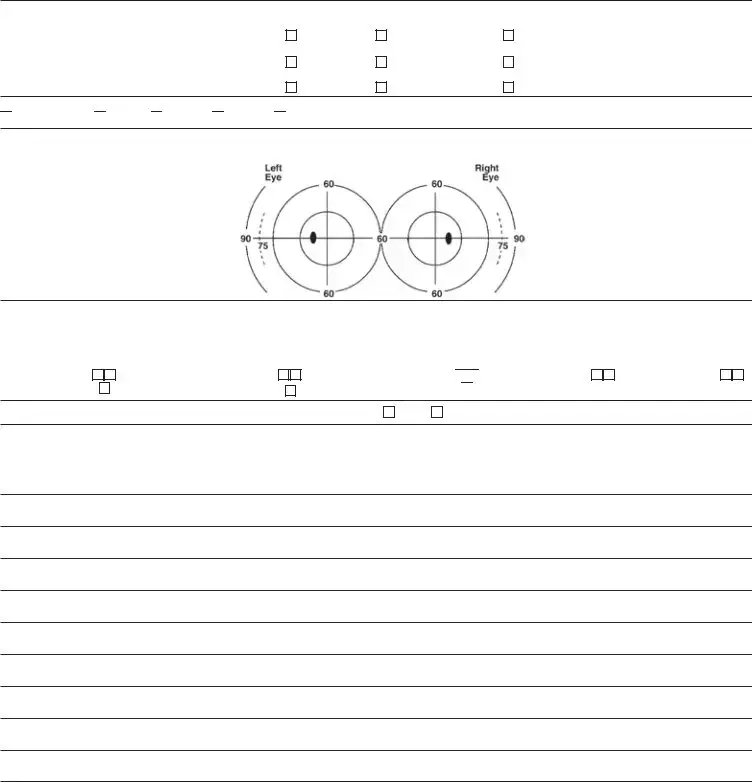
5.VISUAL FIELDS — If vision is not correctable to 20/40 in each eye, or there is possible visual ield loss, a full visual ield examination (con- frontation is permissible) must be performed. Show the approximate peripheral extent and any scotomas in the diagram below.
|
LEFT EYE |
|
RIGHT EYE |
|
Extent: |
|
|
Extent: |
|
Left |
|
|
|
Left |
Right |
|
|
|
Right |
Up |
|
|
|
Up |
Down |
|
|
|
Down |
6.VISUAL ABNORMALITIES — The following information will help our examiners evaluate your patient’s ability to safely operate a motor vehicle. Based upon your testing, clinical impression, or knowledge of the disorder, please indicate the severity of any of the following visual abnormalities which your patient may be experiencing. Indicate severity of condition by placing a 1 (mild), 2 (moderate), or 3 (severe) in the box(es) below.
R L
Decreased Acuity
Color Defect
R L
Visual Field Loss
Reduced Depth Perception
R L
Contrast Sensitivity Loss Abnormal Eye Movements
R L
Problems With Glare
R L
Poor Night Vision
7. ADVICE — Have you given your patient any advice about driving? |
Yes |
No |
If yes, please explain in #8 below. |
8.ADDITIONAL COMMENTS — Report any additional information or comments you feel DMV should know concerning your patient’s visual and perceptual capabilities relating to driving performance. You may use an additional sheet of paper to provide this information as well as
information about any existing conditions which contribute to poor night vision or poor depth perception, etc. Any recommendations about the patient’s general safety should also be made. DMV will make the inal licensing decision based on a combination of factors, including your professional expertise.
9. SIGNATURE — This section must be completed to validate this report.
PRINTED NAME |
|
|
|
M.D. OR O.D. LICENSE NUMBER |
|
|
|
|
|
|
|
SIGNATURE |
|
|
|
DATE OF EXAM (MUST BE WITHIN LAST 6 MONTHS) |
|
X |
|
|
|
|
|
ADDRESS |
CITY |
CA |
ZIP CODE |
TELEPHONE NUMBER |
|
|
|
|
|
( |
) |
|
|
|
|
|
|
|
|
|
|
|
|
DL 62 (REV. 4/2016) WWW
| Fact Name | Details |
|---|---|
| Purpose of the Form | The DMV Vision Form is used to report the results of a vision examination for individuals applying for or renewing a driver's license in California. |
| Confidentiality | All medical information provided is confidential under California Vehicle Code (CVC) §1808.5, ensuring privacy for the applicant. |
| Submission Guidelines | This form should not be mailed back to the DMV unless specifically requested. It must be brought in person, along with any new corrective lenses. |
| Vision Standards | The DMV requires a minimum visual acuity of 20/40 in one eye and 20/70 in the other eye for safe driving. |
Filling out the DMV Vision form is an important step in ensuring that you meet the necessary vision requirements for driving. After completing the form, you will need to bring it along with any new corrective lenses to your DMV appointment for further testing.
What is the DMV Vision Form, and why is it necessary?
The DMV Vision Form is a document required by the California Department of Motor Vehicles to assess an individual's visual ability to safely operate a motor vehicle. This form must be completed by a licensed vision specialist, such as an optometrist or ophthalmologist, after conducting a vision examination. It ensures that drivers meet the necessary visual standards for safety on the road. Completing this form is crucial for maintaining public safety and ensuring that all drivers are fit to drive.
Who needs to complete the DMV Vision Form?
Individuals who are applying for a new driver's license, renewing their existing license, or have been instructed by the DMV to provide a vision examination report must complete the DMV Vision Form. This requirement may also apply to those who have experienced changes in their vision or have certain medical conditions affecting their eyesight. It is essential for anyone in these categories to have their vision evaluated and documented by a qualified specialist.
What information is required on the DMV Vision Form?
The form requires specific personal information from the applicant, including their driver license number, date of birth, name, address, and telephone number. Additionally, the vision specialist must provide details about the applicant's visual acuity, any prescribed corrective lenses, and the results of the vision examination. It is vital that all sections are completed accurately, as incomplete forms may delay the licensing process.
How should I submit the DMV Vision Form?
What happens if my vision does not meet the required standards?
If your vision does not meet the DMV's standards, you may be required to undergo additional testing or obtain corrective lenses before being allowed to drive. The DMV will evaluate the information provided by your vision specialist, along with other factors, to make a final decision regarding your driving eligibility. It is essential to follow any recommendations from your vision specialist to improve your chances of meeting the necessary requirements.
How often do I need to have my vision examined for the DMV?
The DMV typically requires a new vision examination report every one to five years, depending on your specific circumstances and any previous recommendations made by your vision specialist. If you have had a recent vision exam within the last six months, you may not need to submit a new form. However, if there are changes in your vision or if you are advised by the DMV, you should seek a new examination as necessary.
Incomplete Personal Information: Applicants often forget to fill in their driver license number, date of birth, telephone number, name, or address. Each of these fields is essential for processing the form.
Missing Signature: Failing to sign and date the authorization line can lead to delays. Without a signature, the form may be considered invalid.
Not Bringing Corrective Lenses: Some individuals neglect to bring their new corrective lenses when returning to the DMV. This is a requirement and can hinder the testing process.
Incorrect Vision Examination Date: The vision examination must be conducted within the last six months. If the date is older, the DMV may require a new exam.
Altering the Form: Making any alterations or erasing information can void the form. It is crucial to fill it out accurately the first time.
Not Following Instructions: Some applicants do not carefully read the instructions provided. This oversight can lead to incomplete sections, resulting in the form being returned for corrections.
Failing to Report All Conditions: Applicants sometimes do not disclose all relevant visual conditions or surgeries. Full disclosure is important for the DMV to make an informed decision regarding driving capabilities.
When applying for a driver’s license or renewing it, several forms and documents may be required alongside the DMV Vision form. Each of these documents serves a unique purpose in ensuring that applicants meet the necessary requirements for safe driving. Below is a list of commonly used forms and documents that accompany the DMV Vision form.
Understanding these additional forms and documents can streamline the application process and help ensure compliance with DMV requirements. Being prepared with all necessary paperwork will facilitate a smoother experience when visiting the DMV.
The DMV Vision form serves a specific purpose in evaluating an individual's vision for safe driving. Several other documents share similarities with this form, particularly in their focus on health assessments and the necessity for professional evaluations. Below is a list of documents that are comparable to the DMV Vision form, highlighting their similarities:
When filling out the DMV Vision form, there are important dos and don'ts to keep in mind. These guidelines will help ensure that your form is completed correctly and efficiently.
Misconceptions about the DMV Vision form can lead to confusion and delays in the licensing process. Below are eight common misconceptions clarified.
Filling out the DMV Vision form is a crucial step for individuals seeking to obtain or renew their driver's license. Here are key takeaways to ensure a smooth process:
By adhering to these guidelines, you can help ensure a more efficient process when dealing with the DMV Vision form.