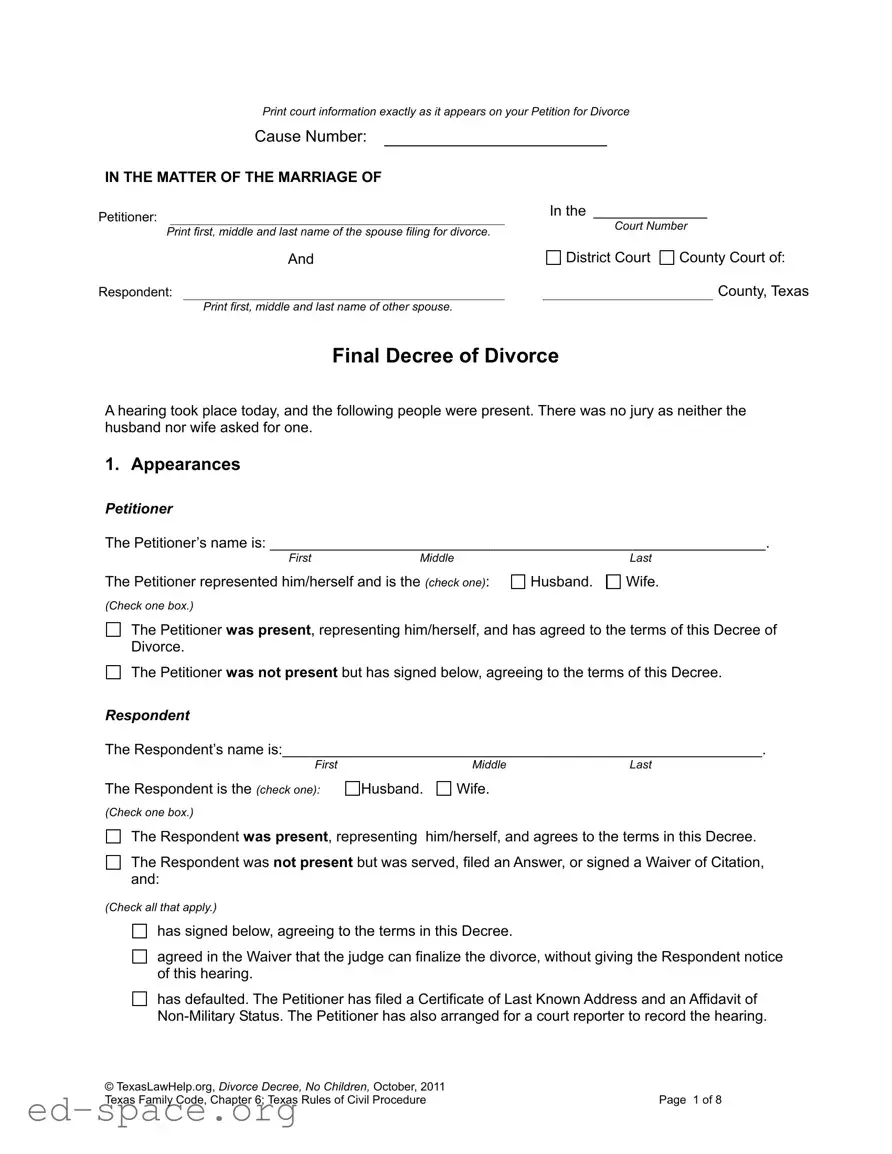
When navigating the often complex process of divorce, the Divorce Decree form serves as a crucial document that finalizes the dissolution of marriage. This form encapsulates key information, including the names of both spouses—the Petitioner and the Respondent—and the court's jurisdiction over the case. It outlines the circumstances under which the divorce is granted, typically citing insupportability as the grounds. In cases where children are involved, the form addresses custody and support arrangements, ensuring that any existing orders are recognized and upheld. Additionally, it details the division of property and debts, emphasizing that Texas operates under community property laws. This means that any property or debt acquired during the marriage is generally shared, unless specified otherwise. The form also requires confirmation of the parties’ agreement to the terms, whether they are present in court or have consented through other means. Understanding the intricacies of this document is essential for ensuring that all legal requirements are met and that both parties are treated fairly throughout the divorce process.

Print court information exactly as it appears on your Petition for Divorce
Cause Number:
IN THE MATTER OF THE MARRIAGE OF
Petitioner: |
|
|
In the ______________ |
|
|
Court Number |
|
|
Print first, middle and last name of the spouse filing for divorce. |
||
|
|
||
And
Respondent:
Print first, middle and last name of other spouse.
District Court
County Court of:
County, Texas
Final Decree of Divorce
A hearing took place today, and the following people were present. There was no jury as neither the husband nor wife asked for one.
1. Appearances
Petitioner
The Petitioner’s name is: _____________________________________________________________.
FirstMiddle
The Petitioner represented him/herself and is the (check one):
(Check one box.)
Husband.
Last
Wife.
The Petitioner was present, representing him/herself, and has agreed to the terms of this Decree of Divorce.
The Petitioner was not present but has signed below, agreeing to the terms of this Decree.
Respondent
The Respondent’s name is:___________________________________________________________.
First
The Respondent is the (check one):
(Check one box.)
Husband.
MiddleLast
Wife.
The Respondent was present, representing him/herself, and agrees to the terms in this Decree.
The Respondent was not present but was served, filed an Answer, or signed a Waiver of Citation, and:
(Check all that apply.)
has signed below, agreeing to the terms in this Decree.
agreed in the Waiver that the judge can finalize the divorce, without giving the Respondent notice of this hearing.
has defaulted. The Petitioner has filed a Certificate of Last Known Address and an Affidavit of
© TexasLawHelp.org, Divorce Decree, No Children, October, 2011 |
|
Texas Family Code, Chapter 6; Texas Rules of Civil Procedure |
Page 1 of 8 |

2. Record
(Check one box.)
A Court reporter recorded today’s hearing.
A Court reporter did not record today’s hearing because the Husband, Wife, and judge agreed not to make a record.
A Statement of the Evidence was signed by the Court.
3. Jurisdiction
The Court heard evidence and finds that it has jurisdiction over this case and the parties, that the residency and notice requirements have been met, and the Petition meets all legal requirements.
The Court finds that::
(Check one box.)
the Petition was filed more than 60 days ago.
Petitioner has an active Protective Order under Title 4 of the Texas Family Code, or an active magistrate’s order for emergency protection under Article 17.292 of the Texas Code of Criminal Procedure against Respondent because Respondent committed family violence during the marriage.
Respondent has a final conviction or has received deferred adjudication for a crime involving family violence against Petitioner or a member of Petitioner’s household.
4. Children
Children of the Marriage
(Check one box.)
The Court finds that the Husband and Wife do not have minor children under 18, or any adult, disabled children who are entitled to child support or medical support.
The Court finds that the Husband and Wife are the parents of the minor children listed below. The Court finds that a final court order for custody and support of the children was made in
________________ County, _____________ in Cause # ________________________________.
Name of County |
Name of State |
The court that made the order has continuing, exclusive jurisdiction of the children. No changes are made to the order in this Decree. A copy of the order is attached to this Decree, as Exhibit A, and is made a part of this Decree for all purposes, as provided for by Texas Family Code, Section 6.407.
(You MUST attach a copy of the order, and write Exhibit A at the top.)
|
|
State where child lives |
Child’s name |
Sex |
Date of Birth now |
1
2
3
4
5
6
© TexasLawHelp.org, Divorce Decree, No Children, October, 2011 |
|
Texas Family Code, Chapter 6; Texas Rules of Civil Procedure |
Page 2 of 8 |
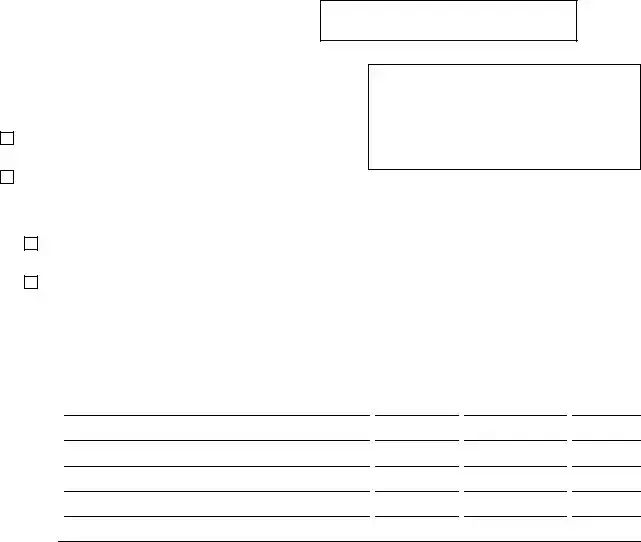
B.Pregnancy
The Court finds that the Wife is not pregnant.
Remember: You cannot finish your divorce
while the wife is pregnant.
C.Children Born during the Marriage, but the Husband is Not the Father
(Check one box.)
The Court finds that the Wife did not have children with another man while married to the Husband.
Remember: If the wife had children with
another man while married to the husband, you cannot finish your divorce until paternity of the children has been established. See Texas Family Code Section 160.204. Get more information about establishing paternity at www.TexasLawHelp.org.
The Court finds that the children named below
were born during the marriage, but are not the Husband’s children.
The Court further finds that paternity of each child has been established:
(Check one box.)
A court order has determined the father of each of child named below. A copy of the order is attached to and made part of this Final Decree of Divorce for all purposes.
An Acknowledgement of Paternity signed by the genetic father and a Denial of Paternity signed by the Husband has been filed with the bureau of vital statistics for each child named below. A copy of this document or documents is attached to and made part of this Final Decree of Divorce for all purposes.
(List all children born during the marriage, who are not the adopted or biological children of the husband.) (Paternity of each child must already have been established.)
Child’s name |
Age |
Date of Birth |
Sex |
1.
2.
3.
4.
5.
6.
If more than 6 children, list them on another sheet and write Attachment B at the top. Then attach it to this form.
5. Divorce
IT IS ORDERED that the Petitioner and the Respondent are divorced on the grounds of insupportability.
© TexasLawHelp.org, Divorce Decree, No Children, October, 2011 |
|
Texas Family Code, Chapter 6; Texas Rules of Civil Procedure |
Page 3 of 8 |

6. Property And Debts
Note: Additional forms are needed to divide retirement benefits and to transfer title to real estate.
If you plan to divide retirement benefits or you jointly own a house or land with your spouse, do NOT use this form without first talking to a lawyer.
You can hire a lawyer just to give you advice and/or write the documents you need for a flat fee.
Call your local lawyer referral service or the State Bar of Texas Lawyer Referral Information Service at 1(800)
Texas is a community property state. This means that any new property or debt that either party obtains from the minute they are married until the minute the judge grants the divorce is community property, even if the property or debt is only in one spouse’s name.
All community property and debt should be included in the Final Decree of Divorce. There are a few exceptions to the law of community property. If either party receives a gift, an inheritance, or money from a lawsuit that does not compensate for lost wages, it is separate property. It is a good idea to confirm separate property obtained during the marriage as that individual’s separate property in the Final Decree of Divorce. More information about community and separate property can be found in the Texas Family Code, chapters 3,4, and 5.
The Court makes the following orders regarding the parties’ community and separate property:
Husband’s Property
Husband’s Separate Property
The Court confirms that the Husband owns the following property as his separate property: |
|
|||
1. |
House located at: _______________________________________________________________ |
|||
|
Street Address |
City |
State |
Zip |
|
Husband owned this house before marriage. |
|
|
|
|
Husband received this house as a gift or inheritance. |
|
|
|
2. |
Land located at: ________________________________________________________________ |
|||
|
Street Address |
City |
State |
Zip |
Husband owned this land before marriage.
Husband received this land as a gift or inheritance.
3.Cars, trucks, motorcycles or other vehicles
Husband owned these vehicles before marriage or received them as a gift or inheritance during the marriage:
Year |
|
Make |
|
Model |
|
Vehicle Identification No. [VIN] |
|
|
|
|
|
|
|
|
|
|
|
|
|
|
|
|
|
|
|
|
|
|
|
|
|
|
|
|
|
|
|
|
|
4.Other Money or Property
Husband owned the following money or property before the marriage or inherited or received it as a gift during the marriage.
Husband received the following money from a lawsuit during the marriage. This money was not compensation for lost wages.
© TexasLawHelp.org, Divorce Decree, No Children, October, 2011 |
|
Texas Family Code, Chapter 6; Texas Rules of Civil Procedure |
Page 4 of 8 |
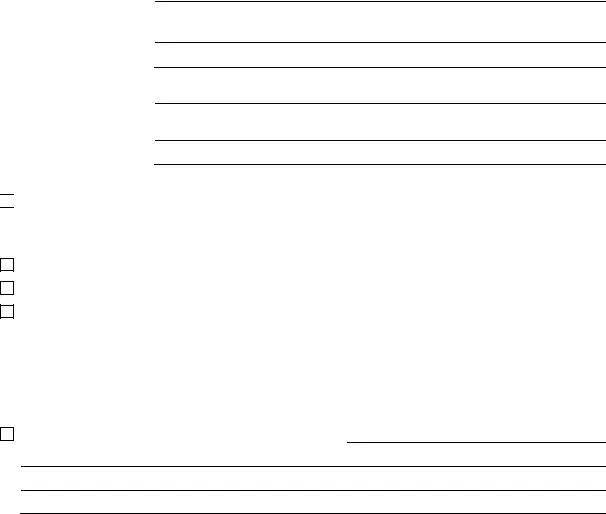
Husband’s Community Property
The Court ORDERS that the Husband is awarded (gets) the following Community Property, and the Wife is divested of (doesn’t get) any interest, title or claim she may have to the property listed below.
Wife IS ORDERED to sign any deeds or documents needed to transfer any property listed below to the Husband. Husband is responsible for preparing the documents.
1.All property in Husband’s care, custody or control, or in Husband’s name, that this Order does not give to the Wife.
2.House or land located at:
Street Address |
City |
State |
Zip |
Legal Description:
3. Other real property located at:
Street Address |
City |
State |
Zip |
Legal Description:
(Check ALL that apply.)
4. All of the Husband’s employment benefits, including retirement, pension, 401(k),
5.
6.
7.
All cash and money in any bank or other financial institution listed in Husband’s name ALONE. Any insurance policy that covers the Husband’s life.
The Husband’s cars, trucks, motorcycles or other vehicles listed below
Year |
|
Make |
|
Model |
|
Vehicle Identification No. [VIN] |
|
|
|
|
|
|
|
|
|
|
|
|
|
|
|
|
|
|
|
|
|
8.
The Husband will also keep the property listed below:
© TexasLawHelp.org, Divorce Decree, No Children, October, 2011 |
|
Texas Family Code, Chapter 6; Texas Rules of Civil Procedure |
Page 5 of 8 |

Husband’s Debts
(Check all that apply.)
The Husband shall pay the debts listed below:
1.
2.
All taxes, bills, liens, and other charges, present and future, for all personal and real property that are in the Husband’s name alone or that this Order gives to the Husband alone, unless this Order requires otherwise.
Any debt Husband incurred after separation. Date of separation: _______________.
Month Day Year
3.
4.
5.
The balance due on any loan or mortgage for the real property that this Order gives to the Husband alone.
The balance due on any loan for any vehicles that this Order gives to the Husband alone.
All other debts listed below, which are not in Husband’s name alone, such as credit cards, student loans, medical bills, income taxes:
Wife’s Property
Wife’s Separate Property
The Court confirms that Wife owns the following property as her separate property:
1. |
House located at: _______________________________________________________________ |
|||
|
Street Address |
City |
State |
Zip |
|
Wife owned this house before marriage. |
|
|
|
|
Wife received this house as a gift or inheritance. |
|
|
|
2. |
Land located at: ________________________________________________________________ |
|||
|
Street Address |
City |
State |
Zip |
|
Wife owned this land before marriage. |
|
|
|
|
Wife received this land as a gift or inheritance. |
|
|
|
3.Cars, trucks, motorcycles or other vehicles
Wife owned these vehicles before the marriage or received them as a gift or inheritance during the marriage:
Year |
|
Make |
|
Model |
|
Vehicle Identification No. [VIN] |
|
|
|
|
|
|
|
|
|
|
|
|
|
|
4.Other Money or Property
Wife owned the following money or property before the marriage or inherited or received it as a gift during the marriage.
Wife received the following money from a lawsuit during the marriage. This money was not compensation for lost wages.
© TexasLawHelp.org, Divorce Decree, No Children, October, 2011 |
|
Texas Family Code, Chapter 6; Texas Rules of Civil Procedure |
Page 6 of 8 |
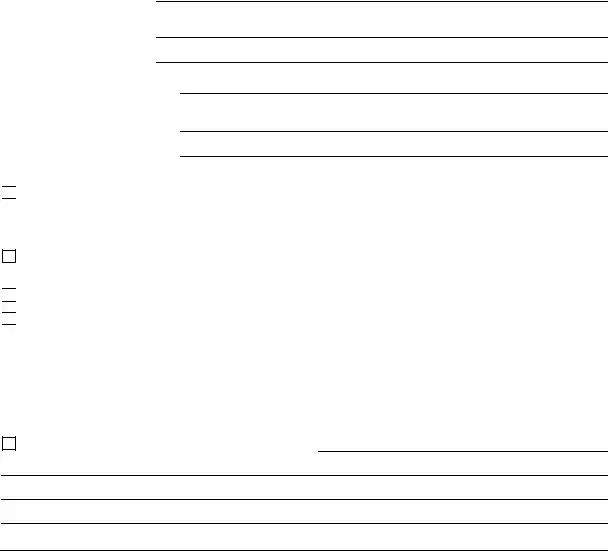
Wife’s Community Property
The Court ORDERS that Wife is awarded (gets) the following Community Property, and Husband is divested of (doesn’t get) any interest, title, or claim he may have to the property listed below.
Husband IS ORDERED to sign any deeds or documents needed to transfer any property listed below to the Wife. Wife is responsible for preparing the documents.
1.All property in Wife’s care, custody, or control, or in Wife’s name, that this Order does not give to the Husband.
2.House or land located at:
Street Address |
City |
State Zip |
Legal Description:
3. Other real property located at:
Street Address |
City |
State Zip |
Legal Description:
(Check all that apply.)
4. All of the Wife’s employment benefits, including retirement, pension, 401(k),
5. All of the Wife’s cash and money in any bank or other financial institution that is listed in her name ALONE.
6. Any insurance policy that covers the Wife’s life.
7. The Wife’s cars, trucks, motorcycles or other vehicles listed below:
Year |
|
Make |
|
Model |
|
Vehicle Identification No. [VIN] |
|
|
|
|
|
|
|
|
|
|
|
|
|
|
|
|
|
|
|
|
|
8.
The Wife will also keep the property listed below:
© TexasLawHelp.org, Divorce Decree, No Children, October, 2011 |
|
Texas Family Code, Chapter 6; Texas Rules of Civil Procedure |
Page 7 of 8 |
Wife’s Debts
(Check all that apply.)
The Wife shall pay the debts listed below:
1.
2.
All taxes, bills, liens, and other charges, present and future, for all personal and real property that are in the Wife’s name alone or that this Order gives to the Wife alone, unless this Order requires otherwise.
Any debt Wife incurred after separation. Date of separation:______________________.
Month Day Year
3.
4.
5.
The balance due on any loan or mortgage for the real property that this Order gives to the Wife alone.
The balance due on any loan for any vehicles that this Order gives to the Wife alone.
All other debts listed below, which are not in Wife’s name alone, such as credit cards, student loans, medical bills, income taxes:
7. Name Change
The Court ORDERS the name of the (check one): Husband Wife back to the name used before marriage, as it appears below.
First |
Middle |
Last |
8. Court Costs
The Husband will pay for his court costs; the Wife will pay for her court costs.
9. Other Orders
The court has the right to make other orders, if needed, to clarify or enforce the orders above. Any orders requested that do not appear above are denied.
Date of Judgment |
Judge’s signature |
Approved as to Form and Substance:
By signing below, the Petitioner agrees to the form and substance of this decree.
By signing below, the Respondent agrees to the form and substance of this decree.
|
|
( ) |
|
|
|
( ) |
||
Petitioner’s Name (print) |
|
Phone number |
|
Respondent’s Name (print) |
|
Phone number |
||
|
|
|
|
|
|
|
||
Petitioner’s Signature |
|
Date |
|
Respondent’s Signature |
|
Date |
||
Mailing |
|
|
|
|
Mailing |
|
|
|
Address: |
|
|
|
Address |
|
|
||
|
|
|
|
|
|
|
|
|
© TexasLawHelp.org, Divorce Decree, No Children, October, 2011 |
|
Texas Family Code, Chapter 6; Texas Rules of Civil Procedure |
Page 8 of 8 |
| Fact Name | Description |
|---|---|
| Purpose of the Divorce Decree | The Divorce Decree serves as the official court document that finalizes the divorce, outlining the terms agreed upon by both parties. |
| Governing Law | This form is governed by the Texas Family Code, specifically Chapter 6, which addresses divorce proceedings in Texas. |
| Presence of Parties | Both the Petitioner and Respondent must either be present at the hearing or have agreed to the terms of the Decree through signatures or waivers. |
| Children Consideration | If there are children involved, the court must confirm custody arrangements and child support obligations, if applicable. |
| Community Property | Texas is a community property state, meaning any property or debts acquired during the marriage are typically considered shared, unless specified otherwise. |
Filling out the Divorce Decree form can seem daunting, but by following a clear set of steps, you can complete it accurately. Once you have filled out the form, it will be submitted to the court for review. The court will then process your divorce based on the information provided. Below are the steps to guide you through filling out the form.
What is a Divorce Decree form?
A Divorce Decree form is a legal document that finalizes the divorce between two spouses. It outlines the terms of the divorce, including the division of property, debts, and any arrangements regarding children, if applicable. The decree is issued by a court and serves as the official record of the divorce.
Who fills out the Divorce Decree form?
The Divorce Decree form is typically filled out by the Petitioner, who is the spouse filing for divorce. The form must include specific details such as the names of both spouses, the court information, and any relevant agreements made during the divorce proceedings. If both spouses agree on the terms, the Respondent may also sign the form.
What information is required on the Divorce Decree form?
The form requires various details, including the names of both spouses, the court's name and address, the cause number, and information about any children involved. It also requires the parties to indicate whether they have minor children, the jurisdiction of the court, and any agreements regarding property and debts.
What happens if there are children involved?
If there are children involved, the Divorce Decree must address custody and support arrangements. The form will ask whether the couple has minor children or adult disabled children entitled to support. If there are existing custody orders, these must be attached to the decree as an exhibit.
What is the significance of jurisdiction in the Divorce Decree?
Jurisdiction refers to the court's authority to hear the case. The Divorce Decree form must confirm that the court has jurisdiction over the parties and the case. This ensures that the court has met residency and notice requirements, which are necessary for the divorce to be legally recognized.
What is community property, and how is it handled in the Divorce Decree?
In Texas, community property refers to assets and debts acquired during the marriage. The Divorce Decree must outline how community property will be divided between the spouses. Each party should confirm any separate property they owned before the marriage or received as a gift or inheritance during the marriage.
Can I finalize my divorce if my spouse is not present?
Yes, a divorce can still be finalized if one spouse is not present, provided that the absent spouse has been properly served with notice of the divorce proceedings. If the absent spouse agrees to the terms through a signed waiver or has defaulted, the court can proceed with the divorce.
What should I do if I have additional questions about the Divorce Decree?
If you have further questions about the Divorce Decree or the divorce process, it is advisable to consult with a legal professional. They can provide guidance specific to your situation and ensure that all legal requirements are met.
What should I do after completing the Divorce Decree form?
After completing the Divorce Decree form, you should file it with the appropriate court. Ensure you have all necessary signatures and attached documents, such as custody orders if applicable. Once filed, the court will review the decree, and if everything is in order, it will be signed by the judge, finalizing the divorce.
Incorrectly Filling Court Information: One common mistake is failing to accurately print the court information exactly as it appears on the Petition for Divorce. This includes the court name, cause number, and county details.
Missing Signatures: Both parties must sign the decree. If the Petitioner or Respondent does not sign the document, the court may reject it. Ensure that all necessary signatures are obtained before submission.
Omitting Children’s Information: If there are minor children involved, it is crucial to provide accurate details about them. This includes their names, dates of birth, and any existing custody arrangements. Failing to include this information can delay the process.
Neglecting Property and Debt Disclosure: All community property and debts acquired during the marriage must be disclosed. Omitting assets or liabilities can lead to complications later. It is important to be thorough and honest in this section.
Ignoring Legal Requirements: Each state has specific legal requirements for divorce decrees. Not checking that the petition meets these requirements can result in the court rejecting the decree. It is advisable to review the Texas Family Code or consult a legal professional for guidance.
When navigating a divorce, several important documents accompany the Divorce Decree form. Each document serves a distinct purpose and is crucial for ensuring that the divorce process is handled correctly. Below is a list of commonly used forms and documents that you may need to consider.
Each of these documents plays a vital role in the divorce proceedings. Properly preparing and filing them can help ensure a smoother process and reduce the likelihood of complications. Always consider seeking legal advice to navigate these forms effectively.
When filling out the Divorce Decree form, it is important to follow specific guidelines to ensure accuracy and compliance with legal requirements. Below is a list of things to do and avoid during this process.
Misconceptions about the Divorce Decree form can lead to confusion and potential legal issues. Below is a list of six common misconceptions, along with explanations to clarify them.
Ensure that all court information is accurately printed as it appears on the Petition for Divorce, including the Cause Number and court name.
Clearly identify both the Petitioner and Respondent by providing their full names, including first, middle, and last names.
Indicate whether the Petitioner and Respondent are representing themselves or have legal representation.
Confirm that the Petitioner has filed a Certificate of Last Known Address and an Affidavit of Non-Military Status.
Check the appropriate boxes regarding the presence of a court reporter during the hearing.
Verify that the court has jurisdiction over the case and that all residency and notice requirements have been satisfied.
If there are children involved, accurately list their names, ages, and dates of birth.
Attach a copy of any existing court orders regarding custody and support as Exhibit A to the Decree.
Understand that Texas is a community property state, meaning all property and debts acquired during the marriage are considered community property.
Consult with a lawyer before using the form if dividing retirement benefits or transferring real estate, as additional forms may be required.