The District of Columbia Transfer-on-Death Deed form serves as a valuable tool for property owners looking to streamline the transfer of their real estate assets upon death. This legal document allows individuals to designate one or more beneficiaries who will inherit their property without the need for probate, simplifying the process for loved ones during a difficult time. By using this deed, property owners can maintain control over their property while they are alive, ensuring that it automatically transfers to the chosen beneficiaries when they pass away. The form requires specific information, such as the property owner's details, a clear description of the property, and the names of the beneficiaries. Importantly, the deed must be properly executed and recorded with the appropriate government office to be valid. Understanding the nuances of this form can help property owners make informed decisions about their estate planning and ensure their wishes are honored after they are gone.
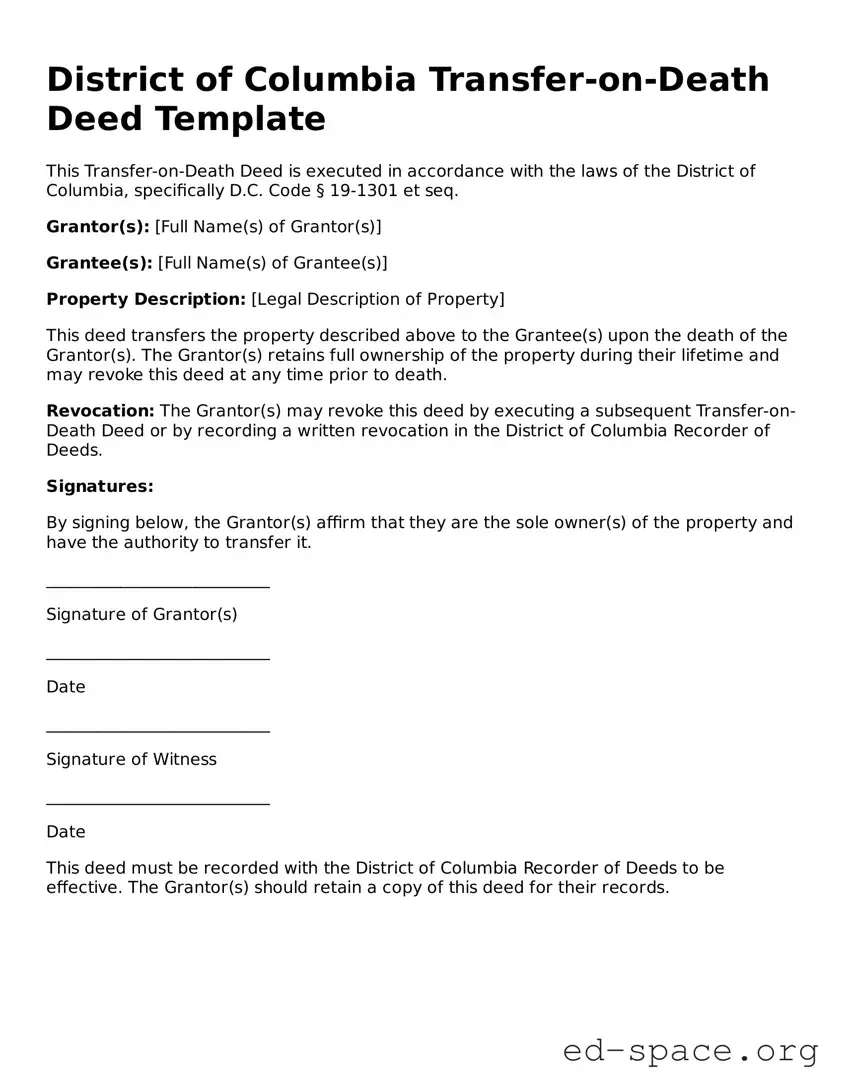
District of Columbia Transfer-on-Death Deed Template
This Transfer-on-Death Deed is executed in accordance with the laws of the District of Columbia, specifically D.C. Code § 19-1301 et seq.
Grantor(s): [Full Name(s) of Grantor(s)]
Grantee(s): [Full Name(s) of Grantee(s)]
Property Description: [Legal Description of Property]
This deed transfers the property described above to the Grantee(s) upon the death of the Grantor(s). The Grantor(s) retains full ownership of the property during their lifetime and may revoke this deed at any time prior to death.
Revocation: The Grantor(s) may revoke this deed by executing a subsequent Transfer-on-Death Deed or by recording a written revocation in the District of Columbia Recorder of Deeds.
Signatures:
By signing below, the Grantor(s) affirm that they are the sole owner(s) of the property and have the authority to transfer it.
___________________________
Signature of Grantor(s)
___________________________
Date
___________________________
Signature of Witness
___________________________
Date
This deed must be recorded with the District of Columbia Recorder of Deeds to be effective. The Grantor(s) should retain a copy of this deed for their records.
| Fact Name | Description |
|---|---|
| What is a Transfer-on-Death Deed? | A Transfer-on-Death Deed allows an individual to transfer real estate to a beneficiary upon their death, bypassing probate. |
| Governing Law | The Transfer-on-Death Deed in the District of Columbia is governed by D.C. Code § 19-1301 et seq. |
| Beneficiary Designation | Individuals can name one or more beneficiaries, and they can also specify different percentages for each beneficiary. |
| Revocation | The deed can be revoked at any time before the death of the grantor, ensuring flexibility in estate planning. |
| Filing Requirements | While the deed must be recorded with the District of Columbia Recorder of Deeds, it does not require a witness or notarization. |
After obtaining the District of Columbia Transfer-on-Death Deed form, you will be ready to provide the necessary information to ensure that your property is transferred according to your wishes. This process is straightforward but requires careful attention to detail. Below are the steps you need to follow to complete the form correctly.
What is a Transfer-on-Death Deed in the District of Columbia?
A Transfer-on-Death Deed (TOD) allows a property owner to transfer real estate to a beneficiary upon their death without going through probate. This deed is recorded with the District of Columbia’s land records and becomes effective only when the property owner passes away. The beneficiary receives full ownership without the need for court intervention.
Who can use a Transfer-on-Death Deed?
Any individual who owns real estate in the District of Columbia can use a Transfer-on-Death Deed. This includes homeowners and property owners. However, the deed must be properly executed and recorded to be valid. It is advisable to consult with a professional to ensure compliance with all requirements.
How do I create a Transfer-on-Death Deed?
To create a Transfer-on-Death Deed, you need to complete the appropriate form, which includes information about the property, the owner, and the beneficiary. The form must be signed by the owner in front of a notary public. After signing, the deed must be recorded with the D.C. Recorder of Deeds to take effect.
Can I change or revoke a Transfer-on-Death Deed?
Yes, you can change or revoke a Transfer-on-Death Deed at any time before your death. To do this, you must create a new deed or a revocation form. The new deed or revocation must also be recorded with the D.C. Recorder of Deeds to be legally effective.
What happens if the beneficiary dies before the property owner?
If the beneficiary named in the Transfer-on-Death Deed dies before the property owner, the transfer will not occur. The property owner can designate a new beneficiary by executing a new Transfer-on-Death Deed or by updating the existing deed with a revocation and a new beneficiary.
Are there any tax implications with a Transfer-on-Death Deed?
Generally, a Transfer-on-Death Deed does not trigger immediate tax consequences. The property is transferred to the beneficiary without being part of the probate estate. However, the beneficiary may be responsible for property taxes and capital gains taxes when they sell the property. Consulting a tax professional is recommended to understand specific implications.
Incomplete information: Failing to provide all required details, such as the full names and addresses of both the grantor and the beneficiary, can lead to delays or rejection of the deed.
Incorrect property description: Not accurately describing the property being transferred can create confusion and complications during the transfer process.
Not signing the deed: The grantor must sign the deed for it to be valid. Omitting this crucial step can invalidate the document.
Failure to have witnesses: In the District of Columbia, the deed requires two witnesses to be valid. Neglecting to include witnesses can render the deed unenforceable.
Not notarizing the deed: A Transfer-on-Death Deed must be notarized to be legally binding. Skipping this step can lead to issues with the deed’s acceptance.
Ignoring state-specific requirements: Each state has its own rules regarding Transfer-on-Death Deeds. Not adhering to the District of Columbia’s specific regulations can result in legal challenges.
Failing to record the deed: After completing the deed, it must be recorded with the appropriate government office. Not doing so can prevent the transfer from being recognized.
Overlooking beneficiary changes: If circumstances change, such as the death of a beneficiary, failing to update the deed can lead to unintended consequences.
The District of Columbia Transfer-on-Death Deed form allows property owners to transfer their real estate to beneficiaries without going through probate. When utilizing this form, several other documents may be necessary to ensure a smooth transfer process. Below is a list of commonly used forms and documents that complement the Transfer-on-Death Deed.
Understanding these documents can help streamline the transfer process and avoid potential complications. It is advisable to consult with a legal expert when preparing these forms to ensure compliance with local laws and regulations.
The Transfer-on-Death Deed (TODD) form has similarities with several other legal documents. Here’s a list of eight documents that share characteristics with the TODD:
When filling out the District of Columbia Transfer-on-Death Deed form, it is essential to approach the process with care. This deed allows property owners to transfer their property to designated beneficiaries upon their death without going through probate. Here are ten important do's and don'ts to consider:
The District of Columbia Transfer-on-Death Deed (TOD) form can be a useful tool for estate planning. However, several misconceptions often arise regarding its use and implications. Here are six common misunderstandings:
This is not true. Anyone can use a TOD deed, regardless of their financial status. It is designed to simplify the transfer of property without the need for probate, making it accessible for a wide range of individuals.
Actually, the property owner can designate beneficiaries without needing approval from others. This allows for a straightforward transfer to the chosen beneficiaries upon the owner's death.
This is incorrect. The property remains under the owner's control during their lifetime. The transfer only occurs after the owner's death, ensuring they can continue to manage the property as they wish.
In reality, a TOD deed can be revoked easily. The property owner can execute a new deed or a revocation form to change their beneficiaries at any time before their death.
This is misleading. While a TOD deed can help avoid probate, it does not eliminate potential tax liabilities. Beneficiaries may still be responsible for estate taxes or capital gains taxes, depending on the situation.
This is a common misunderstanding. A TOD deed specifically transfers real property outside of probate, while a will covers a broader range of assets and requires probate to be executed. They serve different purposes in estate planning.
When filling out and using the District of Columbia Transfer-on-Death Deed form, several important points should be considered. Here are key takeaways to keep in mind:
Understanding these points can help ensure that the Transfer-on-Death Deed is used effectively and in accordance with the law.