The District of Columbia Small Estate Affidavit form serves as a vital tool for individuals navigating the complexities of settling a deceased person's estate when the total value of the estate falls below a specific threshold. This form simplifies the process, allowing heirs to claim assets without the need for formal probate proceedings. It is designed for estates valued at $40,000 or less, which can include various types of property such as bank accounts, personal belongings, and real estate. By utilizing this affidavit, individuals can expedite the transfer of assets, ensuring that rightful heirs receive their inheritance in a timely manner. The form requires detailed information about the deceased, including their date of death and a list of assets, as well as the signatures of the heirs affirming their entitlement. Additionally, the affidavit must be notarized, adding a layer of authenticity and legal recognition to the claims made. Understanding the nuances of this form is essential for anyone looking to efficiently manage the affairs of a loved one who has passed away, particularly in a jurisdiction like the District of Columbia, where specific rules and regulations govern estate administration.
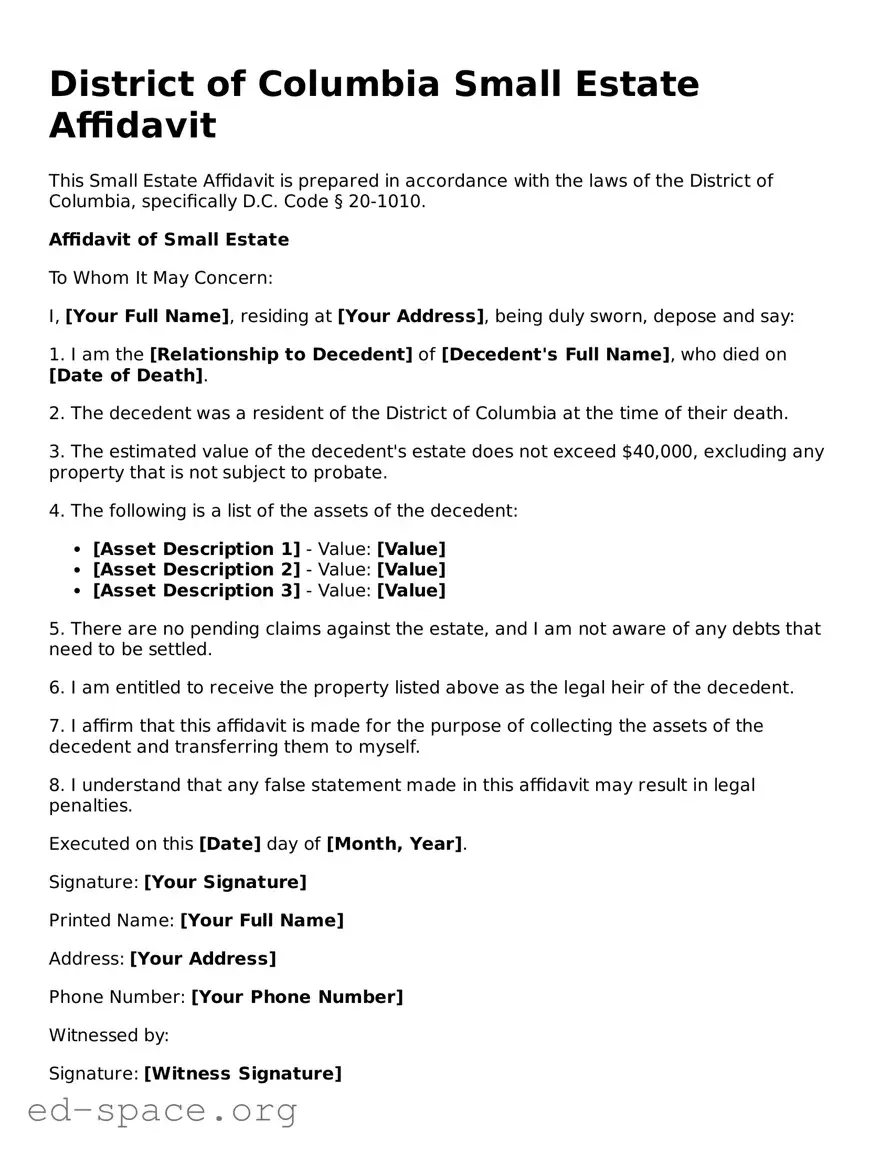
District of Columbia Small Estate Affidavit
This Small Estate Affidavit is prepared in accordance with the laws of the District of Columbia, specifically D.C. Code § 20-1010.
Affidavit of Small Estate
To Whom It May Concern:
I, [Your Full Name], residing at [Your Address], being duly sworn, depose and say:
1. I am the [Relationship to Decedent] of [Decedent's Full Name], who died on [Date of Death].
2. The decedent was a resident of the District of Columbia at the time of their death.
3. The estimated value of the decedent's estate does not exceed $40,000, excluding any property that is not subject to probate.
4. The following is a list of the assets of the decedent:
5. There are no pending claims against the estate, and I am not aware of any debts that need to be settled.
6. I am entitled to receive the property listed above as the legal heir of the decedent.
7. I affirm that this affidavit is made for the purpose of collecting the assets of the decedent and transferring them to myself.
8. I understand that any false statement made in this affidavit may result in legal penalties.
Executed on this [Date] day of [Month, Year].
Signature: [Your Signature]
Printed Name: [Your Full Name]
Address: [Your Address]
Phone Number: [Your Phone Number]
Witnessed by:
Signature: [Witness Signature]
Printed Name: [Witness Full Name]
Address: [Witness Address]
| Fact Name | Description |
|---|---|
| Purpose | The District of Columbia Small Estate Affidavit form allows individuals to claim property of a deceased person without going through the lengthy probate process. |
| Eligibility | This form is applicable when the total value of the deceased's estate is $40,000 or less, excluding real estate. |
| Governing Law | The use of the Small Estate Affidavit is governed by the District of Columbia Code, specifically Title 20, Chapter 10. |
| Required Information | The affidavit must include details such as the decedent's name, date of death, and a list of assets. |
| Signatures | The form must be signed by the affiant, who is typically a close relative or an individual entitled to inherit. |
| Filing Process | Once completed, the affidavit can be presented to financial institutions or other entities holding the decedent's assets for transfer. |
Filling out the District of Columbia Small Estate Affidavit form is an important step for individuals managing the estate of someone who has passed away. Completing this form accurately can help streamline the process of settling the estate, allowing heirs to access the deceased's assets more quickly. Follow these steps to ensure you fill out the form correctly.
Once the form is submitted, the court will review it. If everything is in order, the process of transferring the assets to the rightful heirs can begin. It’s essential to stay informed about any additional requirements or follow-up actions that may be necessary.
What is a Small Estate Affidavit in the District of Columbia?
A Small Estate Affidavit is a legal document that allows individuals to claim the assets of a deceased person without going through the full probate process. This is typically used when the total value of the estate is below a certain threshold, making it a simpler and quicker option for settling the estate.
What is the value limit for a Small Estate in D.C.?
In the District of Columbia, the total value of the estate must be less than $40,000 for individuals or $60,000 for married couples to qualify for the Small Estate Affidavit. This includes all assets, such as bank accounts, personal property, and real estate.
Who can file a Small Estate Affidavit?
The affidavit can be filed by an heir or a beneficiary of the deceased person. This individual must be at least 18 years old and must have a legitimate claim to the assets of the estate.
What information is needed to complete the affidavit?
You will need details about the deceased, including their name, date of death, and a list of their assets. Additionally, you must provide information about the heirs and any debts or liabilities of the estate.
How do I obtain the Small Estate Affidavit form?
The Small Estate Affidavit form can be obtained from the D.C. Superior Court's website or at the court's probate division. It's important to ensure you have the most current version of the form.
Is there a fee to file the Small Estate Affidavit?
There is typically no filing fee associated with submitting a Small Estate Affidavit in the District of Columbia. However, it’s wise to check for any changes or additional costs that may apply.
How long does it take to process the Small Estate Affidavit?
The processing time can vary, but generally, once the affidavit is filed, it can take a few weeks for the court to review and approve it. After approval, you can begin collecting the assets.
Can the Small Estate Affidavit be used for real estate?
Yes, a Small Estate Affidavit can be used to transfer real estate, provided the value of the entire estate is within the specified limits. However, additional steps may be required to ensure the property is properly transferred.
What happens if the estate exceeds the Small Estate limit?
If the estate's value exceeds the limit, you will need to go through the formal probate process. This involves filing a petition with the court and may require the appointment of a personal representative to manage the estate.
Can I use the Small Estate Affidavit if there is a will?
Yes, you can use the Small Estate Affidavit even if there is a will, as long as the estate value is below the limit. However, the will must be properly probated if the estate exceeds the threshold or if there are disputes among heirs.
Incomplete Information: One of the most common mistakes is leaving out essential details. Ensure that all required fields are filled in accurately. Missing information can delay the process or lead to rejection of the affidavit.
Incorrect Value of the Estate: Applicants sometimes miscalculate the total value of the estate. Be sure to include all assets and their fair market values. An inaccurate valuation can result in legal complications.
Failure to Sign: Neglecting to sign the affidavit is a frequent oversight. Remember that your signature is necessary for the document to be valid. Double-check that all required parties have signed.
Not Including Required Documentation: Supporting documents, such as a death certificate or a will, may be necessary. Review the requirements carefully to ensure all necessary paperwork is attached.
Using Outdated Forms: Some individuals mistakenly use old versions of the Small Estate Affidavit form. Always download the most current version from the official website to avoid issues.
Ignoring Local Laws: Each jurisdiction may have specific rules regarding small estates. Familiarize yourself with the District of Columbia's laws to ensure compliance and avoid unnecessary delays.
The District of Columbia Small Estate Affidavit form is often accompanied by several other documents to ensure a smooth process in settling a small estate. Below is a list of forms and documents that may be required or beneficial when using the Small Estate Affidavit.
Gathering these documents can help streamline the process of settling a small estate in the District of Columbia. It is advisable to ensure all necessary paperwork is complete and accurate to avoid delays.
When filling out the District of Columbia Small Estate Affidavit form, it is important to approach the process carefully. Here are some guidelines to help ensure that you complete the form accurately and efficiently.
By following these guidelines, you can help ensure that the process goes smoothly. If you have any questions or concerns, consider seeking assistance from a qualified professional.
The District of Columbia Small Estate Affidavit form is a useful tool for settling the estates of deceased individuals who have limited assets. However, several misconceptions often arise regarding its use and requirements. Here are seven common misunderstandings:
This is incorrect. The Small Estate Affidavit is designed for estates with a total value of $40,000 or less, not for estates with no assets at all.
While family members often file, anyone who has a legal interest in the estate may submit the affidavit, provided they meet the necessary criteria.
This form simplifies the process and may avoid formal probate, but it does not eliminate the need for legal procedures entirely.
This is a misconception. While it is advisable to address debts, the affidavit can still be filed even if some debts remain unpaid.
These documents serve different purposes. A Last Will outlines how assets should be distributed, while the Small Estate Affidavit is a tool for transferring property without going through probate.
The Small Estate Affidavit can often be downloaded online, making it accessible without the need for a courthouse visit.
While the process is generally faster than formal probate, various factors can affect the timeline, including the complexity of the estate and any disputes that may arise.
Understanding these misconceptions can help individuals navigate the Small Estate Affidavit process more effectively and ensure that they are making informed decisions regarding estate matters.
When dealing with the District of Columbia Small Estate Affidavit form, it’s essential to understand its purpose and requirements. Here are some key takeaways: