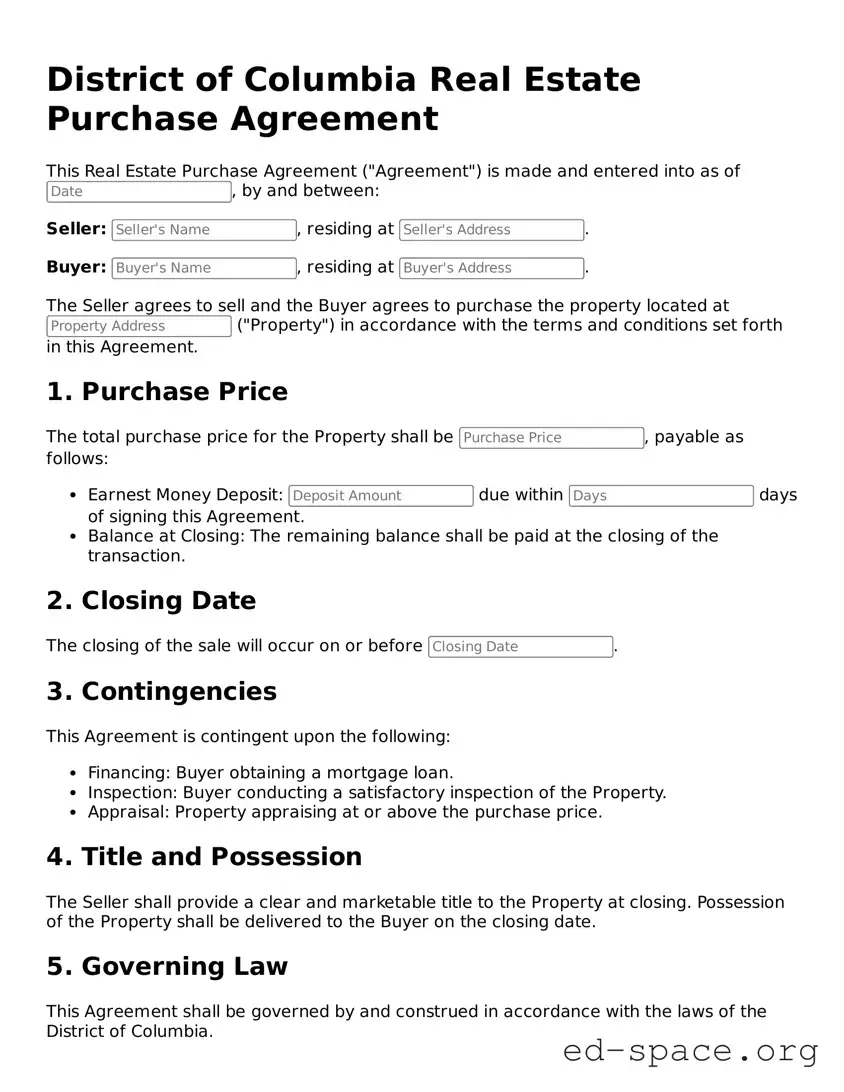
When navigating the complexities of buying or selling property in the District of Columbia, understanding the Real Estate Purchase Agreement form is essential. This document serves as a legally binding contract between the buyer and seller, outlining the terms and conditions of the real estate transaction. Key aspects of the form include the purchase price, financing details, and the closing date, which are crucial for both parties to agree upon. Additionally, it addresses contingencies such as inspections and financing, ensuring that buyers have the opportunity to assess the property before finalizing the sale. The agreement also specifies the responsibilities of each party, including disclosures and any potential repairs needed prior to closing. By clearly delineating these elements, the Real Estate Purchase Agreement helps to minimize misunderstandings and provides a framework for a smooth transaction process.
District of Columbia Real Estate Purchase Agreement
This Real Estate Purchase Agreement ("Agreement") is made and entered into as of , by and between:
Seller: , residing at .
Buyer: , residing at .
The Seller agrees to sell and the Buyer agrees to purchase the property located at ("Property") in accordance with the terms and conditions set forth in this Agreement.
1. Purchase Price
The total purchase price for the Property shall be , payable as follows:
2. Closing Date
The closing of the sale will occur on or before .
3. Contingencies
This Agreement is contingent upon the following:
4. Title and Possession
The Seller shall provide a clear and marketable title to the Property at closing. Possession of the Property shall be delivered to the Buyer on the closing date.
5. Governing Law
This Agreement shall be governed by and construed in accordance with the laws of the District of Columbia.
6. Signatures
By signing below, both parties agree to the terms of this Agreement:
Seller's Signature: ___________________________ Date: ____________
Buyer's Signature: ___________________________ Date: ____________
This template is intended for informational purposes only and does not constitute legal advice.
| Fact Name | Description |
|---|---|
| Governing Law | The District of Columbia Real Estate Purchase Agreement is governed by the laws of the District of Columbia. |
| Parties Involved | The agreement typically involves a buyer and a seller, both of whom must be clearly identified in the document. |
| Property Description | A detailed description of the property being purchased must be included, specifying the address and legal description. |
| Purchase Price | The total purchase price of the property is a critical component and must be clearly stated in the agreement. |
| Earnest Money | The agreement often requires the buyer to submit earnest money, demonstrating their commitment to the purchase. |
| Contingencies | Common contingencies include financing, inspections, and appraisals, which must be outlined in the agreement. |
| Closing Date | The agreement specifies a closing date, which is the date when the transaction is finalized and ownership is transferred. |
| Disclosure Requirements | Sellers are required to disclose known issues with the property, ensuring buyers are informed before purchase. |
| Signatures | Both parties must sign the agreement for it to be legally binding, indicating their acceptance of the terms. |
Filling out the District of Columbia Real Estate Purchase Agreement form is a crucial step in the process of buying or selling property. This form serves as a legal document that outlines the terms and conditions of the transaction. Completing it accurately will help ensure that both parties understand their rights and responsibilities.
After completing the form, it is advisable to review it carefully to ensure all information is accurate. Both parties should retain a copy for their records, and it may be beneficial to consult with a real estate attorney to clarify any uncertainties before proceeding with the transaction.
What is the District of Columbia Real Estate Purchase Agreement form?
The District of Columbia Real Estate Purchase Agreement form is a legal document that outlines the terms and conditions under which a buyer agrees to purchase property from a seller. This form includes essential details such as the purchase price, property description, and the responsibilities of both parties. It serves as a binding contract once signed, ensuring that both the buyer and seller adhere to the agreed-upon terms throughout the transaction process.
What key elements should be included in the agreement?
Several critical elements must be included in the Real Estate Purchase Agreement. These typically encompass the names and contact information of both the buyer and seller, a detailed description of the property being sold, the purchase price, and the payment terms. Additionally, the agreement should specify any contingencies, such as financing or inspection requirements, and outline the timeline for closing the sale. Including these elements helps prevent misunderstandings and protects the interests of both parties.
What happens if one party does not fulfill their obligations?
If one party fails to meet their obligations as outlined in the agreement, it may be considered a breach of contract. The non-breaching party has several options, including seeking specific performance, which requires the breaching party to fulfill their contractual duties, or pursuing damages. Legal action may be necessary to resolve disputes, so it is advisable for both parties to understand their rights and responsibilities under the agreement. Consulting with a legal professional can provide clarity on the best course of action in such situations.
Can the agreement be modified after it is signed?
Yes, the District of Columbia Real Estate Purchase Agreement can be modified after it is signed, but both parties must agree to any changes. Modifications should be documented in writing and signed by both the buyer and seller to ensure clarity and enforceability. This process helps maintain a clear record of any alterations made to the original agreement, which can be crucial if disputes arise later in the transaction.
Failing to include all necessary parties. It is crucial to list all buyers and sellers involved in the transaction. Omitting a party can lead to legal complications.
Not providing accurate property descriptions. Ensure that the property address and any legal descriptions are correct. Inaccuracies can cause disputes later.
Neglecting to specify the purchase price. The agreement must clearly state the agreed-upon price. Leaving this blank can result in confusion and negotiation issues.
Overlooking contingencies. Buyers should include contingencies, such as financing or inspection clauses. Failing to do so may jeopardize their ability to withdraw from the agreement.
Not addressing earnest money deposits. The amount of earnest money should be specified, along with the conditions for its return. This protects both parties in the event of a cancellation.
Ignoring closing date specifics. The agreement should clearly state the closing date. Ambiguity regarding this date can lead to delays and frustration.
Forgetting to include disclosures. Sellers must provide necessary disclosures about the property. Missing these can lead to legal repercussions.
Not having the agreement reviewed. It is advisable to have a legal professional review the document. This can help identify potential issues before finalizing the agreement.
Failing to sign and date the agreement. All parties must sign and date the document for it to be valid. Without signatures, the agreement holds no legal weight.
The District of Columbia Real Estate Purchase Agreement is a crucial document in any property transaction. However, it is often accompanied by several other forms and documents that help clarify the terms and protect the interests of both buyers and sellers. Below is a list of commonly used documents that may accompany the purchase agreement.
Understanding these accompanying documents is essential for anyone involved in a real estate transaction in the District of Columbia. Each plays a vital role in ensuring that the process is transparent, fair, and legally sound.
When filling out the District of Columbia Real Estate Purchase Agreement form, it's important to keep a few key points in mind. Here’s a list of things you should and shouldn’t do:
The District of Columbia Real Estate Purchase Agreement form can be confusing for many buyers and sellers. Here are nine common misconceptions about this important document:
Many people think the form is merely a template. In reality, it serves as a legally binding contract that outlines the terms of the sale. Ignoring its importance can lead to serious consequences.
While most transactions do require a purchase agreement, some informal agreements might not. However, it’s always best to have a written agreement to protect both parties.
Once both parties have signed the agreement, the terms are typically set. Changes can only be made if both parties agree in writing.
This form can be used for both residential and commercial properties. It’s versatile and can cater to various types of real estate transactions.
While agents often assist in completing the form, clients should always be involved in the process. Their input is crucial to ensure the agreement reflects their wishes.
Signing does not mean the sale is complete. There are still contingencies and conditions that must be met before the transaction is finalized.
While many terms can be negotiated, some are standard and may not be altered. It’s important to understand which terms are flexible and which are not.
There are circumstances under which a party can withdraw, such as failing to meet contingencies. However, backing out without a valid reason can lead to legal repercussions.
Each purchase agreement can vary based on the specifics of the transaction. Factors like property type, location, and buyer/seller needs can all influence the terms.
When dealing with the District of Columbia Real Estate Purchase Agreement form, it's essential to understand the nuances involved. Here are some key takeaways to keep in mind:
By keeping these points in mind, you can navigate the District of Columbia Real Estate Purchase Agreement with greater confidence and clarity.