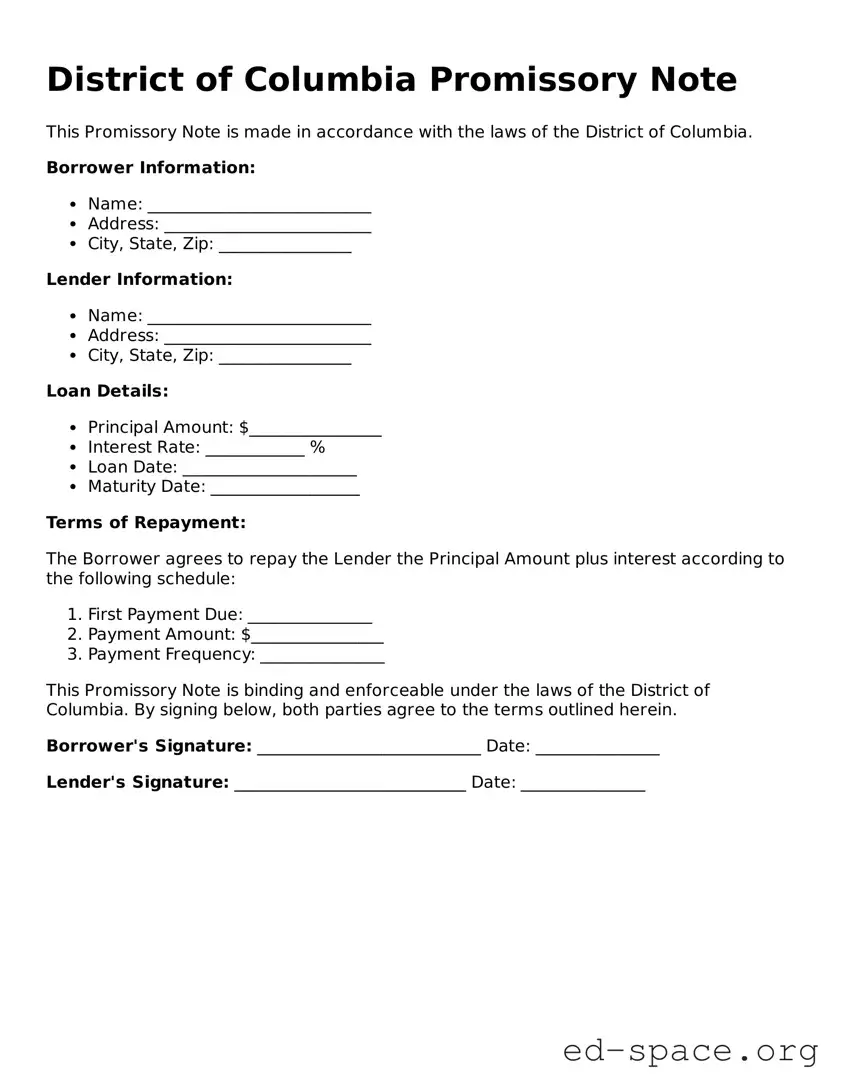
The District of Columbia Promissory Note form serves as a crucial financial instrument for individuals and businesses engaging in lending and borrowing transactions within the district. This form outlines the borrower's promise to repay a specified amount of money to the lender, detailing essential components such as the principal amount, interest rate, repayment schedule, and any applicable late fees. By clearly defining the terms of the loan, the Promissory Note helps to establish a mutual understanding between the parties involved, minimizing the potential for disputes. Additionally, the form may include provisions for default and remedies available to the lender should the borrower fail to meet their obligations. Understanding the structure and requirements of this form is vital for ensuring compliance with local regulations and protecting the rights of both parties in the transaction.
District of Columbia Promissory Note
This Promissory Note is made in accordance with the laws of the District of Columbia.
Borrower Information:
Lender Information:
Loan Details:
Terms of Repayment:
The Borrower agrees to repay the Lender the Principal Amount plus interest according to the following schedule:
This Promissory Note is binding and enforceable under the laws of the District of Columbia. By signing below, both parties agree to the terms outlined herein.
Borrower's Signature: ___________________________ Date: _______________
Lender's Signature: ____________________________ Date: _______________
| Fact Name | Description |
|---|---|
| Definition | A promissory note is a written promise to pay a specified amount of money to a designated person or entity at a specified time. |
| Governing Law | The District of Columbia's promissory note is governed by the D.C. Code, specifically Title 28, which covers commercial transactions. |
| Requirements | For a promissory note to be valid, it must include the date, the amount to be paid, the name of the payee, and the signature of the maker. |
| Types of Notes | Promissory notes can be secured or unsecured. A secured note is backed by collateral, while an unsecured note is not. |
| Interest Rates | The interest rate on a promissory note can be fixed or variable, and it should be clearly stated in the document to avoid confusion. |
| Enforcement | If the borrower fails to repay the loan as agreed, the lender can take legal action to enforce the terms of the note. |
Completing the District of Columbia Promissory Note form requires attention to detail. Ensure you have all necessary information ready before you begin. Follow these steps to accurately fill out the form.
After completing the form, make copies for both parties. Keep the original in a safe place. This document will serve as a record of the loan agreement and its terms.
What is a District of Columbia Promissory Note?
A District of Columbia Promissory Note is a legal document that outlines a borrower's promise to repay a specified amount of money to a lender under agreed-upon terms. This document typically includes details such as the loan amount, interest rate, repayment schedule, and any penalties for late payments. It serves as a formal agreement between the two parties and can be used in various situations, including personal loans, business financing, or real estate transactions.
What are the essential components of a Promissory Note?
Several key components must be included in a Promissory Note to ensure its effectiveness. First, the names and contact information of both the borrower and lender should be clearly stated. Next, the principal amount—the total sum borrowed—must be specified. The interest rate, whether fixed or variable, should also be included, along with the repayment schedule detailing when payments are due. Additionally, the note may outline any late fees or penalties for missed payments, as well as the terms for default and any applicable governing law. Finally, both parties should sign and date the document to validate the agreement.
How is a Promissory Note enforced in the District of Columbia?
Enforcement of a Promissory Note in the District of Columbia typically involves the lender taking legal action if the borrower fails to adhere to the terms outlined in the document. If a borrower defaults on the loan, the lender may file a lawsuit in the appropriate court to recover the owed amount. The court will review the terms of the note and any evidence presented. If the court rules in favor of the lender, it may issue a judgment against the borrower, allowing the lender to collect the debt through various means, such as wage garnishment or bank levies.
Can a Promissory Note be modified after it has been signed?
Yes, a Promissory Note can be modified after it has been signed, but both parties must agree to the changes. It is advisable to document any modifications in writing to avoid misunderstandings in the future. This can be done through an amendment to the original note or by creating a new note that reflects the updated terms. Both parties should sign and date any modifications to ensure clarity and enforceability. Keeping accurate records of any changes is essential for maintaining a clear agreement between the borrower and lender.
Not including the date on the form. The date is crucial as it marks when the agreement begins.
Failing to clearly write the borrower’s name. This should be the full legal name to avoid confusion.
Omitting the lender’s name. Just like the borrower, the lender’s full legal name must be included.
Not specifying the loan amount in clear terms. Write the amount in both numbers and words to ensure clarity.
Ignoring the interest rate. If there is an interest rate, it must be clearly stated to avoid disputes later.
Failing to outline the repayment terms. Specify when and how the borrower will repay the loan.
Not including a default clause. This clause explains what happens if the borrower fails to repay the loan.
Neglecting to sign the form. Both the borrower and lender must sign to make the document legally binding.
When dealing with financial agreements in the District of Columbia, a Promissory Note is a fundamental document that outlines the terms of a loan. However, it is often accompanied by other forms and documents that help clarify the agreement and protect the interests of both parties involved. Below are some commonly used documents that complement the Promissory Note.
Each of these documents plays a crucial role in the lending process, ensuring that all parties are clear about their responsibilities and rights. By understanding these forms, borrowers and lenders can navigate their financial agreements with greater confidence and clarity.
When filling out the District of Columbia Promissory Note form, it is essential to approach the task with care and attention to detail. Below are some important do's and don'ts to keep in mind.
By following these guidelines, you can help ensure that your Promissory Note is properly executed and serves its intended purpose effectively.
Understanding the District of Columbia Promissory Note form can be challenging, and several misconceptions often arise. Here are ten common misunderstandings along with clarifications:
Many people believe that all promissory notes are identical. In reality, the terms and conditions can vary significantly based on the agreement between the parties involved.
Some assume that a verbal agreement suffices. However, for enforceability, a written document is crucial, especially in the District of Columbia.
This is a common myth. Individuals and businesses can create promissory notes as well, provided they meet legal requirements.
While they are commonly used for loans, promissory notes can also be utilized in other transactions, such as for the sale of goods or services.
Notarization is not a requirement for a promissory note to be valid in the District of Columbia, although it can add an extra layer of authenticity.
Some people think that every promissory note must specify an interest rate. However, it is perfectly acceptable to create a note without interest.
Many believe that a signed note is set in stone. In fact, parties can modify the terms if both agree and document the changes properly.
It’s a misconception that promissory notes are only used for significant sums. They can be used for any amount, large or small.
While a promissory note is a promise to pay, it does not guarantee that the borrower will be able to repay the loan.
Some think that promissory notes are no longer relevant in today's digital world. However, they remain a useful tool in many financial transactions.
Understanding these misconceptions can help ensure that individuals and businesses effectively use promissory notes in their financial dealings in the District of Columbia.
When filling out and using the District of Columbia Promissory Note form, consider the following key takeaways:
These steps help ensure clarity and enforceability in the loan agreement.