A prenuptial agreement in the District of Columbia serves as a legal document that outlines the financial and property arrangements between two individuals prior to marriage. This agreement can address various aspects such as the division of assets, debts, and spousal support in the event of divorce or separation. It is designed to protect each party's interests and clarify expectations, thereby potentially reducing conflict in the future. The form typically requires both parties to disclose their financial situations, ensuring transparency and fairness. Additionally, it must be signed voluntarily by both parties, and it is advisable for each individual to seek independent legal counsel to ensure that their rights are protected. The agreement must also comply with specific state laws to be enforceable, highlighting the importance of understanding local regulations when drafting such a document.
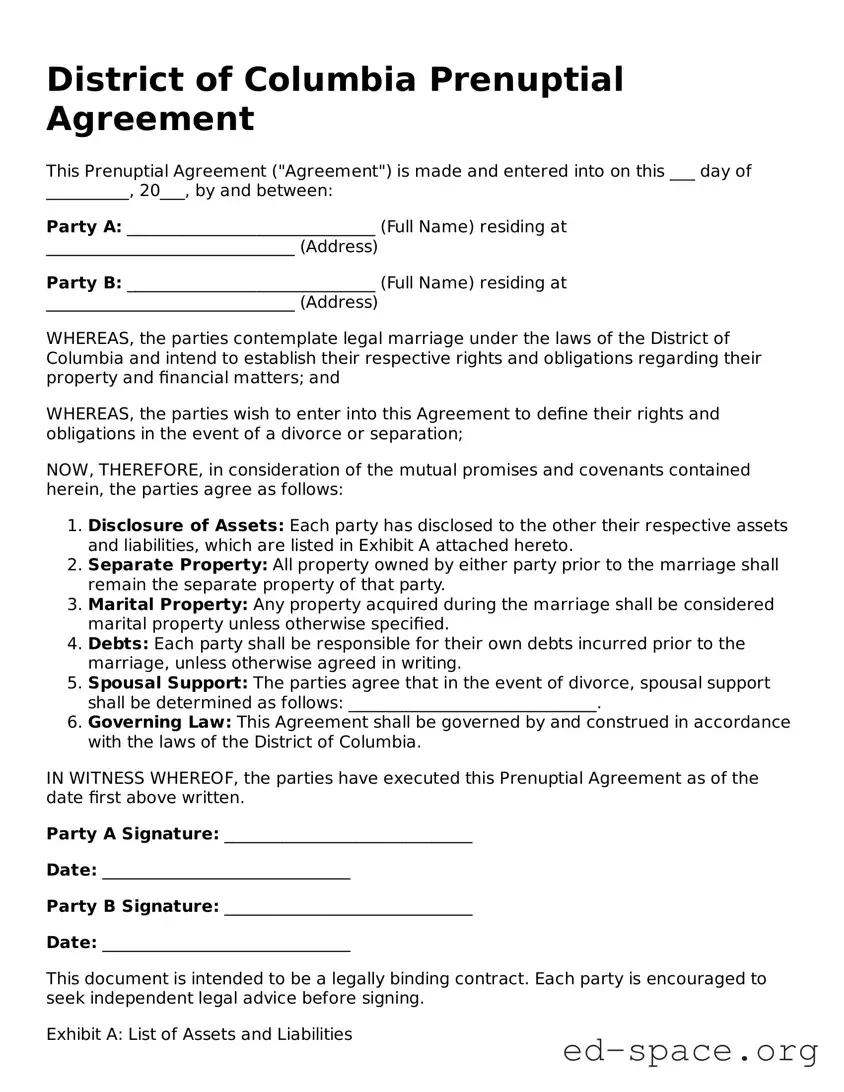
District of Columbia Prenuptial Agreement
This Prenuptial Agreement ("Agreement") is made and entered into on this ___ day of __________, 20___, by and between:
Party A: ______________________________ (Full Name) residing at ______________________________ (Address)
Party B: ______________________________ (Full Name) residing at ______________________________ (Address)
WHEREAS, the parties contemplate legal marriage under the laws of the District of Columbia and intend to establish their respective rights and obligations regarding their property and financial matters; and
WHEREAS, the parties wish to enter into this Agreement to define their rights and obligations in the event of a divorce or separation;
NOW, THEREFORE, in consideration of the mutual promises and covenants contained herein, the parties agree as follows:
IN WITNESS WHEREOF, the parties have executed this Prenuptial Agreement as of the date first above written.
Party A Signature: ______________________________
Date: ______________________________
Party B Signature: ______________________________
Date: ______________________________
This document is intended to be a legally binding contract. Each party is encouraged to seek independent legal advice before signing.
Exhibit A: List of Assets and Liabilities
| Fact Name | Description |
|---|---|
| Governing Law | District of Columbia law governs prenuptial agreements. |
| Written Requirement | A prenuptial agreement must be in writing to be enforceable. |
| Voluntary Agreement | Both parties must enter into the agreement voluntarily. |
| Full Disclosure | Each party should fully disclose their financial situation. |
| Notarization | While not required, notarization can strengthen the agreement's validity. |
| Enforceability | The agreement may be challenged if deemed unconscionable or unfair. |
Filling out the District of Columbia Prenuptial Agreement form is an important step in preparing for your future together. This process requires careful attention to detail to ensure that both parties are protected and that the agreement reflects your intentions clearly.
After completing these steps, you will have a signed prenuptial agreement that can provide clarity and protection for both parties as you embark on your marriage. It’s advisable to consult with a legal professional to ensure that the agreement meets all legal requirements and adequately reflects your wishes.
What is a prenuptial agreement in the District of Columbia?
A prenuptial agreement, often called a prenup, is a legal contract between two people before they get married. It outlines how assets and debts will be divided in case of divorce or separation. In the District of Columbia, prenups can also address issues like spousal support and property rights.
Why should couples consider a prenuptial agreement?
Couples may consider a prenup to protect their individual assets, clarify financial responsibilities, and reduce potential conflicts in the event of a divorce. It can provide peace of mind, ensuring that both parties understand their rights and obligations.
What should be included in a District of Columbia prenuptial agreement?
A prenup should include details about each partner's assets and debts, how property will be divided, and any agreements regarding spousal support. It's important to be clear and specific to avoid misunderstandings later. Couples may also include provisions for future financial matters, such as how to handle income earned during the marriage.
Are there any legal requirements for a prenuptial agreement in D.C.?
Yes, for a prenuptial agreement to be enforceable in the District of Columbia, it must be in writing and signed by both parties. Each person should have the opportunity to consult with their own attorney before signing the agreement. Full disclosure of assets and debts is also necessary for the agreement to be valid.
Can a prenuptial agreement be changed after marriage?
Yes, a prenuptial agreement can be modified or revoked after marriage. Both parties must agree to the changes, and it’s best to put any modifications in writing. This ensures clarity and helps avoid disputes in the future.
What happens if a prenuptial agreement is not enforced?
If a prenup is not enforced, the court may divide assets and debts according to state law, which may not align with the couple's wishes. This can lead to disputes and complications during divorce proceedings, making it essential to ensure the agreement is valid and enforceable.
How can couples ensure their prenuptial agreement is valid?
To ensure validity, couples should have the agreement drafted or reviewed by a qualified attorney. They should provide full financial disclosure and avoid any coercion during the process. Signing the agreement well in advance of the wedding can also help demonstrate that both parties entered into it willingly.
Where can couples find a prenuptial agreement form in D.C.?
Couples can find prenuptial agreement forms through various legal websites, or they may choose to work with an attorney to create a customized agreement. It's important to ensure that any form used complies with D.C. laws and adequately addresses the couple's specific needs.
Not Disclosing All Assets: One of the most common mistakes individuals make is failing to fully disclose their assets. Transparency is crucial in a prenuptial agreement. Both parties should provide a complete list of their financial holdings, including bank accounts, real estate, investments, and any other valuable property.
Using Ambiguous Language: Clarity is key when drafting a prenuptial agreement. Vague terms can lead to misunderstandings and disputes later. It is essential to use precise language to define rights, responsibilities, and the division of assets.
Not Considering Future Changes: Life circumstances can change significantly over time. Failing to address how the prenuptial agreement will adapt to future changes, such as the birth of children or career advancements, can render it less effective.
Neglecting Legal Advice: Some individuals attempt to fill out the form without consulting a legal professional. This can lead to oversights and errors. Seeking legal advice ensures that the agreement complies with local laws and adequately protects both parties' interests.
Not Reviewing the Agreement Together: A prenuptial agreement should be a collaborative effort. Failing to review the document together can create feelings of mistrust or resentment. Open communication about the terms fosters a sense of partnership and understanding.
A Prenuptial Agreement is an essential document for couples planning to marry, as it outlines the division of assets and responsibilities in the event of a divorce. However, other forms and documents can complement this agreement, providing additional clarity and protection for both parties. Below is a list of commonly used documents alongside the District of Columbia Prenuptial Agreement.
These documents, when used in conjunction with a Prenuptial Agreement, can help ensure that both parties are protected and informed throughout their marriage and in the event of separation or divorce. Each document plays a vital role in managing expectations and responsibilities, fostering a clearer understanding between partners.
The Prenuptial Agreement form shares similarities with several other legal documents. Each of these documents serves a specific purpose in managing personal and financial matters. Below is a list of documents that are comparable to a Prenuptial Agreement:
When completing the District of Columbia Prenuptial Agreement form, it is essential to approach the process with care and attention to detail. Here are seven important guidelines to follow:
Following these guidelines can help ensure that the prenuptial agreement serves its intended purpose effectively.
When it comes to prenuptial agreements in the District of Columbia, several misconceptions can cloud understanding. Here are nine common myths about these legal documents, along with clarifications to help you navigate the topic more effectively.
This is a widespread belief, but prenuptial agreements can benefit anyone entering a marriage. They can provide clarity and protect individual assets, regardless of financial status.
Even couples with modest assets can benefit from a prenuptial agreement. It can help outline how debts and property will be handled in the event of a divorce.
While some may view them as unromantic, they can actually foster open communication about finances and expectations, which can strengthen a relationship.
This is incorrect. When properly drafted and executed, prenuptial agreements are generally enforceable in court, provided they meet certain legal requirements.
Prenuptial agreements can be modified or revoked if both parties agree to the changes. This flexibility allows couples to adapt to changing circumstances.
While financial issues are a primary focus, prenuptial agreements can also address other matters, such as property division and spousal support.
It is advisable for both parties to have their own legal representation. This ensures that each person's interests are protected and that the agreement is fair.
In the District of Columbia, prenuptial agreements are available to all couples, regardless of sexual orientation. The law recognizes the rights of all individuals to enter into these agreements.
While the legal language can be complex, the underlying concepts are straightforward. With the help of a qualified attorney, couples can easily grasp the terms and implications of their agreement.
Understanding these misconceptions can lead to informed decisions about prenuptial agreements. They are not just legal documents; they are tools for fostering transparency and security in a relationship.
When considering a prenuptial agreement in the District of Columbia, it is important to keep several key points in mind. This agreement can help protect your assets and clarify financial responsibilities. Here are some essential takeaways:
By understanding these key aspects, you can approach the prenuptial agreement process with confidence and clarity.