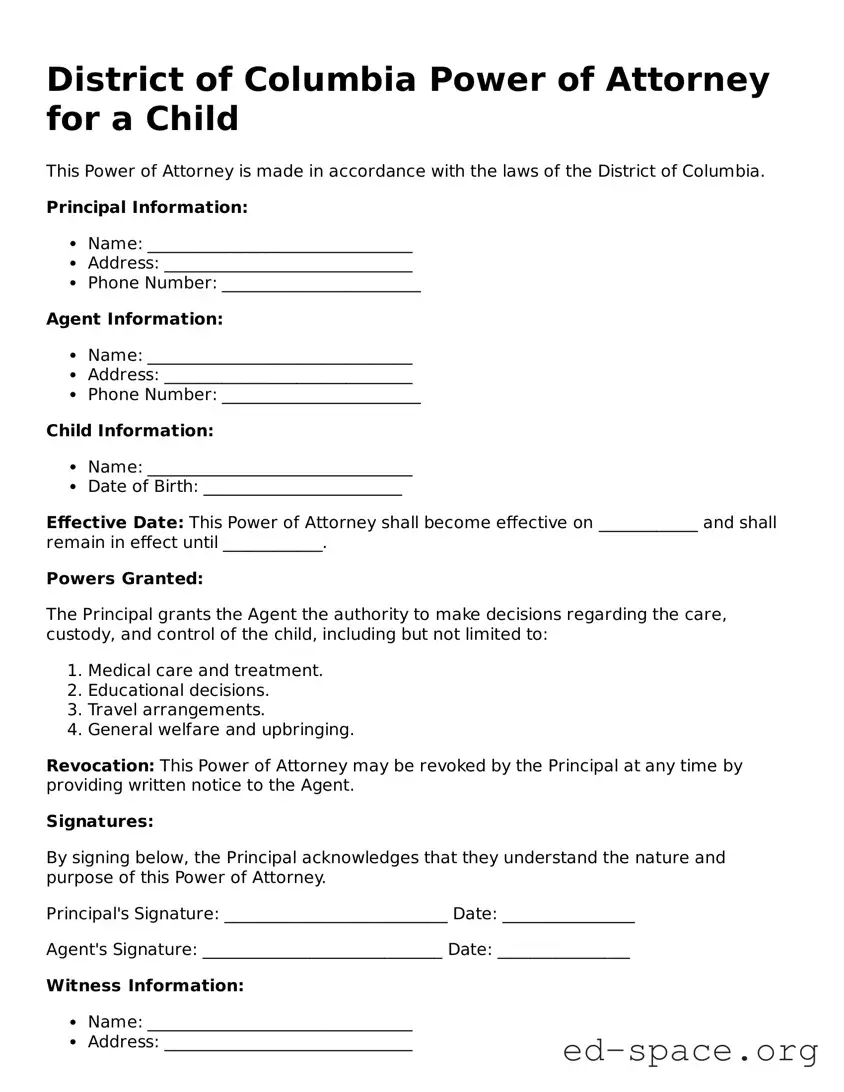
When it comes to ensuring the well-being and care of your child in your absence, the District of Columbia Power of Attorney for a Child form serves as a vital legal tool. This document allows a parent or legal guardian to designate another trusted adult to make important decisions on behalf of their child. It covers a wide range of responsibilities, including medical care, education, and general welfare, empowering the appointed individual to act in the child's best interest. The form must be completed with specific details, such as the names of the child and the designated agent, and it often requires notarization to ensure its validity. Understanding the significance of this form is crucial for parents seeking peace of mind, especially in situations where they may be temporarily unavailable to care for their child. With the right preparation, you can safeguard your child's needs and ensure that they are met by someone you trust.
District of Columbia Power of Attorney for a Child
This Power of Attorney is made in accordance with the laws of the District of Columbia.
Principal Information:
Agent Information:
Child Information:
Effective Date: This Power of Attorney shall become effective on ____________ and shall remain in effect until ____________.
Powers Granted:
The Principal grants the Agent the authority to make decisions regarding the care, custody, and control of the child, including but not limited to:
Revocation: This Power of Attorney may be revoked by the Principal at any time by providing written notice to the Agent.
Signatures:
By signing below, the Principal acknowledges that they understand the nature and purpose of this Power of Attorney.
Principal's Signature: ___________________________ Date: ________________
Agent's Signature: _____________________________ Date: ________________
Witness Information:
This document should be kept in a safe place and copies should be provided to the Agent and any relevant parties.
| Fact Name | Details |
|---|---|
| Purpose | The District of Columbia Power of Attorney for a Child form allows a parent or legal guardian to designate another individual to make decisions regarding the child's welfare and care. |
| Duration | This power of attorney can be effective for a specified period or until revoked by the parent or guardian, providing flexibility based on the child's needs. |
| Governing Law | The form is governed by the District of Columbia Code, specifically Title 21, which outlines the laws regarding powers of attorney. |
| Signatures Required | For the form to be valid, it must be signed by the parent or legal guardian and, in some cases, witnessed or notarized to ensure authenticity. |
Filling out the District of Columbia Power of Attorney for a Child form is an important step in ensuring that your child's needs are met in your absence. This process may seem daunting, but with careful attention to detail, you can navigate it smoothly. Below are the steps to complete the form effectively.
Once you have completed these steps, you will have a fully executed Power of Attorney for your child. This document will empower your chosen agent to act in your child's best interest when necessary, providing peace of mind for you and care for your child.
What is a Power of Attorney for a Child in the District of Columbia?
A Power of Attorney for a Child is a legal document that allows a parent or guardian to grant another adult the authority to make decisions on behalf of their child. This can include decisions about education, healthcare, and general welfare. It is often used when a parent is temporarily unable to care for their child due to travel, illness, or other reasons.
Who can serve as an agent under this Power of Attorney?
The agent can be any trusted adult, such as a relative, friend, or neighbor. It is important to choose someone who is responsible and can act in the best interest of the child. The agent must be at least 18 years old and legally capable of making decisions.
How long does the Power of Attorney for a Child last?
The duration of the Power of Attorney can vary based on the wishes of the parent or guardian. It can be set for a specific time period or remain in effect until revoked. However, it is essential to ensure that the document clearly states the intended duration to avoid any confusion.
Do I need to have the Power of Attorney notarized?
Yes, in the District of Columbia, the Power of Attorney for a Child should be notarized to be legally valid. This adds an extra layer of authenticity and helps prevent any disputes regarding the document's legitimacy.
Can I revoke the Power of Attorney once it is established?
Yes, a Power of Attorney can be revoked at any time by the parent or guardian. To revoke it, a written notice should be provided to the agent and any relevant parties. It is advisable to keep a copy of the revocation for personal records.
What decisions can the agent make on behalf of the child?
The agent can make various decisions, including those related to the child's education, healthcare, and general welfare. However, the specific powers granted should be clearly outlined in the document. This clarity helps ensure that the agent acts within the boundaries set by the parent or guardian.
Is a Power of Attorney for a Child necessary for temporary guardianship?
While a Power of Attorney can facilitate temporary guardianship, it is not always necessary. If a parent is going to be away for a short time, a Power of Attorney may provide peace of mind. However, for longer periods or more complex situations, formal guardianship arrangements might be required.
Where can I obtain a Power of Attorney for a Child form?
Power of Attorney forms can often be found online through legal websites or government resources. It is important to ensure that the form complies with the laws of the District of Columbia. Consulting with a legal professional can also provide guidance in obtaining the correct form and completing it accurately.
Not specifying the child's full name. It's essential to include the child's complete name as it appears on their birth certificate. Omitting or misspelling the name can lead to confusion or legal issues.
Failing to identify the agent clearly. The person designated to act on behalf of the child must be named explicitly. Include their full name, address, and relationship to the child to avoid any ambiguity.
Not providing a clear duration for the Power of Attorney. Indicate how long the authority will last. Whether it’s for a specific period or until revoked, clarity is crucial.
Neglecting to sign and date the form. Both the parent(s) and the agent must sign the document. Without signatures, the form is invalid. Additionally, dating the form is necessary to establish when the authority begins.
Overlooking witness or notarization requirements. Depending on the situation, the form may need to be witnessed or notarized. Check local requirements to ensure compliance.
Using outdated forms. Laws and requirements can change. Always use the most current version of the Power of Attorney for a Child form to ensure it meets legal standards.
Not discussing the arrangement with the child. While the child may be young, it’s important to explain the situation to them. This can help alleviate any confusion or anxiety they may have about the arrangement.
When creating a Power of Attorney for a Child in the District of Columbia, several other forms and documents may be useful to ensure comprehensive legal authority and protection. Below is a list of commonly used documents that complement the Power of Attorney for a Child.
Having these documents prepared alongside the Power of Attorney for a Child can help streamline processes and ensure that the designated agent has the necessary authority to act in the child's best interest.
The Power of Attorney for a Child form shares similarities with several other legal documents. Each of these documents serves a specific purpose, often involving the delegation of authority or decision-making responsibilities. Below is a list of ten documents that are similar in nature:
Each of these documents plays a crucial role in ensuring that the rights and well-being of children are protected, allowing for appropriate decision-making by designated individuals.
When filling out the District of Columbia Power of Attorney for a Child form, there are several important considerations to keep in mind. Here is a list of things you should and shouldn't do:
There are several misconceptions about the District of Columbia Power of Attorney for a Child form. Understanding these can help clarify its purpose and use. Here are five common misunderstandings:
Many believe this form is only necessary in urgent situations. However, it can be used for planned events, such as travel or temporary guardianship, not just emergencies.
Some think that signing this form transfers permanent custody of the child. In reality, it grants temporary authority for specific tasks and does not change legal custody.
While it is true that adults can be appointed, they must be trustworthy and capable of making decisions in the child's best interest. This is an important consideration when choosing an agent.
People often assume the form is difficult to fill out. In fact, it is designed to be straightforward, with clear instructions to guide the person completing it.
Some think the form is only valid within the District of Columbia. However, it may be recognized in other jurisdictions, depending on local laws and regulations.
Filling out a Power of Attorney for a Child form in the District of Columbia can be a straightforward process, but there are important details to keep in mind. Here are some key takeaways:
By following these guidelines, you can confidently navigate the process of filling out and using the Power of Attorney for a Child form in the District of Columbia.