The District of Columbia Power of Attorney form serves as a crucial legal document that allows individuals to appoint someone they trust to make decisions on their behalf. This form is vital for managing financial matters, healthcare decisions, and other important affairs when the principal is unable to act due to illness, absence, or incapacity. It outlines the specific powers granted to the agent, ensuring clarity in the scope of authority. The form can be tailored to meet the unique needs of the principal, allowing for general or limited powers. Additionally, it requires signatures from both the principal and the agent, as well as witnesses or a notary, to ensure its validity. Understanding the nuances of this form is essential for anyone looking to establish a reliable plan for future decision-making.
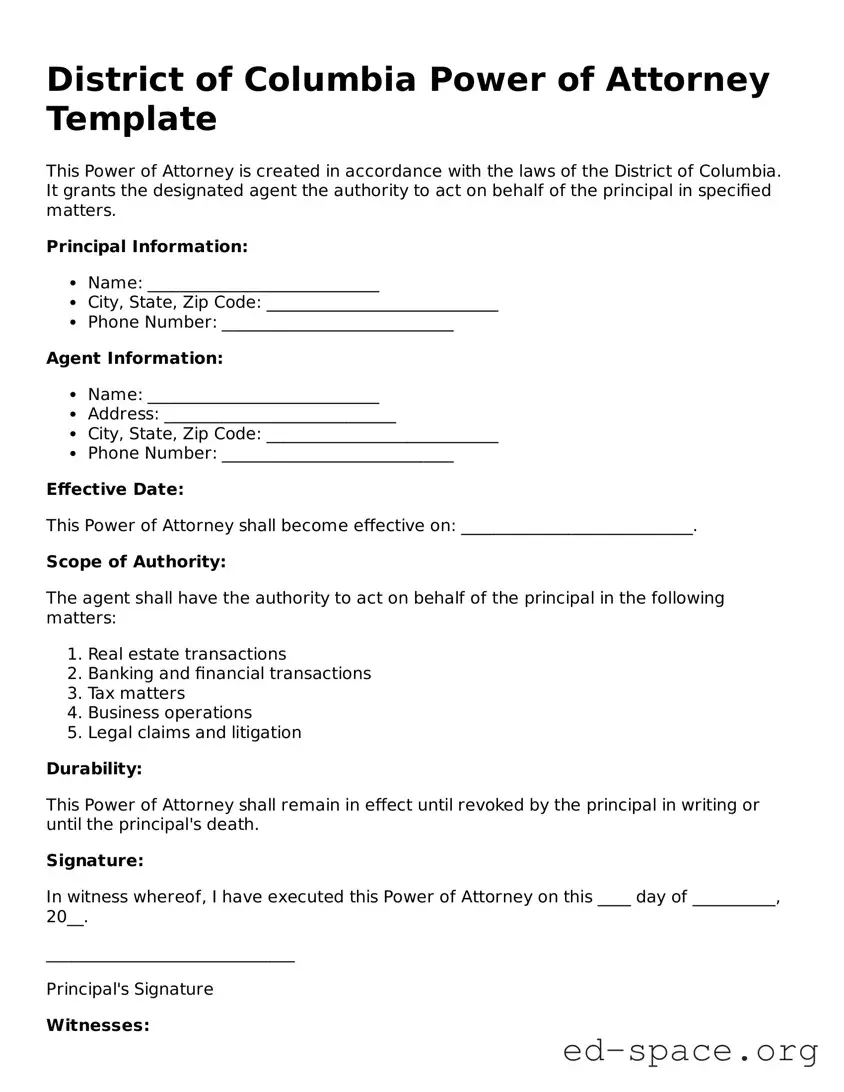
District of Columbia Power of Attorney Template
This Power of Attorney is created in accordance with the laws of the District of Columbia. It grants the designated agent the authority to act on behalf of the principal in specified matters.
Principal Information:
Agent Information:
Effective Date:
This Power of Attorney shall become effective on: ____________________________.
Scope of Authority:
The agent shall have the authority to act on behalf of the principal in the following matters:
Durability:
This Power of Attorney shall remain in effect until revoked by the principal in writing or until the principal's death.
Signature:
In witness whereof, I have executed this Power of Attorney on this ____ day of __________, 20__.
______________________________
Principal's Signature
Witnesses:
We, the undersigned witnesses, declare that the principal is personally known to us, that the principal signed this Power of Attorney in our presence, and that we are not named as agents in this document.
Notary Acknowledgment:
State of ______________________
County of ______________________
On this ____ day of __________, 20__, before me, a Notary Public, personally appeared ____________________________, known to me to be the person who executed the foregoing Power of Attorney.
______________________________
Notary Public Signature
My commission expires: ________________
| Fact Name | Description |
|---|---|
| Definition | A Power of Attorney (POA) in the District of Columbia allows one person to grant another the authority to make decisions on their behalf. |
| Types of POA | The District of Columbia recognizes several types of POA, including General, Durable, and Limited Power of Attorney. |
| Governing Law | The relevant laws governing Power of Attorney in D.C. are found in the D.C. Code, Title 21, Chapter 20. |
| Signing Requirements | The POA must be signed by the principal and witnessed by at least one individual or notarized to be valid. |
After obtaining the District of Columbia Power of Attorney form, you will need to fill it out accurately. This document allows you to appoint someone to act on your behalf in legal or financial matters. Follow these steps carefully to ensure the form is completed correctly.
Once you have completed the form, keep a copy for your records. Provide a copy to your agent, and consider filing it with relevant institutions if necessary.
What is a Power of Attorney in the District of Columbia?
A Power of Attorney (POA) is a legal document that allows one person to act on behalf of another in legal or financial matters. In the District of Columbia, this document can be tailored to fit specific needs, such as managing finances, making healthcare decisions, or handling real estate transactions. The person granting authority is known as the principal, while the person receiving authority is called the agent or attorney-in-fact.
Why might someone need a Power of Attorney?
Individuals often choose to create a Power of Attorney to ensure their affairs are managed according to their wishes, especially if they become incapacitated or are unable to handle their own matters. This can provide peace of mind, knowing that someone trusted will make decisions on their behalf when necessary.
What types of Power of Attorney are available in the District of Columbia?
There are several types of Power of Attorney in the District of Columbia, including General, Limited, and Durable Power of Attorney. A General POA grants broad authority, while a Limited POA restricts the agent's powers to specific tasks. A Durable POA remains effective even if the principal becomes incapacitated, ensuring that the agent can continue to act on their behalf.
How do I create a Power of Attorney in the District of Columbia?
To create a Power of Attorney, you must complete a form that clearly outlines the powers granted to the agent. It is important to sign the document in the presence of a notary public. This ensures that the document is legally binding and can be accepted by financial institutions and other entities.
Can I revoke a Power of Attorney?
Yes, you can revoke a Power of Attorney at any time as long as you are mentally competent. To do so, you must create a written revocation document and notify the agent and any institutions that may have relied on the original POA. This helps prevent any confusion regarding your wishes.
Do I need a lawyer to create a Power of Attorney?
While it is not legally required to have a lawyer draft a Power of Attorney, consulting with one can be beneficial. A lawyer can provide guidance on the specific powers you may need to grant and help ensure that the document complies with all legal requirements in the District of Columbia.
What should I consider when choosing an agent for my Power of Attorney?
Choosing an agent is a significant decision. It is essential to select someone you trust completely, as they will have the authority to make important decisions on your behalf. Consider their reliability, understanding of your wishes, and willingness to take on this responsibility. Discuss your expectations with them to ensure they are prepared for the role.
How does a Power of Attorney affect my healthcare decisions?
A Power of Attorney can include provisions for healthcare decisions if you choose to create a Healthcare Power of Attorney. This document allows your agent to make medical decisions for you if you are unable to communicate your wishes. It is crucial to discuss your healthcare preferences with your agent to ensure they understand your values and desires.
What happens if I do not have a Power of Attorney?
If you do not have a Power of Attorney and become incapacitated, your family may need to go through a legal process to appoint a guardian or conservator to manage your affairs. This can be time-consuming and may not align with your wishes. Having a Power of Attorney in place can help avoid this situation and ensure your preferences are honored.
Not specifying the powers granted. It's important to clearly outline what authority the agent has. If the powers are vague, it can lead to confusion.
Failing to date the document. A date is crucial for determining when the Power of Attorney becomes effective.
Neglecting to sign the form. Both the principal and the agent must sign the document for it to be valid.
Forgetting to have witnesses or notarization. In the District of Columbia, having the document witnessed or notarized is often necessary to ensure its legitimacy.
Using outdated forms. Always check for the most current version of the Power of Attorney form, as laws and requirements can change.
Not reviewing the document thoroughly. It’s essential to read through the entire form to ensure all information is accurate and complete.
Overlooking the agent's contact information. Providing clear contact details for the agent can help avoid complications later.
Assuming all agents have the same powers. Different agents may require different levels of authority, depending on their roles.
Not considering future changes. Life circumstances can change, so it's wise to plan for how to update or revoke the Power of Attorney as needed.
When creating a Power of Attorney (POA) in the District of Columbia, there are several other forms and documents that may be beneficial to consider. These documents can help clarify your intentions and ensure that your wishes are respected. Below is a list of some commonly used forms that accompany a POA.
These forms and documents work together to create a comprehensive plan that reflects your wishes and protects your interests. It is essential to carefully consider each document and consult with a professional if needed, ensuring that your decisions are well-informed and legally sound.
When filling out the District of Columbia Power of Attorney form, it's essential to approach the task with care. Here are nine important dos and don'ts to consider:
Understanding the District of Columbia Power of Attorney form is crucial for anyone considering its use. However, several misconceptions can lead to confusion. Here are ten common misconceptions:
Clarifying these misconceptions can help individuals make informed decisions regarding their legal and financial planning. Understanding the nuances of a Power of Attorney is essential for effective management of personal affairs.
Understanding the District of Columbia Power of Attorney form is essential for effective legal and financial management. Here are key takeaways to consider:
By following these guidelines, individuals can ensure that their Power of Attorney is properly executed and serves their intended purpose effectively.