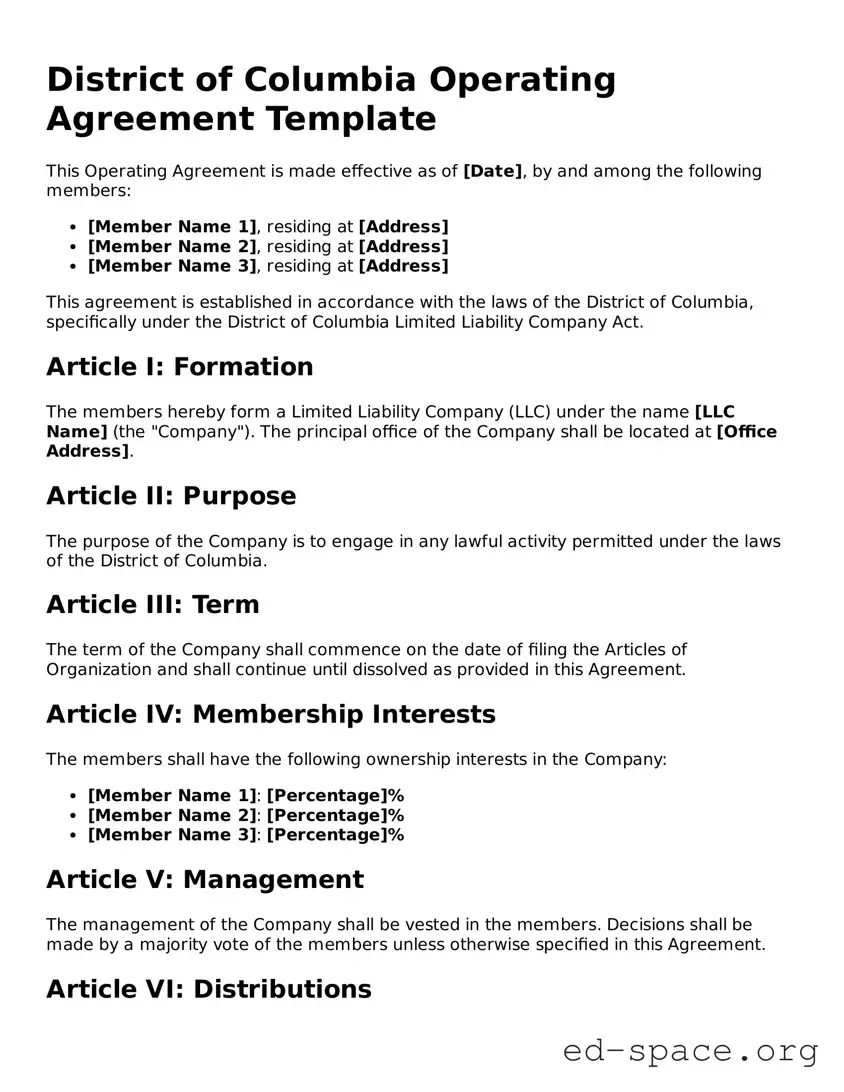
The District of Columbia Operating Agreement form is a crucial document for anyone looking to establish a limited liability company (LLC) in the capital. This form outlines the internal workings of the LLC, detailing the rights and responsibilities of its members, as well as the management structure. Key aspects include the distribution of profits and losses, voting rights, and procedures for adding or removing members. Additionally, the agreement can address how decisions are made and how disputes are resolved, ensuring a clear framework for operations. By setting these terms in advance, members can avoid misunderstandings and conflicts down the line. It serves not only as a guideline for daily operations but also as a protective measure for the members' personal assets. Having a well-drafted Operating Agreement is essential for compliance and for fostering a healthy business environment.
District of Columbia Operating Agreement Template
This Operating Agreement is made effective as of [Date], by and among the following members:
This agreement is established in accordance with the laws of the District of Columbia, specifically under the District of Columbia Limited Liability Company Act.
Article I: Formation
The members hereby form a Limited Liability Company (LLC) under the name [LLC Name] (the "Company"). The principal office of the Company shall be located at [Office Address].
Article II: Purpose
The purpose of the Company is to engage in any lawful activity permitted under the laws of the District of Columbia.
Article III: Term
The term of the Company shall commence on the date of filing the Articles of Organization and shall continue until dissolved as provided in this Agreement.
Article IV: Membership Interests
The members shall have the following ownership interests in the Company:
Article V: Management
The management of the Company shall be vested in the members. Decisions shall be made by a majority vote of the members unless otherwise specified in this Agreement.
Article VI: Distributions
Distributions of profits and losses shall be allocated to the members in proportion to their respective membership interests.
Article VII: Indemnification
The Company shall indemnify any member or manager against expenses and liabilities incurred in connection with the Company, to the fullest extent permitted by law.
Article VIII: Amendments
This Operating Agreement may be amended only by a written agreement signed by all members.
Article IX: Governing Law
This Agreement shall be governed by and construed in accordance with the laws of the District of Columbia.
IN WITNESS WHEREOF, the members have executed this Operating Agreement as of the date first above written.
______________________________
[Member Name 1]
______________________________
[Member Name 2]
______________________________
[Member Name 3]
| Fact Name | Details |
|---|---|
| Definition | The District of Columbia Operating Agreement is a legal document that outlines the management structure and operating procedures of a limited liability company (LLC). |
| Purpose | This agreement serves to protect the members' rights and define their responsibilities within the LLC. |
| Governing Law | The laws governing the Operating Agreement in the District of Columbia are found in Title 29 of the District of Columbia Code. |
| Flexibility | The Operating Agreement allows members to customize their management structure and operational procedures according to their specific needs. |
| Member Roles | It can specify the roles and responsibilities of each member, including management duties and voting rights. |
| Amendments | The agreement can be amended as needed, provided that all members agree to the changes in writing. |
Once you have the District of Columbia Operating Agreement form, you are ready to begin filling it out. This document will help outline the management structure and operational procedures of your business. Follow these steps to complete the form accurately.
What is a District of Columbia Operating Agreement?
An Operating Agreement is a crucial document for Limited Liability Companies (LLCs) in the District of Columbia. It outlines the management structure, responsibilities, and operational procedures of the LLC. While it is not required by law, having one can help prevent disputes among members and clarify how the business will run.
Why should I create an Operating Agreement for my LLC?
Creating an Operating Agreement is essential for several reasons. First, it establishes clear guidelines for the management and operation of the LLC. Second, it helps protect your personal assets by reinforcing the limited liability status of the business. Lastly, having a written agreement can prevent misunderstandings and provide a framework for resolving disputes among members.
Who should draft the Operating Agreement?
What should be included in the Operating Agreement?
An effective Operating Agreement should cover several key components. These include the LLC’s name and purpose, the members’ roles and responsibilities, the distribution of profits and losses, procedures for adding or removing members, and guidelines for decision-making. It may also address how disputes will be resolved and outline the process for dissolving the LLC if necessary.
Is an Operating Agreement legally binding?
Yes, once signed by all members, the Operating Agreement becomes a legally binding contract. This means that all parties are expected to adhere to the terms outlined in the document. If a dispute arises, the agreement can be referenced in legal proceedings to clarify each member's rights and obligations.
Do I need to file the Operating Agreement with the District of Columbia?
No, you do not need to file the Operating Agreement with the District of Columbia government. However, it is recommended that you keep it in a safe place and provide copies to all members. This ensures that everyone is aware of the terms and can refer back to it as needed.
Can I amend the Operating Agreement after it has been created?
Yes, you can amend the Operating Agreement if necessary. Most agreements will include a section that outlines the process for making changes. Typically, amendments require the consent of all members or a specified majority. It’s important to document any changes in writing to maintain clarity and avoid future disputes.
What happens if I don’t have an Operating Agreement?
Without an Operating Agreement, your LLC will be governed by default state laws, which may not align with your intentions for the business. This can lead to confusion, disputes among members, and potential legal issues. Having an Operating Agreement helps ensure that your specific needs and preferences are met, providing a clearer path for the management of your LLC.
Neglecting to Include All Members: One common mistake is failing to list all members involved in the business. Every member's name, address, and ownership percentage should be clearly stated. Omitting a member can lead to confusion and disputes down the line.
Inadequate Description of Business Purpose: Another frequent error is providing a vague or incomplete description of the business's purpose. The Operating Agreement should clearly outline what the business does. A well-defined purpose helps avoid misunderstandings among members.
Ignoring Voting Rights: Some people overlook the importance of detailing voting rights and decision-making processes. It's crucial to specify how votes are counted and what constitutes a quorum. This clarity can prevent conflicts when important decisions need to be made.
Failing to Address Profit and Loss Distribution: Lastly, many forget to include how profits and losses will be shared among members. Clearly stating the distribution method is vital. This ensures everyone knows what to expect and can help maintain harmony within the group.
The District of Columbia Operating Agreement is an essential document for LLCs, outlining the management structure and operational procedures. However, several other forms and documents often accompany it to ensure comprehensive compliance and smooth operations. Below is a list of these documents, along with brief descriptions of each.
Each of these documents plays a crucial role in the formation and operation of an LLC in the District of Columbia. Properly preparing and maintaining these forms helps ensure compliance with legal requirements and supports effective management of the business.
When filling out the District of Columbia Operating Agreement form, it is important to approach the process with care. Here are some key things to keep in mind:
By following these guidelines, you can create a well-structured Operating Agreement that serves your business effectively.
Understanding the District of Columbia Operating Agreement form is crucial for business owners. However, several misconceptions often arise. Here are five common misunderstandings:
By dispelling these misconceptions, business owners can better appreciate the importance of the District of Columbia Operating Agreement form and its role in their business operations.
When filling out and using the District of Columbia Operating Agreement form, consider the following key takeaways: