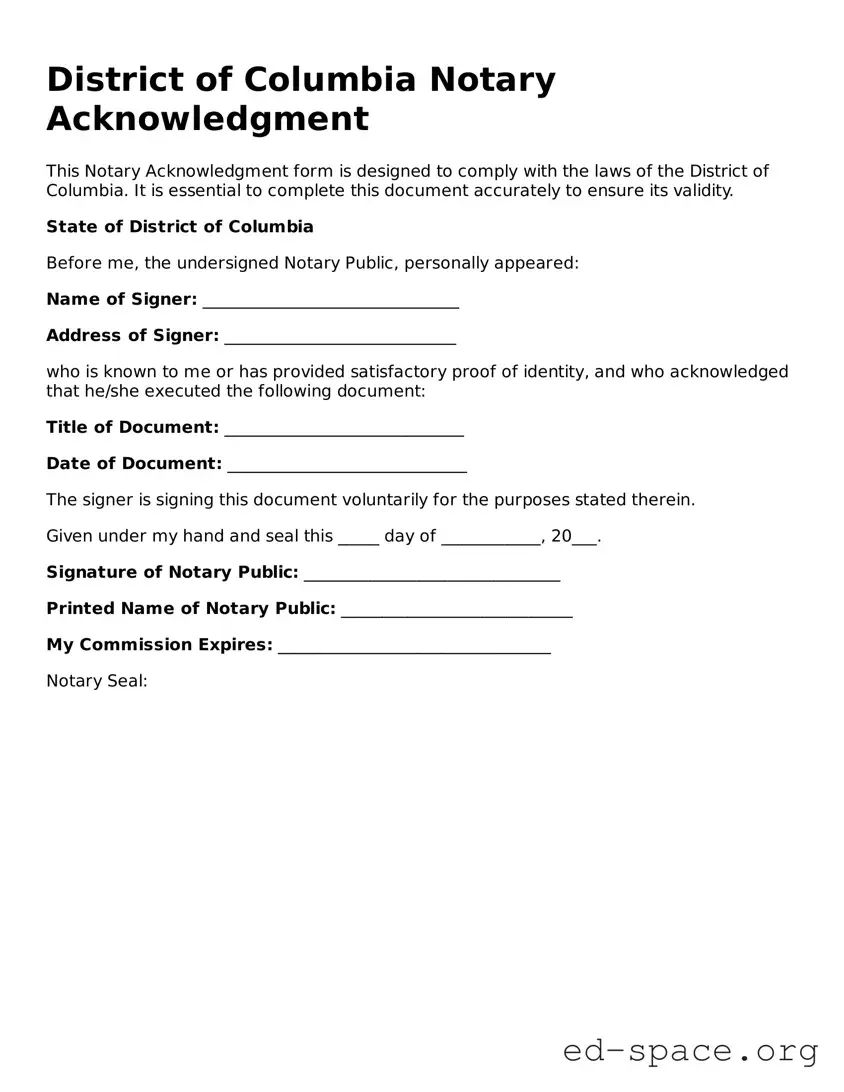
The District of Columbia Notary Acknowledgement form plays a crucial role in various legal and business transactions by providing a means to verify the identity of individuals signing important documents. This form serves as a written declaration that a notary public has witnessed the signing of a document, ensuring that the signatures are authentic and voluntary. It typically includes essential details such as the names of the signers, the date of the acknowledgment, and the notary's official seal. This simple yet vital form helps to prevent fraud and adds a layer of credibility to the documents it accompanies. Understanding the intricacies of this form is essential for anyone involved in real estate transactions, legal agreements, or any situation requiring notarized signatures. By grasping the significance of the Notary Acknowledgement form, individuals can navigate their legal obligations more confidently and ensure that their documents hold up in court or other formal settings.
District of Columbia Notary Acknowledgment
This Notary Acknowledgment form is designed to comply with the laws of the District of Columbia. It is essential to complete this document accurately to ensure its validity.
State of District of Columbia
Before me, the undersigned Notary Public, personally appeared:
Name of Signer: _______________________________
Address of Signer: ____________________________
who is known to me or has provided satisfactory proof of identity, and who acknowledged that he/she executed the following document:
Title of Document: _____________________________
Date of Document: _____________________________
The signer is signing this document voluntarily for the purposes stated therein.
Given under my hand and seal this _____ day of ____________, 20___.
Signature of Notary Public: _______________________________
Printed Name of Notary Public: ____________________________
My Commission Expires: _________________________________
Notary Seal:
| Fact Name | Details |
|---|---|
| Purpose | The District of Columbia Notary Acknowledgement form is used to verify the identity of a signer and confirm their willingness to sign a document. |
| Governing Law | This form is governed by the District of Columbia Notary Public Act, specifically D.C. Code § 1-1231 et seq. |
| Signers | Only individuals who are physically present before the notary can have their signatures acknowledged. |
| Identification | The signer must provide valid identification to the notary at the time of signing. |
| Notary's Role | The notary public must complete the acknowledgment section, which includes their signature and seal. |
| Record Keeping | Notaries are required to maintain a record of all acknowledgments performed in their notary journal. |
| Validity | The acknowledgment remains valid as long as it is executed in accordance with D.C. laws and regulations. |
Once you have obtained the District of Columbia Notary Acknowledgement form, you will need to complete it accurately to ensure it serves its intended purpose. This process involves several straightforward steps, which, when followed carefully, will lead to a properly filled-out form.
With these steps completed, the form will be ready for use. Ensure all information is legible and accurate to avoid any issues in the future.
What is a Notary Acknowledgement form in the District of Columbia?
A Notary Acknowledgement form is a legal document that confirms a person's identity and their willingness to sign a document. In the District of Columbia, this form is often used for various legal transactions, ensuring that the signer is who they claim to be and that they understand the document they are signing.
Who can act as a notary in the District of Columbia?
In the District of Columbia, notaries public must be at least 18 years old, residents or employed in the District, and have completed the necessary application process. They are appointed by the Mayor and must adhere to specific rules and guidelines to maintain their commission.
What documents require a Notary Acknowledgement?
Many legal documents may require a Notary Acknowledgement. Common examples include deeds, powers of attorney, and contracts. However, it is important to check the specific requirements for each document, as not all documents need notarization.
How do I complete a Notary Acknowledgement form?
To complete a Notary Acknowledgement form, the signer must appear before the notary. The signer will need to present valid identification. The notary will then complete the form by filling in details such as the date, location, and the notary’s signature and seal.
Is there a fee for notarization in the District of Columbia?
Yes, notaries in the District of Columbia may charge a fee for their services. The maximum fee that a notary can charge is set by law. It is advisable to confirm the fee with the notary before the appointment to avoid any surprises.
Can a notary refuse to notarize a document?
Yes, a notary can refuse to notarize a document if they believe that the signer is not acting voluntarily, does not understand the document, or if the document appears to be fraudulent. Notaries have a responsibility to ensure that the notarization process is legitimate.
How long is a notary commission valid in the District of Columbia?
A notary commission in the District of Columbia is typically valid for four years. After this period, the notary must apply for renewal to continue performing notarizations.
What should I do if my Notary Acknowledgement is rejected?
If a Notary Acknowledgement is rejected, first check the reason for the rejection. It may be due to missing information or a signature issue. Address the problem and, if necessary, seek the assistance of the notary who performed the acknowledgement to resolve any issues.
Can I notarize a document remotely in the District of Columbia?
Yes, remote notarization is allowed in the District of Columbia. However, it must comply with specific laws and guidelines. The signer and notary must use a secure audio-visual communication platform to complete the notarization process.
Where can I find a notary in the District of Columbia?
Notaries can be found in various locations, including banks, law offices, and public libraries. Additionally, many notaries offer mobile services and can meet clients at their preferred locations. Online directories can also help locate a notary nearby.
Not providing the correct date of the acknowledgment. It’s essential to fill in the date when the notary is performing the acknowledgment. Leaving this blank can lead to confusion about when the document was notarized.
Failing to include the signer’s name clearly. The name of the person signing the document must be legible and match their identification. Any discrepancies can cause issues later on.
Not checking the signature of the signer. The notary must ensure that the signature on the document matches the signature on the identification. This verification is crucial for the validity of the acknowledgment.
Omitting the notary’s seal. The notary’s seal is a vital part of the acknowledgment process. Without it, the document may not be considered valid.
Using an outdated version of the form. Laws and requirements can change, so it’s important to ensure that you are using the most current version of the District of Columbia Notary Acknowledgment form.
Not providing the jurisdiction information. The form requires the notary to indicate where the acknowledgment is taking place. This detail is necessary for the document's legitimacy.
Failing to include the notary’s name and title. The notary must print their name and title clearly on the form. This helps to identify who performed the acknowledgment.
Neglecting to fill out the capacity of the signer. If the signer is acting on behalf of a company or organization, this must be noted. It clarifies the authority of the signer and ensures proper representation.
When engaging in legal transactions or formal agreements in the District of Columbia, several documents often accompany the Notary Acknowledgment form. Each of these documents serves a specific purpose and helps ensure that the transaction is valid and enforceable.
Understanding these documents can help individuals navigate legal processes more effectively. When paired with the Notary Acknowledgment form, they contribute to a robust framework for ensuring that agreements and transactions are legally sound and respected.
The Notary Acknowledgment form serves an important purpose in verifying the identity of signers and confirming their willingness to sign a document. Several other documents share similar functions or characteristics. Here’s a list of eight documents that are comparable to the Notary Acknowledgment form:
Each of these documents plays a crucial role in legal processes, emphasizing the importance of verification and consent, just like the Notary Acknowledgment form.
When filling out the District of Columbia Notary Acknowledgement form, it’s essential to follow specific guidelines to ensure the document is valid and properly executed. Here’s a list of what you should and shouldn’t do:
When it comes to the District of Columbia Notary Acknowledgment form, there are several misconceptions that can lead to confusion. Here’s a breakdown of some common misunderstandings:
Understanding these misconceptions can help ensure that you navigate the notary process more effectively in the District of Columbia.
When filling out and using the District of Columbia Notary Acknowledgement form, consider the following key takeaways: