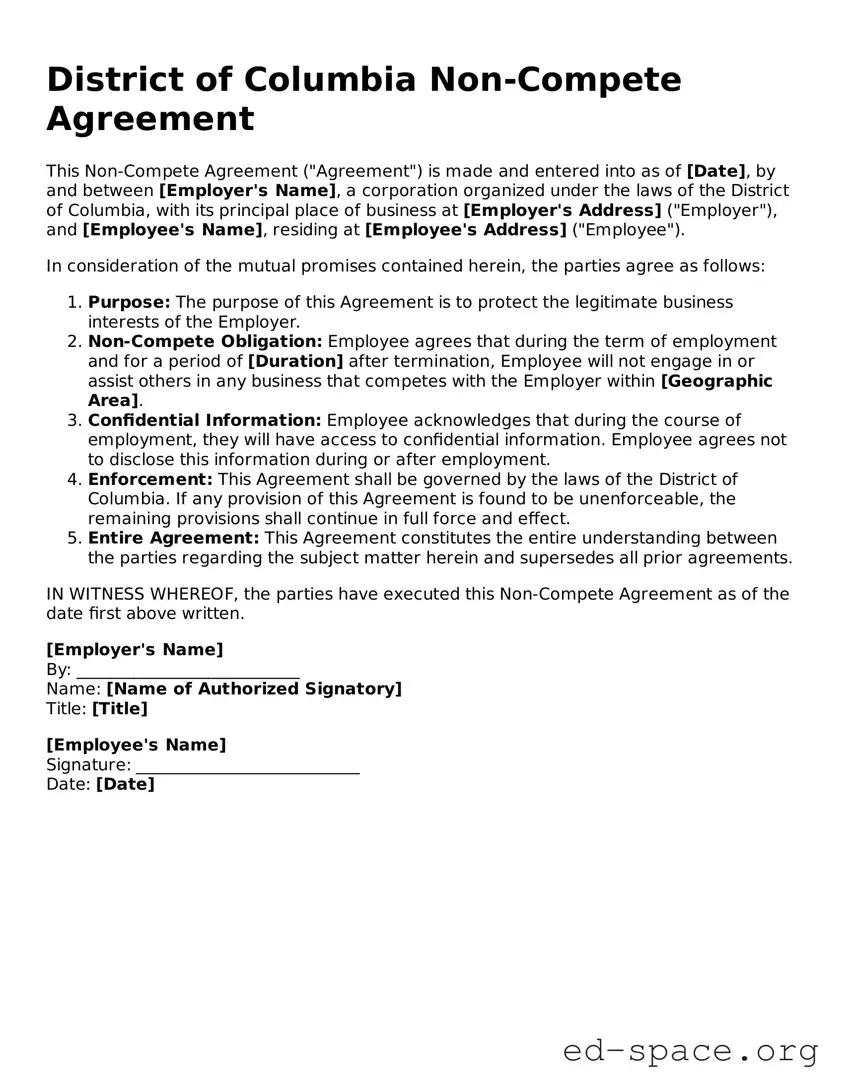
The District of Columbia Non-compete Agreement form serves as a critical tool for employers and employees navigating the complexities of employment contracts. This document outlines the terms under which an employee agrees not to engage in competitive activities within a specified geographic area and time frame after leaving their current position. Key aspects of the form include the definition of "competitive activities," the duration of the non-compete clause, and the geographic scope, all of which must be reasonable and clearly articulated to ensure enforceability. Additionally, the agreement typically addresses considerations such as compensation for the employee during the non-compete period and any exceptions that may apply. Clarity and mutual understanding are essential, as these agreements can significantly impact an individual's future employment opportunities. By establishing fair and transparent terms, both parties can foster a more secure and productive working relationship.
District of Columbia Non-Compete Agreement
This Non-Compete Agreement ("Agreement") is made and entered into as of [Date], by and between [Employer's Name], a corporation organized under the laws of the District of Columbia, with its principal place of business at [Employer's Address] ("Employer"), and [Employee's Name], residing at [Employee's Address] ("Employee").
In consideration of the mutual promises contained herein, the parties agree as follows:
IN WITNESS WHEREOF, the parties have executed this Non-Compete Agreement as of the date first above written.
[Employer's Name]
By: ___________________________
Name: [Name of Authorized Signatory]
Title: [Title]
[Employee's Name]
Signature: ___________________________
Date: [Date]
| Fact Name | Details |
|---|---|
| Governing Law | The District of Columbia governs non-compete agreements under the District of Columbia Code, specifically Title 32, Chapter 5. |
| Enforceability | Non-compete agreements in D.C. are enforceable only if they are reasonable in duration, geographic scope, and the interests they protect. |
| Duration Limit | Typically, a duration of six months to two years is considered reasonable, but this can vary based on the specific circumstances of the employment. |
| Geographic Scope | The geographic area covered by the agreement must be limited to where the employee worked or had a significant presence. |
| Consideration Requirement | For a non-compete agreement to be valid, there must be adequate consideration, such as a job offer or promotion. |
| Public Policy | Non-compete agreements that excessively restrict an individual's right to work may be deemed against public policy and therefore unenforceable. |
Filling out the District of Columbia Non-compete Agreement form is an important step in formalizing the terms of a non-compete arrangement. This process requires careful attention to detail to ensure that all necessary information is accurately provided. After completing the form, it will be essential to review the document for clarity and completeness before submitting it.
What is a Non-compete Agreement in the District of Columbia?
A Non-compete Agreement is a contract between an employer and an employee that restricts the employee from working for competitors or starting a competing business for a specified period after leaving the company. In the District of Columbia, such agreements are subject to specific legal standards to ensure they are fair and reasonable.
Are Non-compete Agreements enforceable in the District of Columbia?
Yes, Non-compete Agreements can be enforceable in the District of Columbia, but they must meet certain criteria. The agreement should protect legitimate business interests, be reasonable in duration and geographic scope, and not impose an undue hardship on the employee. Courts will assess these factors when determining enforceability.
What are the limitations on Non-compete Agreements in D.C.?
In D.C., a Non-compete Agreement cannot be enforced against employees who earn less than a certain salary threshold. As of the latest updates, this threshold is set at $150,000 annually. Additionally, the agreement must not restrict employees from working in their field indefinitely or in an overly broad geographic area.
How long can a Non-compete Agreement last?
The duration of a Non-compete Agreement in D.C. should be reasonable. Typically, courts may find agreements lasting six months to two years to be acceptable, depending on the circumstances of the employment and the nature of the business. An overly long duration may lead to the agreement being deemed unenforceable.
Can an employee negotiate a Non-compete Agreement?
Yes, employees have the right to negotiate the terms of a Non-compete Agreement. It is advisable to discuss any concerns regarding the agreement with the employer before signing. Adjustments can be made to duration, geographic scope, or other terms to ensure they are fair and reasonable.
What happens if I violate a Non-compete Agreement?
If an employee violates a Non-compete Agreement, the employer may take legal action. This could involve seeking an injunction to prevent the employee from working with a competitor or pursuing damages for any losses incurred due to the violation. Legal consequences can vary based on the specifics of the case and the terms of the agreement.
Can a Non-compete Agreement be terminated?
Yes, a Non-compete Agreement can be terminated under certain conditions. For instance, if both parties agree to end the agreement, or if the employer no longer has a legitimate business interest to protect, the agreement may be voided. It is important to have any termination documented in writing.
What should I do if I am asked to sign a Non-compete Agreement?
If you are asked to sign a Non-compete Agreement, it is wise to read the document carefully. Consider consulting with a legal professional who can help you understand the implications and ensure that the terms are fair. Do not hesitate to ask questions or request changes if needed.
Are there any alternatives to Non-compete Agreements?
Yes, there are alternatives to Non-compete Agreements that employers may consider. Non-solicitation agreements, which prevent employees from soliciting clients or employees after leaving, and confidentiality agreements, which protect sensitive business information, are common options that may provide sufficient protection without restricting employment opportunities.
How can I find legal help regarding a Non-compete Agreement?
To find legal assistance with a Non-compete Agreement, consider reaching out to a lawyer who specializes in employment law. They can provide guidance tailored to your specific situation and help you navigate the complexities of the agreement and any potential legal issues.
Failing to read the entire agreement thoroughly before signing. Understanding every clause is crucial.
Not providing accurate personal information. Double-check your name, address, and contact details.
Overlooking the duration of the non-compete clause. Ensure it aligns with your expectations and career plans.
Ignoring the geographic scope of the agreement. Verify that the specified area is reasonable and justifiable.
Neglecting to consult with a legal professional. Seek advice to understand the implications fully.
Not considering the impact on future employment opportunities. Assess how the agreement may limit your options.
Failing to clarify terms that seem vague or ambiguous. Ask for clarification on any points that are unclear.
Signing the agreement under pressure. Take your time to review it without feeling rushed.
Assuming the agreement is standard and cannot be negotiated. Many terms may be open for discussion.
Not keeping a copy of the signed agreement. Retain a record for your reference in the future.
When entering into a Non-compete Agreement in the District of Columbia, several other forms and documents may also be relevant. These documents can help clarify the terms of the agreement, protect intellectual property, and ensure compliance with local laws. Below is a list of commonly used forms that complement a Non-compete Agreement.
Utilizing these documents alongside a Non-compete Agreement can help ensure a comprehensive approach to protecting business interests and maintaining clear expectations between employers and employees. Each form serves a distinct purpose and collectively contributes to a well-structured employment framework.
A Non-compete Agreement is a legal document that restricts an individual's ability to engage in business activities that compete with their employer after leaving the company. Several other documents share similarities with a Non-compete Agreement, as they also aim to protect business interests and intellectual property. Here are five such documents:
When filling out the District of Columbia Non-compete Agreement form, it is essential to approach the task with care. Here are ten guidelines to consider:
Understanding non-compete agreements in the District of Columbia is essential for both employers and employees. However, several misconceptions can lead to confusion and potential legal issues. Here are five common misconceptions:
Addressing these misconceptions is crucial for understanding your rights and obligations. If you find yourself facing a non-compete agreement, consider seeking professional advice to navigate the complexities involved.
When filling out and using the District of Columbia Non-compete Agreement form, it is essential to understand several key points. These takeaways can help ensure that the agreement is both effective and compliant with local laws.