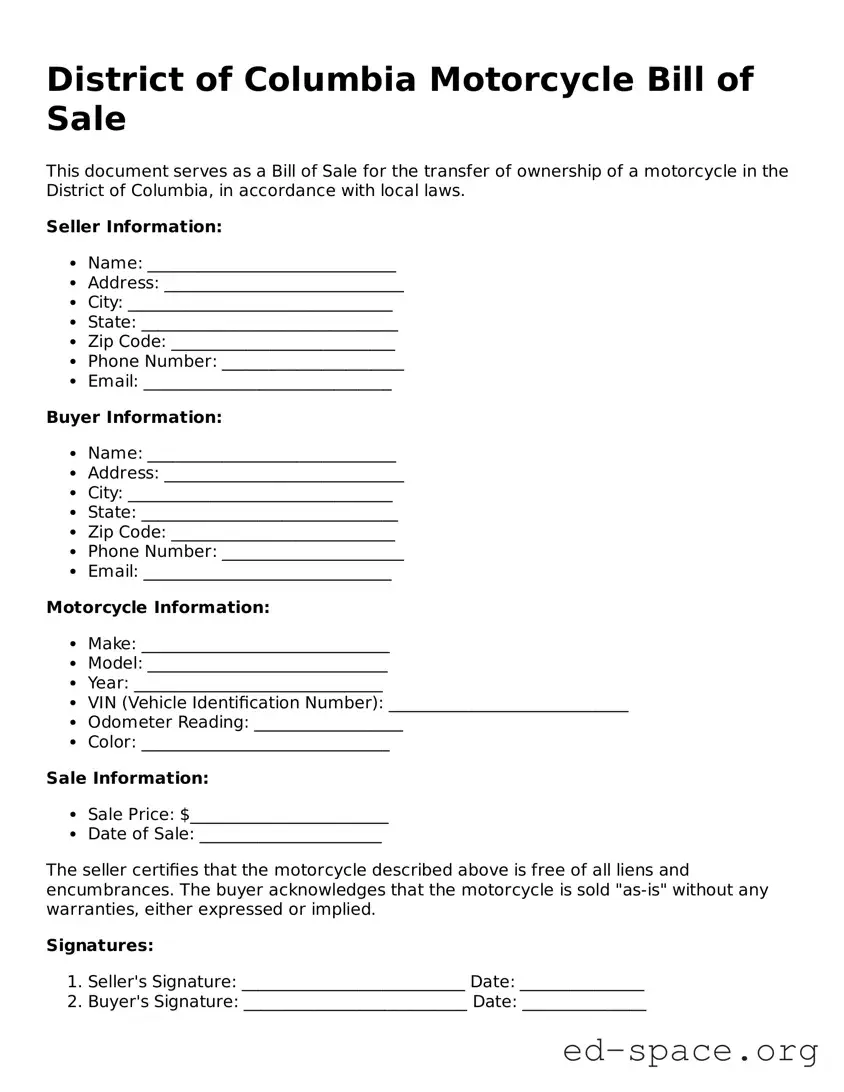
The District of Columbia Motorcycle Bill of Sale form serves as a crucial document in the process of buying or selling a motorcycle. This form not only provides a record of the transaction but also protects both the buyer and the seller by detailing essential information about the motorcycle, including its make, model, year, and Vehicle Identification Number (VIN). Additionally, the form captures the names and addresses of both parties involved in the sale, ensuring that there is a clear chain of ownership. It also includes the sale price and the date of the transaction, which are vital for tax purposes and future registration. By using this form, both parties can confirm that the motorcycle is being sold in its current condition, and any warranties or disclaimers can be noted. Understanding the importance of this document helps facilitate a smooth transfer of ownership while providing legal protection for both the buyer and the seller. Properly filling out the Motorcycle Bill of Sale form can help avoid potential disputes and ensure compliance with local regulations.
District of Columbia Motorcycle Bill of Sale
This document serves as a Bill of Sale for the transfer of ownership of a motorcycle in the District of Columbia, in accordance with local laws.
Seller Information:
Buyer Information:
Motorcycle Information:
Sale Information:
The seller certifies that the motorcycle described above is free of all liens and encumbrances. The buyer acknowledges that the motorcycle is sold "as-is" without any warranties, either expressed or implied.
Signatures:
This Bill of Sale is a legal document that can be used for the transfer of ownership of the motorcycle listed above. It is advisable to keep a copy for your records.
| Fact Name | Description |
|---|---|
| Purpose | The District of Columbia Motorcycle Bill of Sale form serves as a legal document to record the sale of a motorcycle between a buyer and a seller. |
| Governing Law | This form is governed by the laws of the District of Columbia, specifically under Title 50 of the D.C. Code. |
| Required Information | The form typically requires details such as the motorcycle's make, model, year, Vehicle Identification Number (VIN), sale price, and the names and addresses of both parties. |
| Signatures | Both the buyer and seller must sign the form to validate the transaction. This signature indicates agreement to the terms of the sale. |
| Record Keeping | It is advisable for both parties to retain a copy of the completed Bill of Sale for their records, as it may be needed for future reference or registration. |
| Notarization | While notarization is not required for the Bill of Sale in D.C., it can provide an additional layer of authenticity and protection for both parties. |
After gathering all necessary information, you are ready to complete the District of Columbia Motorcycle Bill of Sale form. This form is essential for documenting the sale of a motorcycle and ensuring that both the buyer and seller have a clear record of the transaction.
What is a Motorcycle Bill of Sale in the District of Columbia?
A Motorcycle Bill of Sale is a legal document that records the sale of a motorcycle between a buyer and a seller. It serves as proof of the transaction and includes essential details such as the motorcycle's make, model, year, Vehicle Identification Number (VIN), and the sale price. This document is important for both parties involved in the transaction.
Is a Motorcycle Bill of Sale required in the District of Columbia?
While it is not legally required to have a Motorcycle Bill of Sale in the District of Columbia, it is highly recommended. Having this document protects both the buyer and the seller by providing a clear record of the transaction. It can also be helpful for registration and title transfer purposes.
What information should be included in the Motorcycle Bill of Sale?
The Motorcycle Bill of Sale should include the following information: the names and addresses of both the buyer and seller, the date of the sale, the motorcycle's make, model, year, VIN, odometer reading, sale price, and any warranties or conditions of the sale. Clear and accurate details help avoid disputes in the future.
Do I need to have the Motorcycle Bill of Sale notarized?
No, notarization is not required for a Motorcycle Bill of Sale in the District of Columbia. However, having the document notarized can add an extra layer of protection and authenticity. It can be beneficial if any disputes arise later regarding the sale.
Can I use a generic Bill of Sale template for my motorcycle transaction?
Yes, you can use a generic Bill of Sale template, but it is advisable to ensure that it includes all necessary details specific to motorcycles. Using a tailored Motorcycle Bill of Sale form can help ensure that all pertinent information is covered and that it meets the requirements of the District of Columbia.
What should I do with the Motorcycle Bill of Sale after the transaction?
After completing the transaction, both the buyer and seller should keep a copy of the Motorcycle Bill of Sale for their records. The buyer will need it for registering the motorcycle and obtaining a title. The seller should keep it in case any issues arise regarding the sale in the future.
How does the Motorcycle Bill of Sale affect the title transfer process?
The Motorcycle Bill of Sale is an essential document for the title transfer process. When the buyer goes to register the motorcycle, they will typically need to present the Bill of Sale along with the title. This document proves that the buyer has purchased the motorcycle and is the new owner, facilitating a smooth transfer of ownership.
What if there are issues after the sale?
If any issues arise after the sale, such as disputes over the condition of the motorcycle or payment, the Motorcycle Bill of Sale serves as a reference point. It can help clarify the terms of the sale and protect both parties. If necessary, the parties may seek legal advice to resolve any disputes based on the information documented in the Bill of Sale.
Incomplete Information: Many individuals fail to provide all required details. Ensure that you include the seller's name, buyer's name, and accurate vehicle information.
Incorrect VIN: Double-check the Vehicle Identification Number (VIN). An incorrect VIN can lead to registration issues and delays.
Missing Signatures: Both the seller and buyer must sign the form. Omitting signatures can render the bill of sale invalid.
Failure to Date the Document: Always include the date of the transaction. This is crucial for record-keeping and future reference.
Not Keeping Copies: After filling out the form, make sure to keep copies for both parties. This can help resolve any disputes that may arise later.
The District of Columbia Motorcycle Bill of Sale form is essential for transferring ownership of a motorcycle. However, several other documents often accompany it to ensure a smooth transaction and compliance with local regulations. Below is a list of commonly used forms and documents related to motorcycle sales in the District of Columbia.
Having these documents ready can facilitate the sale process and help avoid potential legal issues down the line. Each form plays a crucial role in ensuring that both the buyer and seller are protected during the transaction.
When filling out the District of Columbia Motorcycle Bill of Sale form, it's important to get it right. Here are some tips to help you through the process.
Many people have misunderstandings about the District of Columbia Motorcycle Bill of Sale form. Here are some common misconceptions:
When filling out and using the District of Columbia Motorcycle Bill of Sale form, keep these key takeaways in mind: