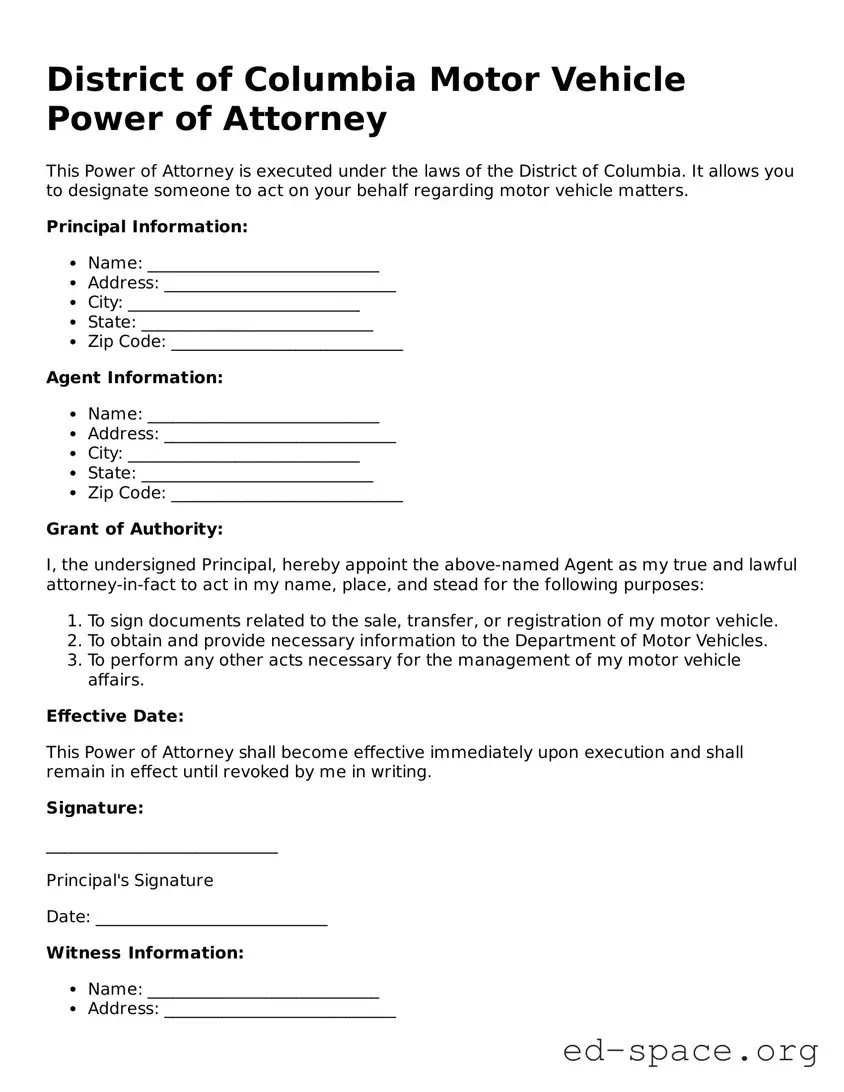
The District of Columbia Motor Vehicle Power of Attorney form is a crucial legal document that enables individuals to delegate authority regarding their motor vehicle transactions to another person. This form is particularly useful for those who may be unable to handle these tasks personally, whether due to time constraints, geographical distance, or other personal reasons. By completing this form, the principal grants specific powers to the agent, allowing them to perform various actions such as registering a vehicle, obtaining titles, or even transferring ownership. It is essential to ensure that the form is filled out accurately and includes all necessary details, such as the names of both the principal and the agent, as well as a clear description of the powers being granted. Additionally, the form must be signed and dated by the principal to be legally binding. Understanding the implications of this document can help individuals make informed decisions about their vehicle-related matters, ensuring that their interests are adequately represented and protected.
District of Columbia Motor Vehicle Power of Attorney
This Power of Attorney is executed under the laws of the District of Columbia. It allows you to designate someone to act on your behalf regarding motor vehicle matters.
Principal Information:
Agent Information:
Grant of Authority:
I, the undersigned Principal, hereby appoint the above-named Agent as my true and lawful attorney-in-fact to act in my name, place, and stead for the following purposes:
Effective Date:
This Power of Attorney shall become effective immediately upon execution and shall remain in effect until revoked by me in writing.
Signature:
____________________________
Principal's Signature
Date: ____________________________
Witness Information:
Notary Public:
State of ________________
County of ________________
Subscribed and sworn to before me this ____ day of __________, 20__.
____________________________
Notary Public Signature
My commission expires: ________________
| Fact Name | Description |
|---|---|
| Definition | The Motor Vehicle Power of Attorney form allows an individual to authorize another person to act on their behalf regarding motor vehicle transactions. |
| Governing Law | This form is governed by the laws of the District of Columbia, specifically the D.C. Code Title 50. |
| Purpose | It is commonly used for tasks such as registering a vehicle, transferring ownership, or obtaining a title. |
| Principal and Agent | The person granting authority is called the principal, while the person receiving authority is the agent. |
| Signature Requirement | The principal must sign the form for it to be valid. Witnesses or notarization may also be required. |
| Revocation | The principal can revoke the power of attorney at any time, as long as they do so in writing. |
| Duration | The power of attorney can be set for a specific time period or remain in effect until revoked. |
| Limitations | The agent's powers can be limited to specific tasks or types of transactions as defined in the form. |
| Filing | While the form does not typically need to be filed with a government agency, it should be kept in a safe place. |
| Legal Advice | It is advisable to seek legal advice when creating a power of attorney to ensure it meets all legal requirements. |
Filling out the District of Columbia Motor Vehicle Power of Attorney form is a straightforward process. Once completed, you will be able to designate someone to act on your behalf in matters related to your vehicle, such as registration or title transfers. Follow these steps to ensure the form is filled out correctly.
After completing the form, you can submit it to the DMV along with any necessary documents. Ensure that the attorney-in-fact is aware of their responsibilities and has the copies of the form for reference.
What is a District of Columbia Motor Vehicle Power of Attorney form?
The District of Columbia Motor Vehicle Power of Attorney form is a legal document that allows an individual, known as the principal, to authorize another person, called the agent, to act on their behalf regarding motor vehicle matters. This can include tasks such as registering a vehicle, transferring ownership, or obtaining a title. The form ensures that the agent has the authority to perform these actions without needing the principal's direct involvement.
Who can serve as an agent on this form?
Any competent adult can serve as an agent on the District of Columbia Motor Vehicle Power of Attorney form. This means the person must be at least 18 years old and mentally capable of making decisions. It is common for individuals to choose trusted friends, family members, or professionals, such as attorneys or financial advisors, to act as their agents.
How do I complete the form?
To complete the form, you will need to provide specific information, including the names and addresses of both the principal and the agent. You must also describe the powers being granted, such as the ability to sign documents or handle transactions related to a specific vehicle. Finally, both parties must sign the form in the presence of a notary public to ensure its validity.
Is notarization required for the form?
Yes, notarization is required for the District of Columbia Motor Vehicle Power of Attorney form. This step is crucial because it verifies the identities of the principal and the agent and confirms that both parties willingly signed the document. Notarization helps prevent fraud and ensures that the form will be accepted by the Department of Motor Vehicles (DMV) and other relevant authorities.
Can I revoke the Power of Attorney once it is signed?
Yes, you can revoke the Power of Attorney at any time, as long as you are mentally competent to do so. To revoke the document, you should create a written notice stating your intention to revoke the Power of Attorney and provide copies to the agent and any institutions or entities that may have relied on the original document. This ensures that everyone is aware of the change and prevents any unauthorized actions by the agent.
What happens if the principal becomes incapacitated?
If the principal becomes incapacitated, the Power of Attorney may still remain in effect unless it is a limited or durable Power of Attorney. A durable Power of Attorney specifically allows the agent to continue acting on behalf of the principal even if they are no longer able to make decisions. It is essential to clearly indicate the type of Power of Attorney when completing the form to avoid confusion in such situations.
Where do I submit the completed form?
The completed District of Columbia Motor Vehicle Power of Attorney form should be submitted to the Department of Motor Vehicles (DMV) when you need to perform any motor vehicle-related transactions. Ensure you keep a copy for your records. Depending on the specific action being taken, additional documentation may be required, so it is advisable to check with the DMV beforehand to ensure a smooth process.
Not specifying the powers granted: Many individuals fail to clearly outline the specific powers they are granting to their agent. This can lead to confusion about what actions the agent can take on their behalf.
Inadequate identification of the principal and agent: It's crucial to provide complete and accurate information about both the person granting the power (the principal) and the person receiving it (the agent). Missing or incorrect details can invalidate the form.
Neglecting to sign and date the form: A common oversight is forgetting to sign and date the document. Without a signature, the form is not legally binding, and the agent cannot act on behalf of the principal.
Failing to have witnesses or notarization when required: Depending on the situation, some forms may require witnesses or notarization. Ignoring these requirements can lead to complications and render the document ineffective.
When dealing with motor vehicle transactions in the District of Columbia, several documents may accompany the Motor Vehicle Power of Attorney form. Each of these documents serves a specific purpose, ensuring that the process runs smoothly and legally. Below is a list of commonly used forms that can enhance the effectiveness of the Power of Attorney.
Using these documents in conjunction with the Motor Vehicle Power of Attorney form can help streamline vehicle transactions and ensure compliance with local regulations. Proper documentation safeguards the interests of all parties involved and facilitates a smoother process.
The Motor Vehicle Power of Attorney form allows an individual to appoint someone else to handle specific vehicle-related matters on their behalf. This document shares similarities with several other legal forms. Here are five documents that are comparable:
When filling out the District of Columbia Motor Vehicle Power of Attorney form, it's important to be careful and thorough. Here are some key things to keep in mind:
By following these guidelines, you can ensure that your Motor Vehicle Power of Attorney form is filled out correctly and efficiently.
Understanding the District of Columbia Motor Vehicle Power of Attorney form is essential for anyone looking to delegate authority regarding vehicle transactions. However, several misconceptions can lead to confusion. Here are seven common misconceptions:
Being informed about these misconceptions can help individuals navigate the Motor Vehicle Power of Attorney process more effectively. Understanding the true nature of this form ensures that vehicle transactions proceed smoothly.
Filling out and utilizing the District of Columbia Motor Vehicle Power of Attorney form is a crucial process for anyone needing to delegate authority regarding vehicle-related matters. Here are five key takeaways to consider:
Taking these steps seriously can help ensure that your vehicle-related matters are handled smoothly and efficiently.