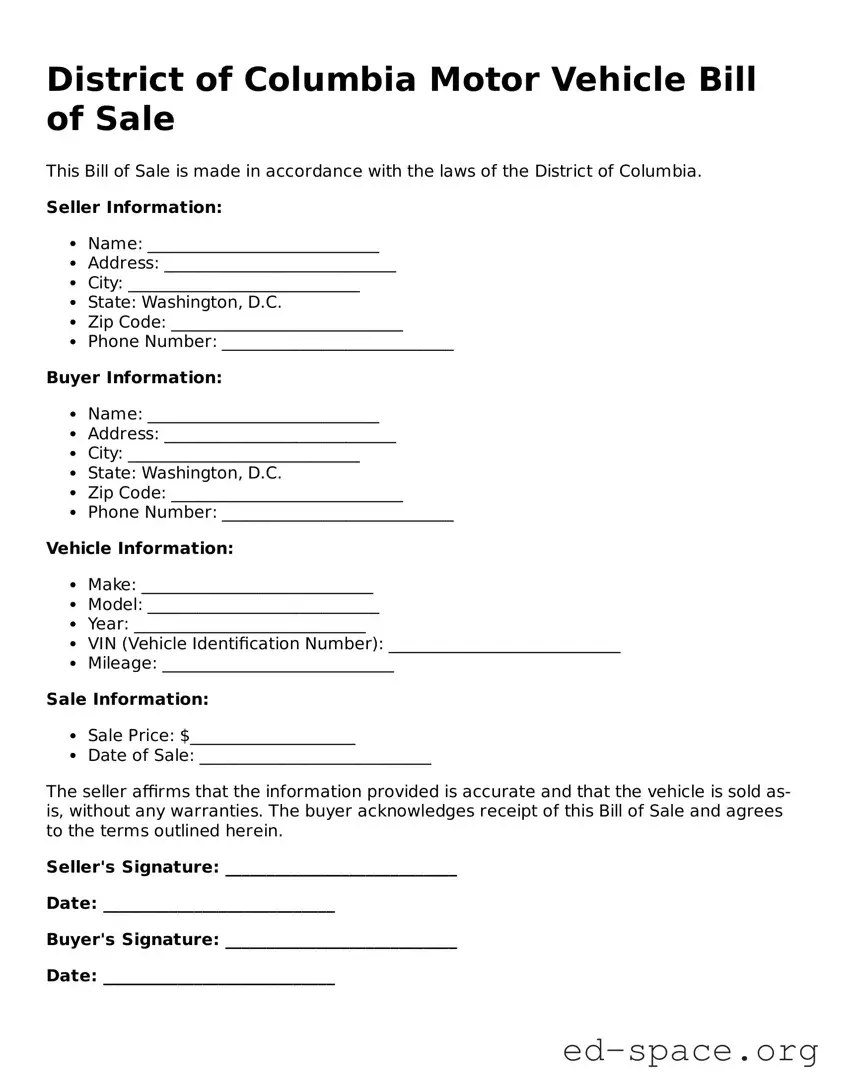
The District of Columbia Motor Vehicle Bill of Sale form serves as a crucial document in the transfer of vehicle ownership between parties. This form captures essential information, including the vehicle's make, model, year, and identification number, ensuring that both the buyer and seller have a clear understanding of the transaction. It also includes details about the sale price, which is vital for tax purposes and registration. Importantly, the form requires signatures from both parties, providing legal protection and clarity. Additionally, it may need to be notarized, depending on the circumstances of the sale. Understanding the intricacies of this form is essential for anyone involved in buying or selling a vehicle in D.C., as it helps prevent disputes and ensures compliance with local regulations.
District of Columbia Motor Vehicle Bill of Sale
This Bill of Sale is made in accordance with the laws of the District of Columbia.
Seller Information:
Buyer Information:
Vehicle Information:
Sale Information:
The seller affirms that the information provided is accurate and that the vehicle is sold as-is, without any warranties. The buyer acknowledges receipt of this Bill of Sale and agrees to the terms outlined herein.
Seller's Signature: ____________________________
Date: ____________________________
Buyer's Signature: ____________________________
Date: ____________________________
| Fact Name | Description |
|---|---|
| Document Purpose | The District of Columbia Motor Vehicle Bill of Sale form serves as a legal record of the transfer of ownership of a motor vehicle. |
| Governing Law | This form is governed by the District of Columbia Code, specifically Title 50, which pertains to motor vehicles. |
| Required Information | The form requires details such as the vehicle identification number (VIN), make, model, year, and odometer reading at the time of sale. |
| Seller and Buyer Information | Both the seller and buyer must provide their names, addresses, and signatures on the form to validate the transaction. |
| Notarization | Notarization is not required for the Bill of Sale in the District of Columbia, but it can add an extra layer of authenticity. |
| Tax Implications | Sales tax may apply based on the sale price of the vehicle, and it is the buyer's responsibility to pay this tax when registering the vehicle. |
| Record Keeping | Both parties should keep a copy of the Bill of Sale for their records, as it may be needed for future reference or disputes. |
| Submission Requirement | While the Bill of Sale is not submitted to the DMV, it is crucial for the buyer when applying for a new title and registration. |
| Use for Gift Transfers | The Bill of Sale can also be used for gifting a vehicle, but it must still include all required information and signatures. |
Once you have obtained the District of Columbia Motor Vehicle Bill of Sale form, you are ready to fill it out. This form is essential for documenting the sale of a vehicle and ensuring that both the buyer and seller have a clear record of the transaction. Follow the steps below to complete the form accurately.
After completing the form, both parties should keep a copy for their records. This ensures that there is proof of the sale, which can be important for future reference, especially for registration and title transfer purposes.
What is a Motor Vehicle Bill of Sale in the District of Columbia?
A Motor Vehicle Bill of Sale is a legal document that records the sale of a vehicle between a buyer and a seller. In the District of Columbia, this form serves as proof of the transaction, detailing the vehicle's make, model, year, and Vehicle Identification Number (VIN). It protects both parties by providing a written record of the sale and the agreed-upon terms.
Is a Bill of Sale required for vehicle transactions in Washington, D.C.?
While it is not legally required to have a Bill of Sale for every vehicle transaction in Washington, D.C., it is highly recommended. This document can help clarify the terms of the sale and provide evidence of ownership transfer, which can be useful for future registrations or if disputes arise.
What information should be included in the Bill of Sale?
The Bill of Sale should include essential details such as the full names and addresses of both the buyer and seller, the date of the sale, the vehicle's make, model, year, and VIN. Additionally, it should specify the purchase price and any conditions of the sale, such as whether the vehicle is sold "as-is" or if any warranties apply.
How do I obtain a Bill of Sale form in D.C.?
You can obtain a Bill of Sale form through various sources. Many websites offer free templates that you can fill out. Additionally, local Department of Motor Vehicles (DMV) offices may provide printed forms. It is important to ensure that any form used complies with D.C. regulations.
Do I need to have the Bill of Sale notarized?
In Washington, D.C., notarization of the Bill of Sale is not a requirement. However, having the document notarized can add an extra layer of security and authenticity. It may also be beneficial if the buyer or seller needs to prove the legitimacy of the transaction in the future.
What should I do with the Bill of Sale after the transaction?
After completing the transaction, both the buyer and seller should keep a copy of the Bill of Sale for their records. The buyer will need it for vehicle registration and title transfer at the DMV. Keeping this document can help resolve any potential disputes regarding ownership or payment in the future.
Can a Bill of Sale be used for vehicles purchased from a dealership?
Yes, a Bill of Sale can also be used for vehicles purchased from a dealership. In such cases, the dealership typically provides a Bill of Sale as part of the sales process. This document will include similar information, detailing the vehicle and the terms of the sale, ensuring that the buyer has proof of purchase.
Failing to include the date of sale. This is crucial as it establishes when the transaction occurred.
Not providing accurate vehicle identification information. This includes the VIN (Vehicle Identification Number), make, model, and year of the vehicle.
Leaving out the seller’s and buyer’s information. Full names, addresses, and contact details should be clearly written to avoid confusion.
Using incorrect purchase price. Ensure that the price reflects the agreed amount to prevent disputes later on.
Not signing the document. Both the seller and buyer must sign the Bill of Sale for it to be valid.
Overlooking the odometer reading. This is important for tracking the vehicle’s mileage and condition.
Failing to specify whether the vehicle is being sold as-is or with warranties. This clarification can protect both parties.
Neglecting to make copies of the completed form. Both the seller and buyer should keep a copy for their records.
Not checking for any state-specific requirements. Each state may have additional regulations or forms that need to be completed.
When buying or selling a vehicle in the District of Columbia, several important documents accompany the Motor Vehicle Bill of Sale. These documents help ensure a smooth transaction and provide necessary information for both parties involved. Below is a list of other forms and documents that are often used in conjunction with the Bill of Sale.
Having these documents ready can simplify the buying or selling process and protect both parties. Ensuring that all paperwork is completed accurately can help avoid future disputes and facilitate a smooth transfer of ownership.
Real Estate Purchase Agreement: Similar to the Motor Vehicle Bill of Sale, this document outlines the terms and conditions of a real estate transaction. Both forms serve as a legal record of the transfer of ownership from one party to another.
Boat Bill of Sale: Just like the Motor Vehicle Bill of Sale, this document is used to transfer ownership of a boat. It includes details such as the boat's identification number and the sale price, ensuring clarity in the transaction.
Aircraft Bill of Sale: This document serves a similar purpose for aircraft as the Motor Vehicle Bill of Sale does for vehicles. It provides proof of ownership transfer and includes specific details about the aircraft.
Personal Property Bill of Sale: This form is used for the sale of various personal items, including furniture or electronics. Like the Motor Vehicle Bill of Sale, it outlines the buyer and seller's information and the item being sold.
Business Asset Purchase Agreement: When businesses buy or sell assets, this document is essential. It details the assets involved, similar to how the Motor Vehicle Bill of Sale details the vehicle being transferred.
Lease Agreement: While primarily used for renting property, a lease agreement can also include terms for purchase options. This is akin to the Motor Vehicle Bill of Sale, which may involve financing or payment terms.
Gift Receipt: When a vehicle is given as a gift, a gift receipt can serve a similar purpose to a Bill of Sale. It documents the transfer of ownership without a monetary exchange, just as the Bill of Sale does for a purchase.
When filling out the District of Columbia Motor Vehicle Bill of Sale form, it is essential to be thorough and accurate. This document serves as a crucial record of the transaction between the buyer and the seller. Here are some important dos and don'ts to keep in mind:
By following these guidelines, you can ensure a smooth transaction and protect the interests of both the buyer and the seller.
The District of Columbia Motor Vehicle Bill of Sale form is often misunderstood. Here are some common misconceptions that people have:
Understanding these misconceptions can help ensure a smoother vehicle transaction process in the District of Columbia.
When dealing with the District of Columbia Motor Vehicle Bill of Sale form, it's essential to understand its purpose and how to complete it correctly. Here are some key takeaways to keep in mind:
By following these key points, you can ensure a smoother transaction when buying or selling a vehicle in the District of Columbia.