In the heart of the nation, the District of Columbia Medical Power of Attorney form serves as a vital tool for individuals seeking to ensure their healthcare wishes are honored when they cannot speak for themselves. This legal document empowers a trusted person, known as an agent, to make medical decisions on behalf of the individual, providing peace of mind during challenging times. It outlines specific preferences regarding treatment options, life-sustaining measures, and end-of-life care, reflecting the individual's values and desires. Importantly, the form must be completed with careful attention to detail, including the selection of a suitable agent, the inclusion of any specific instructions, and the requirement for signatures from witnesses or a notary. Understanding the nuances of this form is crucial for anyone looking to navigate the complexities of healthcare decisions in the District of Columbia, ensuring that their voice is heard even when they are unable to communicate it themselves.
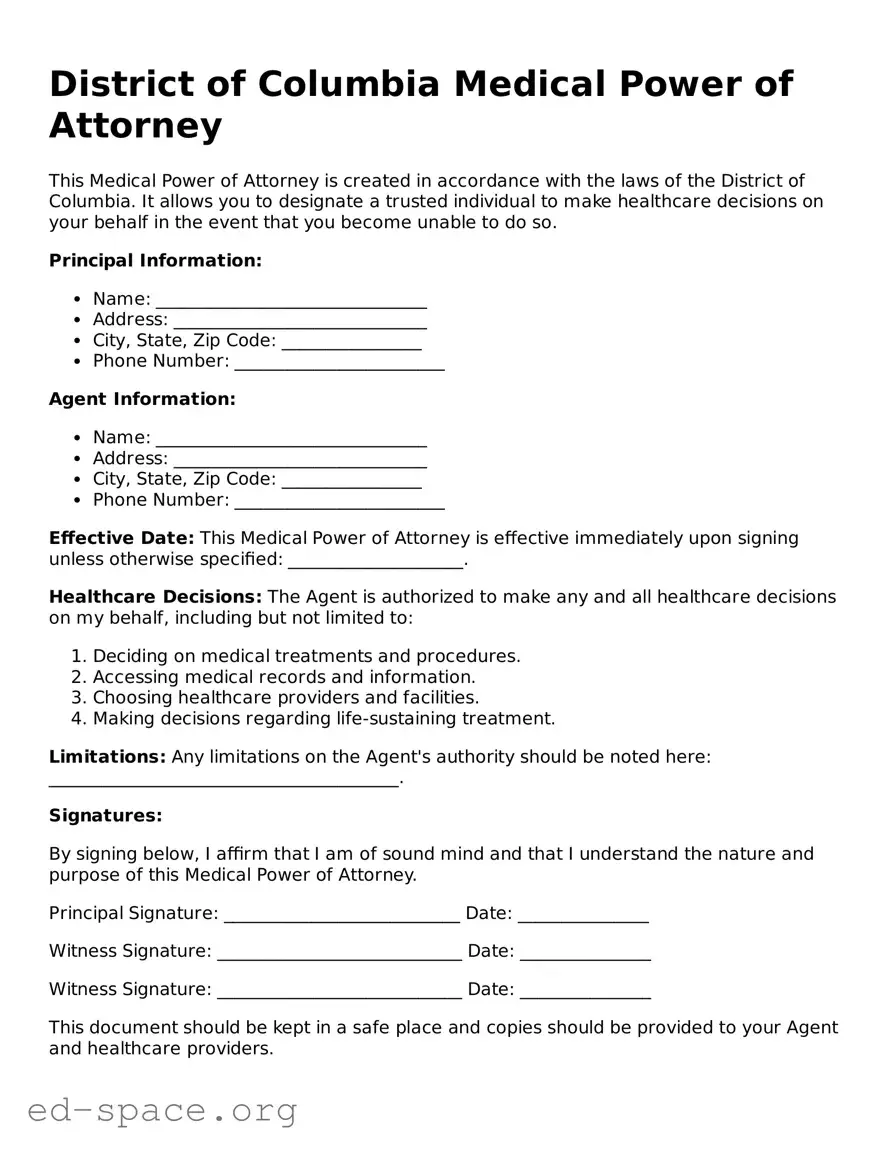
District of Columbia Medical Power of Attorney
This Medical Power of Attorney is created in accordance with the laws of the District of Columbia. It allows you to designate a trusted individual to make healthcare decisions on your behalf in the event that you become unable to do so.
Principal Information:
Agent Information:
Effective Date: This Medical Power of Attorney is effective immediately upon signing unless otherwise specified: ____________________.
Healthcare Decisions: The Agent is authorized to make any and all healthcare decisions on my behalf, including but not limited to:
Limitations: Any limitations on the Agent's authority should be noted here: ________________________________________.
Signatures:
By signing below, I affirm that I am of sound mind and that I understand the nature and purpose of this Medical Power of Attorney.
Principal Signature: ___________________________ Date: _______________
Witness Signature: ____________________________ Date: _______________
Witness Signature: ____________________________ Date: _______________
This document should be kept in a safe place and copies should be provided to your Agent and healthcare providers.
| Fact Name | Details |
|---|---|
| Definition | A Medical Power of Attorney allows an individual to designate someone to make healthcare decisions on their behalf if they become unable to do so. |
| Governing Law | The Medical Power of Attorney in the District of Columbia is governed by the District of Columbia Code, specifically Title 21, Chapter 22. |
| Eligibility | Any competent adult can create a Medical Power of Attorney, as long as they are of sound mind when signing the document. |
| Agent Requirements | The appointed agent must be at least 18 years old and should not be the individual’s healthcare provider or an employee of the healthcare provider. |
| Durability | This document remains effective even if the principal becomes incapacitated, ensuring that decisions can be made at critical times. |
| Revocation | A Medical Power of Attorney can be revoked at any time by the principal, provided they communicate their decision clearly. |
| Witnesses | In the District of Columbia, the signing of the Medical Power of Attorney must be witnessed by two individuals who are not related to the principal. |
Completing the District of Columbia Medical Power of Attorney form is an important step in ensuring your healthcare decisions are honored when you are unable to communicate them. Follow these steps carefully to ensure the form is filled out correctly.
What is a Medical Power of Attorney in the District of Columbia?
A Medical Power of Attorney is a legal document that allows an individual, known as the principal, to designate another person, called an agent, to make healthcare decisions on their behalf if they become unable to make those decisions themselves. This can include decisions about medical treatments, surgeries, and end-of-life care. In the District of Columbia, this document is essential for ensuring that a person's healthcare preferences are respected when they are incapacitated.
Who can be appointed as an agent in a Medical Power of Attorney?
In the District of Columbia, any competent adult can be appointed as an agent in a Medical Power of Attorney. This could be a family member, a close friend, or another trusted individual. It is important to choose someone who understands your values and wishes regarding medical treatment. The agent should be willing to advocate for your healthcare preferences and make decisions based on your best interests.
How does one create a Medical Power of Attorney in the District of Columbia?
To create a Medical Power of Attorney in the District of Columbia, the principal must fill out a specific form that outlines their wishes and the designated agent's authority. The form must be signed by the principal and witnessed by at least two individuals who are not related to the principal or the agent. Alternatively, the document can be notarized. It is advisable to keep copies of the signed document in accessible locations and to provide a copy to the appointed agent and healthcare providers.
Can a Medical Power of Attorney be revoked?
Yes, a Medical Power of Attorney can be revoked at any time by the principal, as long as they are still competent to make decisions. To revoke the document, the principal should notify the agent and any healthcare providers who have a copy of the original document. It is recommended to do this in writing to avoid any confusion. After revocation, the principal may choose to create a new Medical Power of Attorney if they wish to designate a different agent.
What happens if a Medical Power of Attorney is not in place?
If a Medical Power of Attorney is not in place and an individual becomes incapacitated, decisions about their healthcare may be made by family members or healthcare providers, but this can lead to disagreements or confusion. In some cases, a court may need to appoint a guardian to make decisions on behalf of the individual. This process can be lengthy and may not reflect the individual's personal wishes regarding their medical care.
Is a Medical Power of Attorney the same as a living will?
No, a Medical Power of Attorney and a living will are not the same, although they both relate to healthcare decisions. A Medical Power of Attorney designates an agent to make decisions on behalf of the principal, while a living will outlines the principal's wishes regarding specific medical treatments and end-of-life care. Many individuals choose to have both documents to ensure comprehensive planning for their healthcare preferences.
Not Specifying a Primary Agent: One common mistake is failing to designate a primary agent. This person will make medical decisions on your behalf if you are unable to do so. Without a clear choice, there may be confusion about who should act in your best interest.
Neglecting Alternate Agents: It’s important to name alternate agents in case your primary agent is unavailable. Many people overlook this step, which can lead to delays in decision-making during critical times.
Using Vague Language: Being unclear about your wishes can create problems. Avoid ambiguous phrases. Instead, be specific about the types of medical treatments you would or would not want.
Failing to Sign and Date the Form: A Medical Power of Attorney is not valid unless it is signed and dated. Some individuals forget this crucial step, rendering their document ineffective.
Not Having Witnesses or Notarization: Depending on the requirements in the District of Columbia, your form may need to be signed in the presence of witnesses or a notary. Skipping this step can invalidate the document.
Ignoring State-Specific Requirements: Each state has unique laws regarding Medical Power of Attorney forms. Failing to comply with District of Columbia regulations can lead to complications when the document is needed.
Not Reviewing the Document Regularly: Life circumstances change. Failing to review and update your Medical Power of Attorney can result in decisions being made that no longer reflect your current wishes.
The District of Columbia Medical Power of Attorney form is an important document that allows individuals to designate someone to make medical decisions on their behalf if they are unable to do so. Along with this form, several other documents may be relevant to ensure comprehensive healthcare planning. Below is a list of forms and documents that are often used in conjunction with the Medical Power of Attorney.
These documents collectively contribute to a comprehensive approach to healthcare decision-making. It is advisable to consult with a qualified professional when preparing these forms to ensure that they reflect personal wishes and comply with legal requirements.
The Medical Power of Attorney (MPOA) is an important legal document that allows individuals to designate someone to make healthcare decisions on their behalf if they become unable to do so. While the MPOA serves a unique purpose, it shares similarities with several other legal documents. Here are nine documents that are comparable to the Medical Power of Attorney:
Understanding these documents and their similarities can empower individuals to make informed decisions about their healthcare and legal preferences. Each serves a unique role, yet they all share the common goal of ensuring that a person's wishes are respected, especially in times of crisis.
When filling out the District of Columbia Medical Power of Attorney form, it's essential to approach the task with care. Below is a list of things you should and shouldn't do to ensure that the document is completed correctly and serves its intended purpose.
Taking these steps can help ensure that your Medical Power of Attorney form is filled out correctly, allowing your healthcare preferences to be honored when you cannot express them yourself.
Understanding the District of Columbia Medical Power of Attorney form is crucial for anyone looking to make informed decisions about their healthcare. However, several misconceptions often cloud the public's understanding of this important document. Here are seven common misconceptions:
It only applies to terminal illnesses. Many people believe that a Medical Power of Attorney is only necessary when facing terminal conditions. In reality, this document can be essential for any situation where an individual may be unable to communicate their healthcare wishes, regardless of the severity of their condition.
Anyone can act as a healthcare agent. While it may seem straightforward, not everyone is eligible to serve as a healthcare agent. The chosen agent must be an adult and should ideally be someone who understands the individual's values and wishes regarding medical treatment.
It overrides all personal wishes. Some people mistakenly think that once they sign a Medical Power of Attorney, their agent can make any decision without considering their preferences. However, the agent is legally bound to follow the wishes outlined in the document and to act in the best interests of the individual.
It is permanent and cannot be changed. This form is not set in stone. Individuals can revoke or modify their Medical Power of Attorney at any time, as long as they are mentally competent to do so. Regularly reviewing and updating the document is a good practice.
It is only necessary for older adults. Many people associate Medical Powers of Attorney with aging or end-of-life planning. However, anyone over the age of 18 can benefit from having this document in place, as unexpected medical emergencies can occur at any age.
It is the same as a Living Will. While both documents relate to healthcare decisions, they serve different purposes. A Living Will outlines specific wishes regarding medical treatment in end-of-life situations, whereas a Medical Power of Attorney designates someone to make decisions on your behalf when you cannot.
It is not legally binding. Some individuals may believe that a Medical Power of Attorney holds no legal weight. In fact, when properly executed, this document is legally binding and must be honored by healthcare providers, making it a vital tool for ensuring that one's healthcare preferences are respected.
By debunking these misconceptions, individuals can better navigate the complexities of healthcare decision-making and ensure their wishes are honored in times of need.
When filling out and using the District of Columbia Medical Power of Attorney form, keep the following key points in mind: