Homepage Free Marital Separation Agreement Form for District of Columbia
Content Overview

When couples in the District of Columbia decide to separate, navigating the emotional and practical aspects of that decision can be challenging. One essential tool that can help clarify the terms of separation is the Marital Separation Agreement form. This document outlines various important aspects of the separation, such as the division of property, child custody arrangements, and spousal support. By detailing these agreements in writing, both parties can establish clear expectations and responsibilities moving forward. The form also serves as a legal record, which can be crucial in the event of future disputes. Understanding the components of this agreement is vital for anyone considering separation, as it can provide a sense of security and direction during a tumultuous time. Whether you are amicably parting ways or facing more complex issues, having a comprehensive separation agreement can facilitate a smoother transition and help maintain a respectful relationship post-separation.

Document Preview

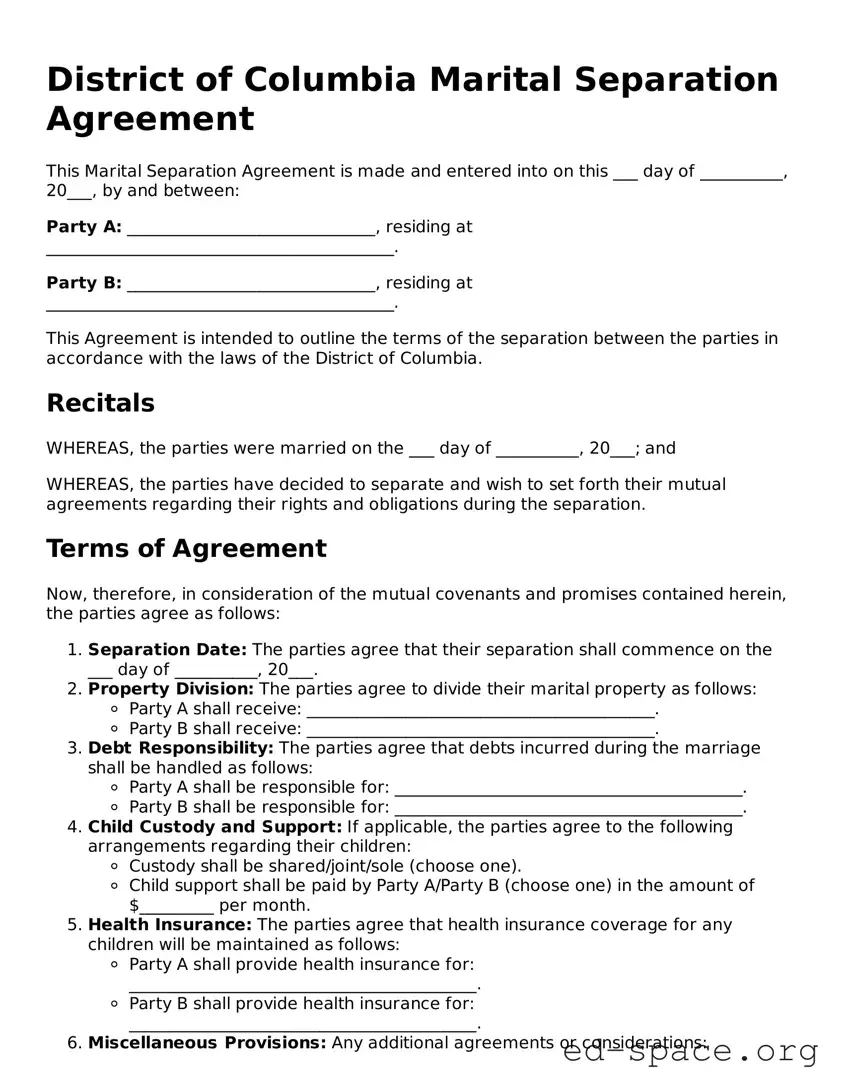
District of Columbia Marital Separation Agreement

This Marital Separation Agreement is made and entered into on this ___ day of __________, 20___, by and between:

Party A: ______________________________, residing at __________________________________________.

Party B: ______________________________, residing at __________________________________________.

This Agreement is intended to outline the terms of the separation between the parties in accordance with the laws of the District of Columbia.

Recitals

WHEREAS, the parties were married on the ___ day of __________, 20___; and

WHEREAS, the parties have decided to separate and wish to set forth their mutual agreements regarding their rights and obligations during the separation.

Terms of Agreement

Now, therefore, in consideration of the mutual covenants and promises contained herein, the parties agree as follows:

  1. Separation Date: The parties agree that their separation shall commence on the ___ day of __________, 20___.
  2. Property Division: The parties agree to divide their marital property as follows:
    • Party A shall receive: __________________________________________.
    • Party B shall receive: __________________________________________.
  3. Debt Responsibility: The parties agree that debts incurred during the marriage shall be handled as follows:
    • Party A shall be responsible for: __________________________________________.
    • Party B shall be responsible for: __________________________________________.
  4. Child Custody and Support: If applicable, the parties agree to the following arrangements regarding their children:
    • Custody shall be shared/joint/sole (choose one).
    • Child support shall be paid by Party A/Party B (choose one) in the amount of $_________ per month.
  5. Health Insurance: The parties agree that health insurance coverage for any children will be maintained as follows:
    • Party A shall provide health insurance for: __________________________________________.
    • Party B shall provide health insurance for: __________________________________________.
  6. Miscellaneous Provisions: Any additional agreements or considerations:
    • ______________________________________________________________________________.
    • ______________________________________________________________________________.

This Agreement shall be binding upon the parties and their respective heirs, executors, and assigns. Both parties acknowledge that they have had the opportunity to consult with independent legal counsel before signing this Agreement.

IN WITNESS WHEREOF, the parties have executed this Marital Separation Agreement as of the day and year first above written.

Party A Signature: ________________________________ Date: _______________

Party B Signature: ________________________________ Date: _______________

PDF Form Details

Fact Name Details
Definition A Marital Separation Agreement is a legal document outlining the terms of separation between spouses.
Governing Law The agreement is governed by the laws of the District of Columbia.
Purpose It serves to clarify rights and responsibilities regarding property, debts, and child custody.
Voluntary Nature Both parties must voluntarily agree to the terms outlined in the agreement.
Written Document The agreement must be in writing to be enforceable in court.
Child Custody Provisions It can include specific arrangements for child custody and visitation rights.
Property Division The agreement can detail how marital property and debts will be divided.
Legal Representation It is advisable for each party to seek independent legal counsel before signing.
Modification The agreement can be modified if both parties consent in writing.
Enforceability If properly executed, it is enforceable in the District of Columbia courts.

District of Columbia Marital Separation Agreement: Usage Guidelines

After obtaining the District of Columbia Marital Separation Agreement form, you will need to carefully fill it out to ensure that all necessary information is included. This form is essential for outlining the terms of your separation and will guide the next steps in your legal process.

  1. Begin by entering the date at the top of the form.
  2. Provide your full name and address in the designated sections. Make sure to include your current contact information.
  3. Next, enter your spouse's full name and address in the appropriate fields.
  4. Specify the date of your marriage. This should be the official date recorded on your marriage certificate.
  5. Indicate the date of separation. This is the date when you and your spouse began living apart.
  6. List any children from the marriage, including their names and birth dates. This information is crucial for custody and support considerations.
  7. Detail the terms of property division. Clearly outline how you and your spouse will divide assets and debts.
  8. Discuss any alimony or spousal support arrangements. Specify the amount and duration if applicable.
  9. Review the section on child support, including the amount and frequency of payments.
  10. Include any other agreements that you and your spouse have made regarding your separation.
  11. Sign and date the form at the bottom. Both parties should sign to indicate mutual agreement.

Once the form is completed, it should be filed with the appropriate court in the District of Columbia. Be sure to keep copies for your records and provide any required documentation to accompany your filing.

Your Questions, Answered

What is a Marital Separation Agreement in the District of Columbia?

A Marital Separation Agreement is a legal document that outlines the terms and conditions under which a couple will live separately while still legally married. It can cover various aspects, including division of property, child custody, and support obligations. This agreement helps both parties understand their rights and responsibilities during the separation period.

Do I need an attorney to create a Marital Separation Agreement?

While it is not legally required to have an attorney to draft a Marital Separation Agreement, it is highly recommended. An attorney can ensure that the agreement complies with local laws and adequately protects your interests. Having professional guidance can also help prevent potential disputes in the future.

How is property divided in a Marital Separation Agreement?

The agreement should specify how marital property will be divided between the spouses. This can include real estate, bank accounts, and personal belongings. Both parties need to agree on the division to avoid conflicts later. If the couple cannot reach an agreement, the court may intervene to determine the division based on equitable distribution laws.

Can a Marital Separation Agreement be modified?

Yes, a Marital Separation Agreement can be modified if both parties agree to the changes. It is essential to document any modifications in writing and have both parties sign the updated agreement. This ensures that any changes are legally binding and enforceable.

What happens if one party violates the Marital Separation Agreement?

If one party fails to comply with the terms of the agreement, the other party can seek legal recourse. This may involve filing a motion with the court to enforce the agreement. It is crucial to keep records of any violations to support your case if legal action becomes necessary.

Common mistakes

  1. Incomplete Information: One common mistake is failing to provide all necessary details. This includes names, addresses, and dates. Omitting even one piece of information can lead to delays.

  2. Not Seeking Legal Advice: Many individuals attempt to fill out the form without consulting a lawyer. This can result in misunderstandings about rights and obligations, which may affect the outcome.

  3. Ignoring State Requirements: Each state has specific requirements for separation agreements. Not adhering to these can render the agreement invalid. It's essential to understand what is required in the District of Columbia.

  4. Failing to Address All Issues: Some people overlook important topics such as child custody, support, and property division. Each of these areas needs to be clearly defined to avoid future disputes.

  5. Not Signing the Agreement: A completed form without signatures is not legally binding. Both parties must sign the agreement for it to be effective, so it's crucial to remember this step.

Documents used along the form

When navigating the complexities of a marital separation in the District of Columbia, several important documents may accompany the Marital Separation Agreement. Each of these forms serves a specific purpose and can help clarify rights and responsibilities during this transitional period.

  • Separation Notice: This document formally informs your spouse of your intention to separate. It can help establish a clear timeline and may be necessary for legal proceedings.
  • Child Custody Agreement: If children are involved, this agreement outlines the arrangements for their care, including physical and legal custody, visitation schedules, and decision-making responsibilities.
  • Child Support Agreement: This form details the financial obligations each parent has towards their children. It includes the amount of support, payment frequency, and any additional expenses such as medical or educational costs.
  • Property Division Agreement: This document addresses how marital assets and debts will be divided. It is crucial for ensuring both parties understand their rights regarding property ownership.
  • Spousal Support Agreement: This outlines any financial support one spouse may provide to the other after separation. It can specify the amount, duration, and conditions of support.
  • Parenting Plan: A detailed plan that includes parenting time, communication methods, and how to handle disputes regarding the children. This document promotes cooperation and stability for the children.
  • Financial Disclosure Statement: This form requires both parties to disclose their financial information. Transparency is essential for fair negotiations regarding support and property division.
  • Final Divorce Decree: This is the official court order that finalizes the divorce. It incorporates the terms of the separation agreement and any other related agreements.

Each of these documents plays a vital role in ensuring that both parties understand their rights and responsibilities during a marital separation. It is essential to approach this process thoughtfully and carefully to protect your interests and those of any children involved.

Similar forms

  • Separation Agreement: Similar to a marital separation agreement, this document outlines the terms of separation between spouses, including asset division and support obligations.
  • Divorce Settlement Agreement: This document finalizes the terms of a divorce, detailing property division, alimony, and child custody arrangements, much like a marital separation agreement.
  • Child Custody Agreement: Focused specifically on the custody of children, this agreement specifies living arrangements and visitation rights, paralleling aspects of a marital separation agreement related to children.
  • Property Settlement Agreement: This document addresses the division of marital property and debts, similar to the property-related provisions found in a marital separation agreement.
  • Spousal Support Agreement: This agreement outlines financial support from one spouse to another, akin to the support provisions often included in a marital separation agreement.
  • Postnuptial Agreement: Created after marriage, this document sets forth terms for asset division and support in the event of separation or divorce, sharing similarities with a marital separation agreement.
  • Prenuptial Agreement: Established before marriage, this document outlines the division of assets and debts, serving a similar purpose to a marital separation agreement in the context of separation.
  • Memorandum of Understanding: This document can outline the intentions and agreements between parties, often addressing similar issues as a marital separation agreement.
  • Child Support Agreement: This document specifically addresses financial obligations for child support, paralleling the child-related aspects of a marital separation agreement.

Dos and Don'ts

When filling out the District of Columbia Marital Separation Agreement form, it's important to approach the process carefully. Here are five things you should and shouldn't do:

  • Do read the entire form thoroughly before starting. Understanding what is required will save you time and avoid mistakes.
  • Don't rush through the form. Take your time to ensure that all information is accurate and complete.
  • Do consult with a legal expert if you have questions. Getting professional advice can clarify any uncertainties.
  • Don't leave any sections blank. If a section doesn't apply to you, write "N/A" instead of skipping it.
  • Do keep a copy of the completed form for your records. This can be useful for future reference.

By following these guidelines, you can ensure that your submission is handled smoothly and efficiently.

Misconceptions

When it comes to the District of Columbia Marital Separation Agreement form, there are several misconceptions that can lead to confusion. Understanding these misconceptions is crucial for anyone considering a separation. Here’s a breakdown of seven common misunderstandings:

  1. It's the same as a divorce. Many people think a marital separation agreement is just a step toward divorce. In reality, it’s a separate legal document that outlines the terms of separation without terminating the marriage.
  2. It’s only for couples with children. Some believe that only couples with children need a separation agreement. However, this form can be beneficial for any couple looking to clarify their rights and responsibilities during separation.
  3. It’s not legally binding. There’s a misconception that these agreements have no legal weight. In fact, once signed, a marital separation agreement can be enforceable in court, provided it meets certain legal standards.
  4. All assets are automatically divided. Many assume that simply signing a separation agreement divides assets. However, the agreement must explicitly state how assets and debts will be divided; otherwise, they remain jointly owned.
  5. It’s a simple form to fill out. Some think that completing the form is straightforward. While it may seem simple, the details can be complex, and it’s often wise to seek legal advice to ensure all important aspects are covered.
  6. It cannot be changed once signed. There’s a belief that once the agreement is signed, it cannot be modified. In reality, couples can renegotiate and amend the agreement later if both parties consent.
  7. It’s only necessary if you plan to divorce. Many think that a separation agreement is only needed if divorce is imminent. However, it can also serve as a helpful tool for couples who want to live apart but aren’t ready to end their marriage.

By clearing up these misconceptions, individuals can make more informed decisions about their separation and ensure that their rights are protected.

Key takeaways

When filling out and using the District of Columbia Marital Separation Agreement form, it is important to keep several key points in mind. These takeaways will help ensure that the process is smooth and effective.

  • Understand the purpose of the agreement: It outlines the terms of separation, including division of assets, child custody, and support obligations.
  • Ensure both parties are in agreement: Open communication is essential for a fair and amicable separation.
  • Complete all required sections: Incomplete forms may lead to delays or complications in the process.
  • Be clear and specific: Use straightforward language to avoid misunderstandings regarding the terms.
  • Consider legal advice: Consulting with a lawyer can provide valuable insights and help protect your rights.
  • Review local laws: Familiarize yourself with D.C. regulations regarding marital separation to ensure compliance.
  • Keep copies of the signed agreement: Both parties should retain copies for their records and future reference.
  • Update the agreement if circumstances change: Life events may necessitate modifications to the original terms.