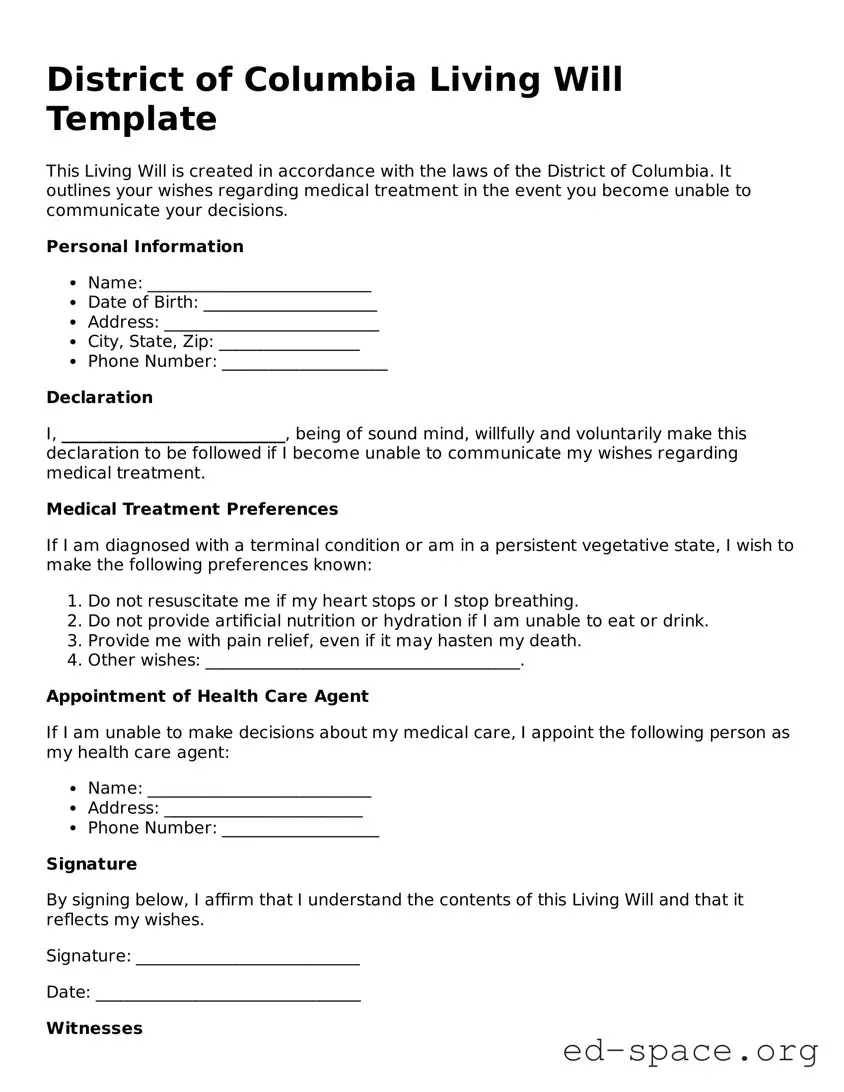
Creating a Living Will is an essential step for anyone who wants to ensure their medical preferences are respected in the event they cannot communicate their wishes. In the District of Columbia, this form allows individuals to outline their desires regarding medical treatment, particularly in situations involving terminal illness or irreversible conditions. It empowers you to specify what types of life-sustaining measures you do or do not want, such as resuscitation or artificial nutrition. Additionally, the Living Will can address your preferences for pain relief and other comfort measures. By completing this document, you take an active role in your healthcare decisions, providing clarity for your loved ones and healthcare providers during difficult times. Understanding the nuances of this form can help you make informed choices that align with your values and beliefs.
District of Columbia Living Will Template
This Living Will is created in accordance with the laws of the District of Columbia. It outlines your wishes regarding medical treatment in the event you become unable to communicate your decisions.
Personal Information
Declaration
I, ___________________________, being of sound mind, willfully and voluntarily make this declaration to be followed if I become unable to communicate my wishes regarding medical treatment.
Medical Treatment Preferences
If I am diagnosed with a terminal condition or am in a persistent vegetative state, I wish to make the following preferences known:
Appointment of Health Care Agent
If I am unable to make decisions about my medical care, I appoint the following person as my health care agent:
Signature
By signing below, I affirm that I understand the contents of this Living Will and that it reflects my wishes.
Signature: ___________________________
Date: ________________________________
Witnesses
This Living Will must be witnessed by two individuals who are not related to me and who will not benefit from my estate.
It is recommended to keep this document in a safe place and to provide copies to your health care agent and medical providers.
| Fact Name | Description |
|---|---|
| Governing Law | The District of Columbia Living Will form is governed by the District of Columbia Code, specifically Title 21, Chapter 22. |
| Purpose | This form allows individuals to express their wishes regarding medical treatment in the event they become incapacitated. |
| Eligibility | Any adult resident of the District of Columbia can complete a Living Will to ensure their healthcare preferences are known. |
| Witness Requirements | The Living Will must be signed in the presence of two witnesses who are not related to the individual or entitled to any portion of their estate. |
Filling out the District of Columbia Living Will form is an important step in expressing your healthcare preferences. This document allows you to communicate your wishes regarding medical treatment in the event that you cannot speak for yourself. Follow these steps carefully to ensure that your form is completed accurately.
After completing the form, ensure that your loved ones are aware of your wishes and know where to find the document. This proactive approach can provide peace of mind for both you and your family.
What is a Living Will in the District of Columbia?
A Living Will is a legal document that allows individuals to express their wishes regarding medical treatment in case they become unable to communicate those wishes themselves. In the District of Columbia, this document specifically outlines your preferences for life-sustaining treatments and other medical interventions if you are diagnosed with a terminal illness or are in a persistent vegetative state.
How do I create a Living Will in D.C.?
To create a Living Will in the District of Columbia, you need to fill out the official form provided by the government. You can find this form online or request it from a healthcare provider. After completing the form, it must be signed in the presence of two witnesses or a notary public. It’s important that the witnesses are not related to you or beneficiaries of your estate to ensure the document's validity.
Can I change or revoke my Living Will?
Yes, you can change or revoke your Living Will at any time as long as you are mentally competent. To revoke the document, you can destroy it or create a new Living Will that explicitly states your updated wishes. It's a good idea to inform your healthcare providers and family members about any changes to ensure that your most current wishes are followed.
Who should have a copy of my Living Will?
It is advisable to provide copies of your Living Will to several key individuals. These include your primary healthcare provider, family members, and anyone you have designated as a healthcare proxy. Having multiple copies ensures that your wishes are known and can be easily accessed in case of a medical emergency.
Is a Living Will the same as a Durable Power of Attorney for Healthcare?
No, a Living Will and a Durable Power of Attorney for Healthcare are different documents. A Living Will focuses specifically on your wishes regarding medical treatment, while a Durable Power of Attorney allows you to appoint someone to make healthcare decisions on your behalf if you are unable to do so. Many people choose to have both documents to ensure comprehensive planning for their healthcare needs.
Not being clear about medical preferences. Individuals often fail to specify their wishes regarding life-sustaining treatments, which can lead to confusion during critical moments.
Forgetting to sign and date the document. A common oversight is neglecting to sign the Living Will, as an unsigned document may not be considered valid.
Not including alternate decision-makers. Many people forget to designate an alternate agent, which is important in case the primary agent is unavailable or unable to act.
Using vague language. Ambiguous terms can create uncertainty. It is essential to use clear and specific language when describing medical treatments.
Failing to review the document regularly. Life circumstances change. Regularly reviewing the Living Will ensures that it reflects current wishes and medical advancements.
Not discussing wishes with family and agents. Open communication about end-of-life preferences can prevent misunderstandings and conflicts among family members.
Overlooking state-specific requirements. Each state has different rules regarding Living Wills. Ignoring these can result in a document that is not legally recognized.
Relying solely on verbal agreements. Verbal instructions may not hold up legally. Written documentation is crucial for ensuring that wishes are honored.
Not keeping copies accessible. After completing the Living Will, it is vital to share copies with family members and healthcare providers to ensure they are aware of the individual's wishes.
A Living Will is an important document that outlines an individual's wishes regarding medical treatment in the event they become unable to communicate those wishes. In addition to the Living Will, several other forms and documents may be relevant for individuals considering their healthcare preferences. Below is a list of commonly used documents that can complement a Living Will in the District of Columbia.
Having these documents in place can provide clarity and ensure that an individual's healthcare preferences are respected. It is advisable to review these documents periodically and discuss them with family members and healthcare providers to ensure everyone is aware of the individual's wishes.
When filling out the District of Columbia Living Will form, it is important to approach the process with care and consideration. Here are some guidelines to help ensure that your wishes are accurately reflected.
By following these guidelines, individuals can create a Living Will that accurately reflects their desires and provides clarity to their loved ones and healthcare providers.
Many people have misunderstandings about the District of Columbia Living Will form. Here are six common misconceptions:
A Living Will specifically addresses medical decisions and end-of-life care, while a Last Will and Testament deals with the distribution of assets after death.
A Living Will can be created at any time. It is a proactive measure to outline your medical preferences in case you cannot communicate them later.
Anyone, regardless of age, can benefit from having a Living Will. Accidents or sudden illnesses can happen to anyone.
While a Living Will is specific to the laws of the District of Columbia, it may be recognized in other jurisdictions, depending on local laws.
You can modify or revoke your Living Will at any time, as long as you are mentally competent to do so.
While a Living Will provides guidance for healthcare providers, it may not be honored in every situation, especially if circumstances change or if there are conflicting legal documents.
When filling out and using the District of Columbia Living Will form, consider these key points: