Creating a Last Will and Testament is a crucial step in ensuring that your wishes are honored after your passing. In the District of Columbia, this legal document serves as a blueprint for distributing your assets, appointing guardians for minor children, and designating an executor to manage your estate. The form allows you to specify how your property should be divided among heirs, whether they are family members, friends, or charitable organizations. Additionally, it provides a space for you to express your final wishes, which can include funeral arrangements or specific bequests. Understanding the requirements and components of the D.C. Last Will and Testament form is essential, as it must be signed and witnessed according to local laws to be considered valid. By taking the time to complete this form thoughtfully, you can provide clarity and peace of mind for your loved ones during a difficult time.
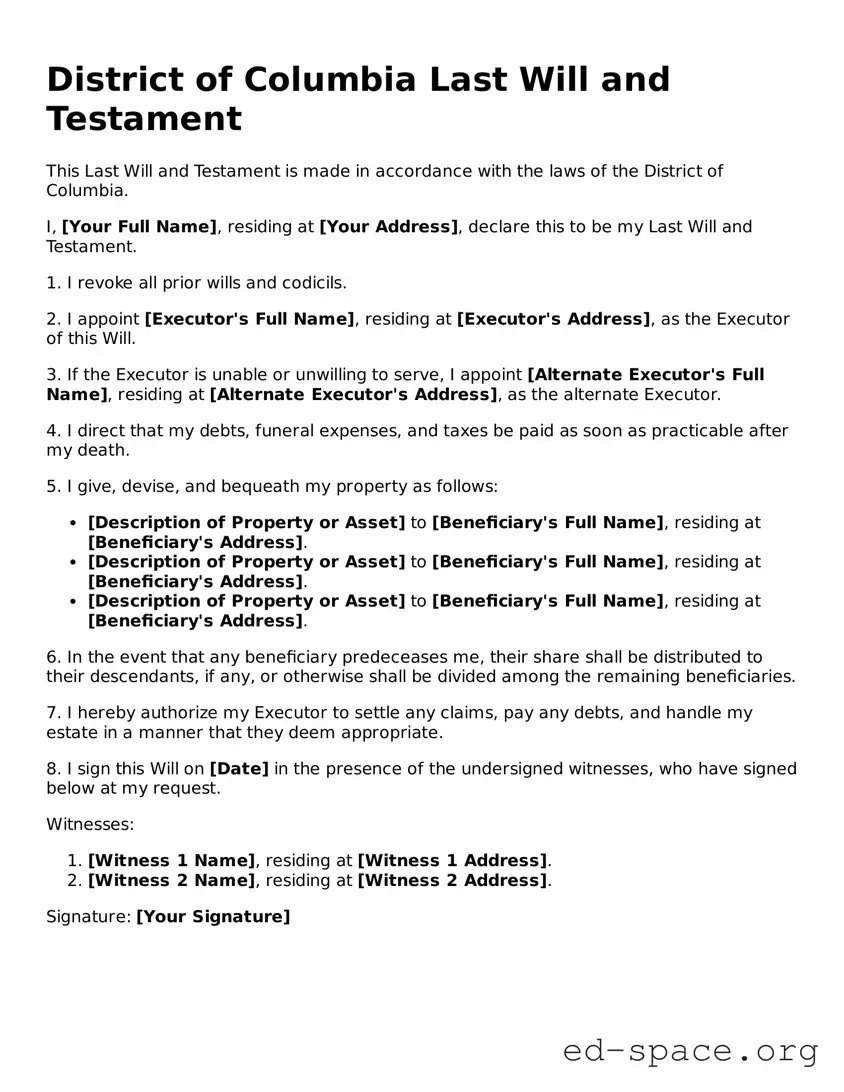
District of Columbia Last Will and Testament
This Last Will and Testament is made in accordance with the laws of the District of Columbia.
I, [Your Full Name], residing at [Your Address], declare this to be my Last Will and Testament.
1. I revoke all prior wills and codicils.
2. I appoint [Executor's Full Name], residing at [Executor's Address], as the Executor of this Will.
3. If the Executor is unable or unwilling to serve, I appoint [Alternate Executor's Full Name], residing at [Alternate Executor's Address], as the alternate Executor.
4. I direct that my debts, funeral expenses, and taxes be paid as soon as practicable after my death.
5. I give, devise, and bequeath my property as follows:
6. In the event that any beneficiary predeceases me, their share shall be distributed to their descendants, if any, or otherwise shall be divided among the remaining beneficiaries.
7. I hereby authorize my Executor to settle any claims, pay any debts, and handle my estate in a manner that they deem appropriate.
8. I sign this Will on [Date] in the presence of the undersigned witnesses, who have signed below at my request.
Witnesses:
Signature: [Your Signature]
| Fact Name | Description |
|---|---|
| Governing Law | The District of Columbia's Last Will and Testament is governed by D.C. Code § 18-102. |
| Age Requirement | Testators must be at least 18 years old to create a valid will in D.C. |
| Written Document | The will must be in writing, either typed or handwritten, to be considered valid. |
| Signature Requirement | The testator must sign the will at the end of the document. |
| Witnesses | At least two witnesses must sign the will in the presence of the testator. |
| Self-Proving Wills | Wills can be made self-proving by including a notarized affidavit from the witnesses. |
| Revocation | A will can be revoked by creating a new will or by physically destroying the original document. |
| Holographic Wills | Handwritten wills, known as holographic wills, are valid if they are signed by the testator. |
| Filing Requirements | There is no requirement to file a will with the court until after the testator's death. |
After gathering the necessary information, you will be ready to complete the District of Columbia Last Will and Testament form. This form allows you to specify your wishes regarding the distribution of your assets after your passing.
What is a Last Will and Testament in the District of Columbia?
A Last Will and Testament is a legal document that outlines how a person's assets and affairs should be handled after their death. In the District of Columbia, this document can specify who will inherit property, name guardians for minor children, and appoint an executor to manage the estate. It serves to ensure that a person's wishes are honored and provides clarity to family members and loved ones during a difficult time.
Who can create a Last Will and Testament in the District of Columbia?
Any person who is at least 18 years old and of sound mind can create a Last Will and Testament in the District of Columbia. This means that the individual must understand the nature of the document and the consequences of their decisions. It is important for the will-maker to be clear about their intentions and to express them in a manner that can be easily understood.
What are the requirements for a valid Last Will and Testament in the District of Columbia?
For a Last Will and Testament to be considered valid in the District of Columbia, it must be in writing and signed by the testator (the person making the will). Additionally, the will must be witnessed by at least two individuals who are not beneficiaries of the will. These witnesses must also sign the document in the presence of the testator. Following these guidelines helps to ensure that the will is legally enforceable.
Can a Last Will and Testament be changed or revoked in the District of Columbia?
Yes, a Last Will and Testament can be changed or revoked at any time as long as the testator is of sound mind. Changes can be made by creating a new will or by adding a codicil, which is a document that modifies the existing will. To revoke a will, the testator can destroy it or create a new will that explicitly states that the previous will is revoked. It is important to ensure that any changes are made in accordance with legal requirements to maintain the validity of the document.
What happens if someone dies without a Last Will and Testament in the District of Columbia?
If an individual dies without a Last Will and Testament, they are considered to have died "intestate." In this case, the District of Columbia's intestacy laws will determine how their assets are distributed. Typically, assets will be divided among surviving relatives according to a specific order of priority established by law. This process can be more complicated and may lead to disputes among family members, highlighting the importance of having a will in place.
Not signing the document properly. In the District of Columbia, a will must be signed by the testator (the person making the will) in the presence of two witnesses. Failing to do this can invalidate the will.
Overlooking witness requirements. The witnesses must be at least 18 years old and should not be beneficiaries of the will. If they are, it could create complications during the probate process.
Failing to date the will. While not legally required, dating the will is crucial. It helps clarify the most current intentions of the testator, especially if there are multiple versions of the will.
Being vague in instructions. Clear and specific language is essential. Ambiguities can lead to disputes among heirs and may not reflect the testator's true wishes.
Neglecting to review and update the will. Life changes such as marriage, divorce, or the birth of children can impact how assets should be distributed. Regularly reviewing the will ensures it remains relevant.
Not considering tax implications. Understanding potential estate taxes and how they affect beneficiaries is important. Failing to address this can lead to unexpected financial burdens for heirs.
When preparing a Last Will and Testament in the District of Columbia, several other forms and documents may be necessary to ensure that all aspects of estate planning are covered. Each document serves a specific purpose in the overall process of managing one’s estate and wishes after death.
Utilizing these documents in conjunction with a Last Will and Testament can help clarify intentions, streamline the estate management process, and ensure that wishes are respected. It is advisable to consult with a legal professional to ensure that all forms are completed correctly and in accordance with local laws.
The Last Will and Testament is an important legal document that outlines how a person's assets and affairs should be handled after their death. There are several other documents that serve similar purposes or complement the Last Will and Testament. Here’s a look at nine of them:
Each of these documents serves a unique purpose but shares the common goal of ensuring that a person's wishes are respected and followed, whether during their lifetime or after their passing.
When filling out the District of Columbia Last Will and Testament form, it’s important to follow some key guidelines. Here are seven things to keep in mind.
By following these guidelines, you can help ensure that your wishes are clearly stated and legally recognized. Taking the time to do it right will provide peace of mind for you and your loved ones.
Understanding the District of Columbia's Last Will and Testament form can be challenging due to various misconceptions. Here are ten common misunderstandings that people often have:
This is a common myth. Everyone, regardless of their financial situation, can benefit from having a will. It allows individuals to specify how they want their assets distributed after their death.
In D.C., a will must be in writing and signed to be considered valid. Verbal wishes, while important, do not hold legal weight.
While a spouse may inherit a significant portion of the estate, the distribution can vary based on the will's instructions and other factors, such as children or other beneficiaries.
Wills can be updated or revoked at any time, as long as the person is of sound mind. This flexibility allows individuals to adapt their wishes as circumstances change.
In D.C., handwritten wills, also known as holographic wills, can be valid if they meet certain requirements, such as being signed by the testator.
In D.C., a will must be signed by at least two witnesses who are present at the same time. Their signatures help validate the will's authenticity.
A will does not prevent probate; rather, it provides instructions for the probate process. Assets will still need to go through probate unless they are placed in a trust or have designated beneficiaries.
While debts must be settled, the order of payment can vary. Executors have discretion in how they manage the estate's finances, but they must follow legal guidelines.
While legal assistance can be beneficial, individuals can create their own wills using templates or online resources. However, it's important to ensure that the will complies with D.C. laws.
A will only takes effect upon the death of the person who created it. Until then, the individual retains full control over their assets.
By understanding these misconceptions, individuals can make informed decisions about their estate planning in the District of Columbia.
When preparing a Last Will and Testament in the District of Columbia, there are several important points to consider. Understanding these key takeaways can help ensure that your will is valid and reflects your wishes accurately.
By keeping these takeaways in mind, you can navigate the process of creating a Last Will and Testament in the District of Columbia with greater confidence and clarity.