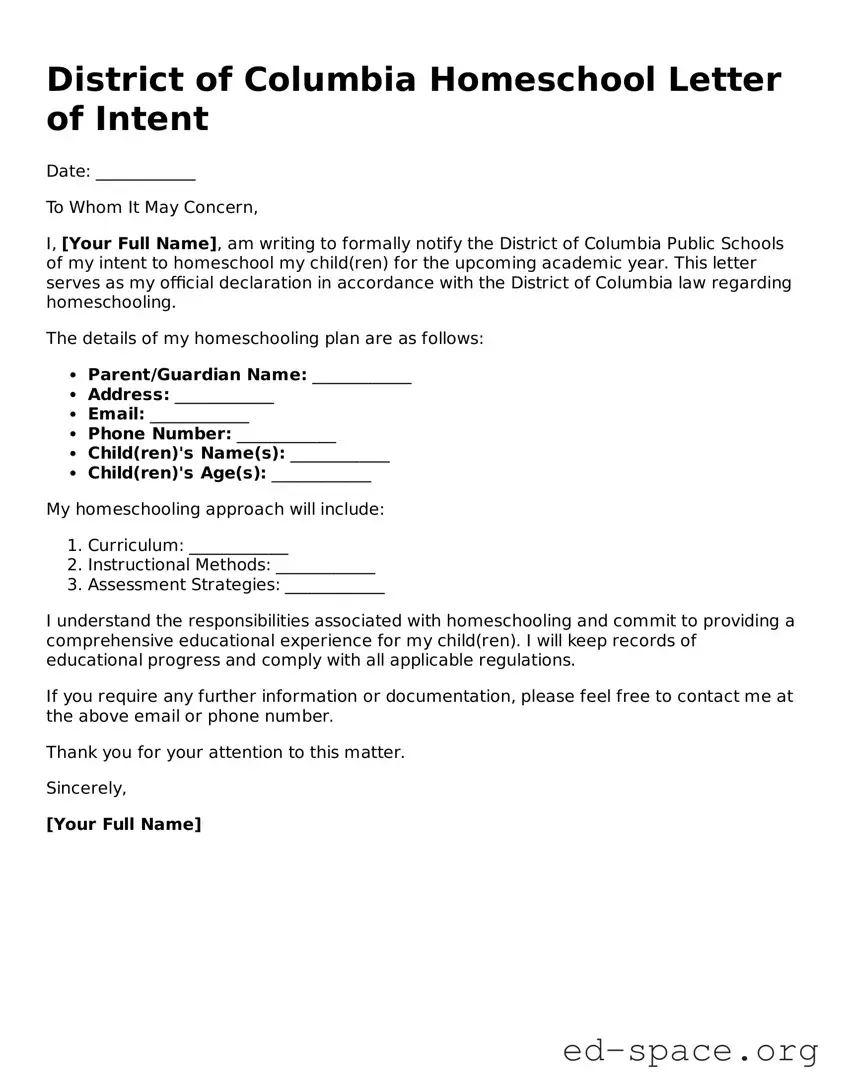
In the District of Columbia, families considering homeschooling their children must navigate several important steps to ensure compliance with local regulations. One of the first and most crucial requirements is the submission of the Homeschool Letter of Intent form. This document serves as a formal notification to the District of Columbia Public Schools that a parent or guardian intends to educate their child at home. The form typically requires basic information, such as the names and ages of the children being homeschooled, as well as the address of the home where the instruction will take place. Additionally, it may ask for the educational curriculum or approach the family plans to use, allowing the school district to understand the educational framework being implemented. Timeliness is critical; submitting the form within the designated timeframe ensures that families remain in good standing with local education authorities. Understanding the requirements and implications of this form is essential for parents to successfully embark on their homeschooling journey.
District of Columbia Homeschool Letter of Intent
Date: ____________
To Whom It May Concern,
I, [Your Full Name], am writing to formally notify the District of Columbia Public Schools of my intent to homeschool my child(ren) for the upcoming academic year. This letter serves as my official declaration in accordance with the District of Columbia law regarding homeschooling.
The details of my homeschooling plan are as follows:
My homeschooling approach will include:
I understand the responsibilities associated with homeschooling and commit to providing a comprehensive educational experience for my child(ren). I will keep records of educational progress and comply with all applicable regulations.
If you require any further information or documentation, please feel free to contact me at the above email or phone number.
Thank you for your attention to this matter.
Sincerely,
[Your Full Name]
| Fact Name | Description |
|---|---|
| Purpose | The Homeschool Letter of Intent form is used to notify the District of Columbia's Office of the State Superintendent of Education that a parent intends to homeschool their child. |
| Governing Law | The form is governed by the District of Columbia Municipal Regulations, specifically Title 5, Chapter 100. |
| Submission Deadline | The Letter of Intent must be submitted at least 15 days before the start of the homeschool program. |
| Required Information | Parents must provide their child's name, age, and the address where homeschooling will take place. |
| Signature Requirement | The form must be signed by the parent or legal guardian who will be overseeing the homeschooling. |
| Annual Renewal | Parents are required to submit a new Letter of Intent each year to continue homeschooling. |
| Contact Information | Parents can contact the Office of the State Superintendent of Education for questions or assistance regarding the form. |
After obtaining the District of Columbia Homeschool Letter of Intent form, you will need to complete it with accurate information. This form is essential for notifying the appropriate authorities of your intent to homeschool. Follow these steps to ensure that you fill it out correctly.
What is the District of Columbia Homeschool Letter of Intent?
The Homeschool Letter of Intent is a formal document that parents or guardians must submit to the District of Columbia's Office of the State Superintendent of Education (OSSE) to notify them of their intention to homeschool their child. This letter is an essential first step in the homeschooling process, ensuring that the local education authority is aware of your educational plans.
Who needs to submit the Homeschool Letter of Intent?
Any parent or guardian who wishes to homeschool their child in the District of Columbia must submit this letter. This applies to children of compulsory school age, which is typically between 5 and 18 years old. If you are starting to homeschool for the first time or changing your educational approach, this letter is necessary.
When should I submit the Letter of Intent?
It is recommended to submit the Letter of Intent at least 15 days before you begin homeschooling. This timeframe allows the OSSE to process your application and ensures that you are compliant with local regulations. If you are withdrawing your child from a traditional school, it’s wise to submit the letter as soon as possible to avoid any gaps in education.
What information do I need to include in the Letter of Intent?
Your Letter of Intent should include your name, address, and contact information, as well as your child’s name and date of birth. Additionally, you may need to provide details about your educational plan, such as the curriculum you intend to use and your approach to teaching. This information helps the OSSE understand your homeschooling framework.
Is there a specific format for the Letter of Intent?
While there is no strict format required, the letter should be clear and concise. It should include all necessary information mentioned above. Many parents choose to draft a simple letter that outlines their intent to homeschool and includes their contact information. A straightforward approach is often the most effective.
Do I need to renew the Letter of Intent every year?
Yes, the Letter of Intent must be submitted annually. Each year, parents or guardians are required to notify the OSSE of their continued intent to homeschool. This ensures that the local education authority remains informed about your educational choices and that your child’s homeschooling status is up to date.
What happens if I don’t submit the Letter of Intent?
Failing to submit the Letter of Intent can lead to legal complications. Your child may be considered truant, which could result in fines or other penalties. To avoid these issues, it’s crucial to follow the proper procedures and submit your letter on time.
Can I change my mind after submitting the Letter of Intent?
Yes, you can change your mind about homeschooling after submitting the Letter of Intent. If you decide to enroll your child in a traditional school or another educational program, simply notify the OSSE of this change. Keeping them informed helps ensure that your child’s educational records are accurate and up to date.
Where do I send the Homeschool Letter of Intent?
The Letter of Intent should be sent to the Office of the State Superintendent of Education (OSSE). You can typically submit it via mail or email, depending on the current guidelines provided by the OSSE. Always check their official website for the most current submission methods and contact information.
Are there any resources available for homeschooling in D.C.?
Absolutely! There are numerous resources available for homeschooling families in the District of Columbia. The OSSE website provides guidance, curriculum resources, and support networks. Additionally, local homeschooling groups and co-ops can offer community support, shared resources, and socialization opportunities for your child.
Incomplete Information: One common mistake is failing to provide all required details. Ensure that every section of the form is filled out completely. Missing information can lead to delays in processing your application.
Incorrect Student Information: Double-check the spelling of your child's name and ensure that the date of birth is accurate. Errors in this information can cause confusion and may require you to resubmit the form.
Not Signing the Form: It may seem simple, but forgetting to sign the letter of intent can result in rejection. Always include your signature to validate the document.
Missing the Deadline: Each school year has a specific deadline for submitting the letter of intent. Be aware of these dates and submit your form on time to avoid complications.
Using Incorrect Contact Information: Providing outdated or incorrect contact details can hinder communication. Ensure your phone number and email address are current so the school district can reach you if needed.
Not Following Local Guidelines: Each district may have specific requirements for homeschooling. Familiarize yourself with local regulations to ensure compliance when filling out the form.
Neglecting to Include Educational Plan: Some districts may require a brief outline of your educational plan. Failing to include this information can raise questions about your homeschooling intentions.
Overlooking Updates: If your circumstances change, such as moving to a new address or changing your educational approach, it’s essential to update your letter of intent. Failing to do so can lead to misunderstandings with the school district.
When families choose to homeschool in the District of Columbia, several documents and forms may be required in addition to the Homeschool Letter of Intent. Each of these documents serves a specific purpose in ensuring that the homeschooling process is compliant with local regulations and supports the educational journey of the student.
These documents collectively support the homeschooling process, ensuring that families meet legal requirements while fostering a rich educational experience for their children. Proper organization and record-keeping can significantly ease the homeschooling journey.
When filling out the District of Columbia Homeschool Letter of Intent form, it is important to follow certain guidelines to ensure that your submission is complete and accurate. Here is a list of things you should and shouldn't do:
When it comes to homeschooling in the District of Columbia, many people hold misconceptions about the Letter of Intent form. Understanding the truth behind these misunderstandings can help parents navigate the homeschooling process more effectively. Here are four common misconceptions:
Many believe that once they submit the Letter of Intent, they are legally bound to homeschool their children for the entire year. In reality, this form simply notifies the local education authority of your intent to homeschool. You can change your mind at any time without legal repercussions.
Some parents think they can only submit the form at the start of the academic year. However, the District of Columbia allows parents to submit the Letter of Intent at any time during the year. This flexibility accommodates families who may decide to homeschool mid-year.
It is a common belief that parents must list all their children on the Letter of Intent. In fact, you only need to submit the form for the children you plan to homeschool. If you have children in both public school and homeschool, you can specify which ones are being homeschooled.
Some parents worry that the Letter of Intent demands a lot of paperwork or detailed information about their homeschooling plans. In truth, the form is quite simple and requires minimal information. It primarily serves as a notification rather than a comprehensive educational plan.
By clearing up these misconceptions, parents can feel more confident in their decision to homeschool and understand the process involved in submitting the Letter of Intent in the District of Columbia.
Filling out and using the District of Columbia Homeschool Letter of Intent form is an important step for families choosing to homeschool their children. Here are some key takeaways to keep in mind: