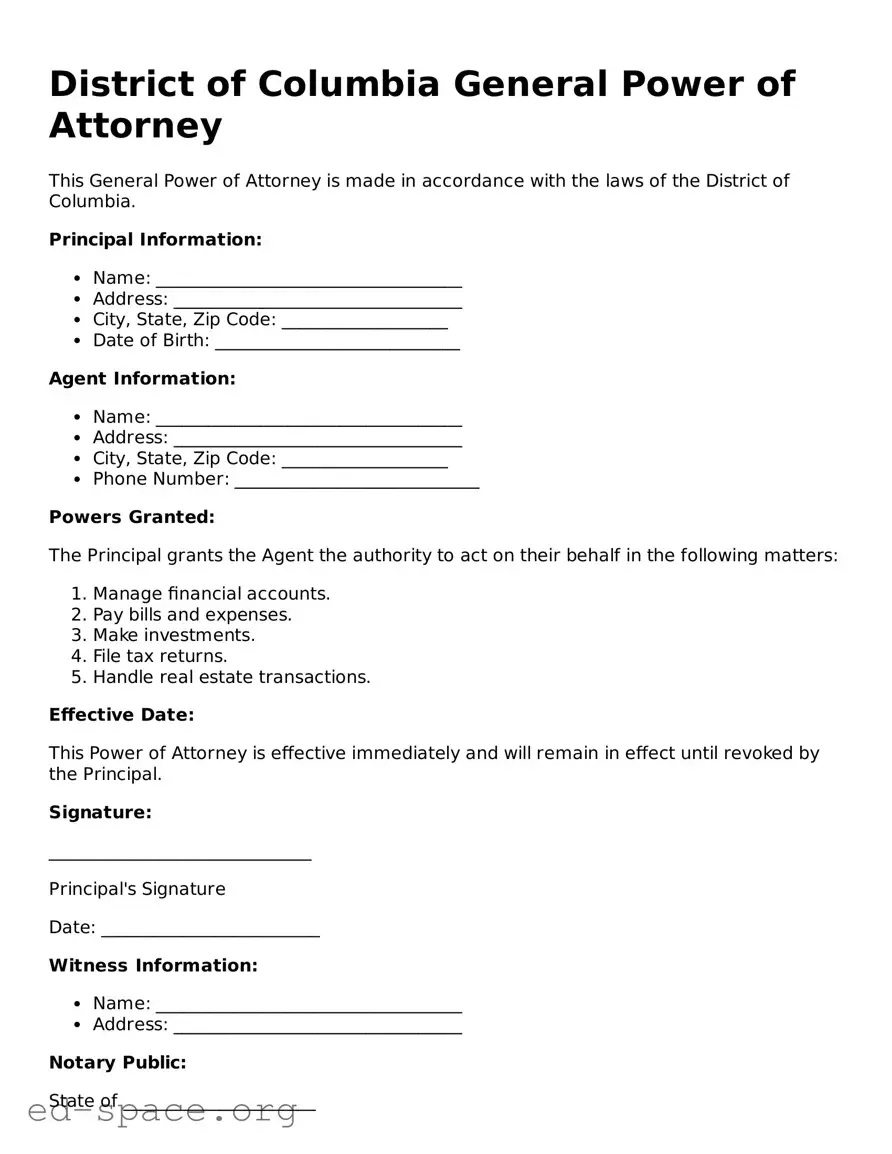
The District of Columbia General Power of Attorney form serves as a crucial legal document that allows individuals to appoint an agent to manage their financial and legal affairs on their behalf. This form empowers the designated agent to make decisions regarding property transactions, banking, and other financial matters, thereby providing a layer of convenience and support. It is important to understand that the authority granted can be broad or limited, depending on the preferences of the principal, the individual granting the power. The form typically requires the principal's signature, the agent's information, and may also need to be notarized to ensure its validity. Additionally, the General Power of Attorney can be effective immediately or set to activate upon the occurrence of a specific event, such as the principal's incapacitation. Understanding the implications of this document is essential for both the principal and the agent, as it outlines the scope of authority and the responsibilities involved in managing another person's affairs.
District of Columbia General Power of Attorney
This General Power of Attorney is made in accordance with the laws of the District of Columbia.
Principal Information:
Agent Information:
Powers Granted:
The Principal grants the Agent the authority to act on their behalf in the following matters:
Effective Date:
This Power of Attorney is effective immediately and will remain in effect until revoked by the Principal.
Signature:
______________________________
Principal's Signature
Date: _________________________
Witness Information:
Notary Public:
State of ______________________
County of _____________________
Subscribed and sworn to before me on this _____ day of ______________, 20__.
______________________________
Notary Public Signature
My Commission Expires: ________________
| Fact Name | Description |
|---|---|
| Definition | The District of Columbia General Power of Attorney form allows an individual to appoint someone else to manage their financial affairs. |
| Governing Law | This form is governed by the District of Columbia Code, specifically Title 21, Chapter 20. |
| Durability | The General Power of Attorney can be durable, meaning it remains effective even if the principal becomes incapacitated, unless specified otherwise. |
| Execution Requirements | The form must be signed by the principal and witnessed by two individuals or notarized to be valid. |
| Revocation | The principal can revoke the General Power of Attorney at any time, provided they are competent to do so. |
Filling out the District of Columbia General Power of Attorney form is an important step in designating someone to act on your behalf in financial and legal matters. After completing the form, you will need to sign it in front of a notary to ensure its validity. Follow these steps carefully to ensure that all necessary information is accurately provided.
What is a General Power of Attorney in the District of Columbia?
A General Power of Attorney (GPOA) is a legal document that allows one person, known as the principal, to appoint another person, called the agent or attorney-in-fact, to make decisions on their behalf. This authority can cover a wide range of financial and legal matters, such as managing bank accounts, signing contracts, and handling real estate transactions. In the District of Columbia, a GPOA can be effective immediately or can be set to take effect upon the principal's incapacity.
How do I create a General Power of Attorney in the District of Columbia?
To create a GPOA, you must complete a specific form that includes your name, the name of your chosen agent, and the powers you wish to grant. It’s important to clearly outline the scope of authority you are giving. After filling out the form, you must sign it in the presence of a notary public. This step is crucial, as notarization helps to verify your identity and ensures the document is legally binding.
Can I revoke a General Power of Attorney once it is established?
Yes, you can revoke a General Power of Attorney at any time, as long as you are mentally competent. To do this, you should create a revocation document stating that you are canceling the previous GPOA. It’s advisable to inform your agent and any relevant institutions, such as banks or healthcare providers, about the revocation to prevent any confusion.
What happens if I become incapacitated and have a General Power of Attorney?
If you become incapacitated, the General Power of Attorney remains in effect if it was set up to continue during such circumstances. Your agent will then have the authority to act on your behalf according to the powers granted in the document. However, if you did not specify that the GPOA should remain effective during incapacity, it will automatically terminate, and a court-appointed guardian may need to be established to manage your affairs.
Are there any limitations to what my agent can do under a General Power of Attorney?
Yes, there are limitations to the powers granted under a GPOA. While you can give your agent broad authority, you can also specify certain actions they cannot take. For example, you might restrict them from making healthcare decisions or selling your home without your explicit consent. It’s essential to think carefully about the powers you grant and to communicate any limitations clearly in the document.
Not specifying the powers granted: One common mistake is failing to clearly outline the specific powers you wish to grant. The form allows for customization, and vague language can lead to misunderstandings.
Inadequate identification of the agent: It's essential to provide complete and accurate information about the agent. Omitting details such as their full name or address can cause issues in the future.
Forgetting to date the document: A date is crucial for the validity of the Power of Attorney. Without it, there may be confusion regarding when the authority begins or ends.
Neglecting to sign in the appropriate places: Signatures are necessary for both the principal and the agent. Missing signatures can render the document invalid.
Not having witnesses or notarization: Depending on the requirements, failing to have the document witnessed or notarized can lead to challenges in its acceptance.
Overlooking the expiration clause: It's wise to include an expiration date or condition. Without this, the Power of Attorney may remain in effect longer than intended.
Using outdated forms: Legal documents can change over time. Using an outdated version of the General Power of Attorney form can lead to complications.
Failing to communicate with the agent: It's crucial to discuss your wishes with the agent before completing the form. This ensures they understand your intentions and are willing to take on the responsibility.
Not keeping copies: After completing the form, make sure to keep copies for your records. This can be vital if questions arise about the authority granted.
When creating a General Power of Attorney (POA) in the District of Columbia, several other forms and documents may be necessary to ensure comprehensive legal authority and protection. These documents can enhance the effectiveness of the POA and clarify the agent's powers. Here’s a list of common forms that are often used alongside a General Power of Attorney.
In summary, while the General Power of Attorney is a powerful tool for managing affairs, it is often beneficial to utilize additional documents to address specific needs and situations. Each of these forms serves a unique purpose and can enhance the effectiveness of the POA, ensuring that the principal's wishes are respected and upheld.
When filling out the District of Columbia General Power of Attorney form, it’s essential to approach the process with care. Here are some important dos and don’ts to keep in mind:
Understanding the District of Columbia General Power of Attorney form can be challenging. Misconceptions often arise, leading to confusion about its purpose and functionality. Below are ten common misconceptions along with clarifications to provide a clearer understanding.
Many people believe that a General Power of Attorney is solely for financial transactions. In reality, it can also grant authority over health care decisions and other personal matters, depending on how it is drafted.
This is a common misunderstanding. A General Power of Attorney typically becomes invalid if the principal becomes incapacitated, unless it is specified as a durable power of attorney.
While it is true that individuals can choose their agents, it is important that the chosen person is trustworthy and capable of handling the responsibilities. Some may mistakenly think that any acquaintance can serve in this role.
Although notarization is highly recommended to ensure authenticity, it is not always a strict requirement for the General Power of Attorney form to be legally valid in D.C.
Many believe that once a General Power of Attorney is executed, it remains effective forever. However, changes in circumstances or laws may necessitate updates to the document.
This misconception can lead to significant misunderstandings. The authority granted depends on the specific powers outlined in the document; it does not automatically include all financial accounts or decisions.
Some individuals confuse a General Power of Attorney with a healthcare proxy. While both involve granting authority to act on another's behalf, a healthcare proxy specifically addresses medical decisions.
This is not accurate. A principal can revoke a General Power of Attorney at any time, as long as they are mentally competent to do so. A written notice is usually sufficient.
People often assume that a standard form will meet all their needs. However, the powers granted can vary significantly based on individual circumstances and intentions, necessitating customization.
This misconception leads many to overlook the importance of having a General Power of Attorney. It can be beneficial for anyone, regardless of age or health, as it prepares for unforeseen circumstances.
By addressing these misconceptions, individuals can make more informed decisions regarding the use of a General Power of Attorney in the District of Columbia.
Filling out and using the District of Columbia General Power of Attorney form can be straightforward if you keep a few key points in mind. Here are some essential takeaways:
By keeping these takeaways in mind, you can effectively navigate the process of filling out and using the General Power of Attorney form in the District of Columbia.