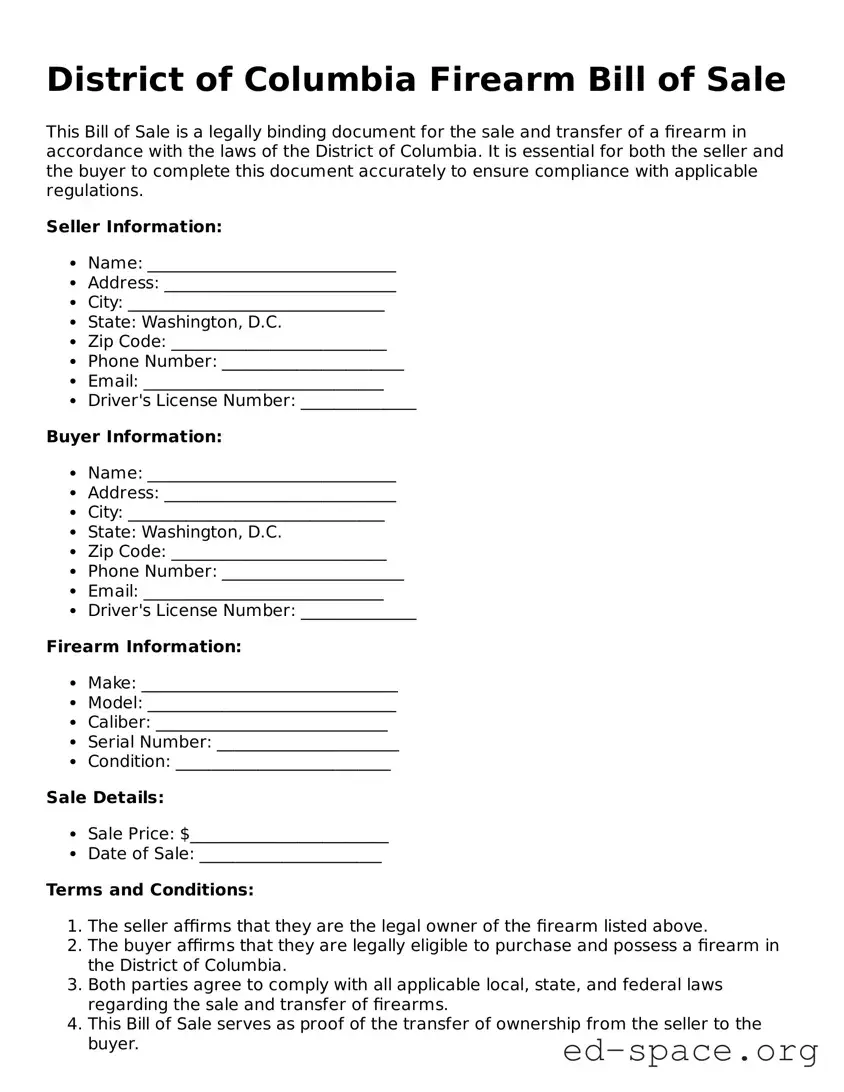
The District of Columbia Firearm Bill of Sale form plays a crucial role in the legal transfer of firearm ownership. This document serves as a record that outlines the details of the transaction between the buyer and the seller, ensuring both parties are protected under the law. Key components of the form typically include the names and addresses of both the buyer and seller, a description of the firearm being sold, including its make, model, and serial number, and the date of the transaction. Additionally, the form may require both parties to sign, affirming that the sale complies with all applicable laws and regulations. By properly completing this form, individuals can help prevent misunderstandings and disputes that may arise from the sale of firearms, thereby promoting responsible ownership and accountability within the community.
District of Columbia Firearm Bill of Sale
This Bill of Sale is a legally binding document for the sale and transfer of a firearm in accordance with the laws of the District of Columbia. It is essential for both the seller and the buyer to complete this document accurately to ensure compliance with applicable regulations.
Seller Information:
Buyer Information:
Firearm Information:
Sale Details:
Terms and Conditions:
By signing below, both parties agree to the terms outlined in this Bill of Sale.
Seller Signature: ____________________________
Date: ____________________________________
Buyer Signature: ____________________________
Date: ____________________________________
| Fact Name | Details |
|---|---|
| Purpose | The District of Columbia Firearm Bill of Sale form is used to document the sale of a firearm between private parties. |
| Governing Law | The sale of firearms in the District of Columbia is governed by D.C. Code § 7-2501.01 et seq. |
| Required Information | The form requires the seller's and buyer's names, addresses, and signatures, along with details of the firearm being sold. |
| Legal Implications | Completing the Bill of Sale does not substitute for any required background checks or compliance with local laws. |
Filling out the District of Columbia Firearm Bill of Sale form is an essential step in ensuring a legal transfer of ownership. Once completed, this document serves as proof of the transaction between the buyer and the seller. Follow the steps below to accurately fill out the form.
After completing these steps, review the form for accuracy before finalizing the transaction. Retain a copy for your records, as it may be necessary for future reference.
What is a Firearm Bill of Sale in the District of Columbia?
A Firearm Bill of Sale is a legal document that records the sale or transfer of a firearm between two parties. In the District of Columbia, this form serves as proof of the transaction and includes essential details such as the buyer's and seller's information, the firearm's description, and the date of the sale. This document helps ensure compliance with local laws and provides protection for both the buyer and seller by establishing clear ownership of the firearm.
Is a Firearm Bill of Sale required in the District of Columbia?
While a Firearm Bill of Sale is not explicitly required by law in the District of Columbia, it is highly recommended. Having this document can help protect both parties in the event of a dispute regarding the sale or ownership of the firearm. Additionally, if the firearm is ever used in a crime, the Bill of Sale can serve as evidence that the seller no longer owns the weapon, which may shield them from legal liability.
What information should be included in a Firearm Bill of Sale?
A comprehensive Firearm Bill of Sale should include several key pieces of information. Start with the names and addresses of both the buyer and seller. Next, provide a detailed description of the firearm, including the make, model, caliber, and serial number. It's also important to include the date of the transaction and any conditions of the sale. Both parties should sign and date the document to validate the transaction.
Can I create my own Firearm Bill of Sale?
Yes, you can create your own Firearm Bill of Sale. However, ensure that it includes all necessary information to make it legally binding. Templates are often available online, which can simplify the process. Just remember that both parties should keep a signed copy for their records. If you have any doubts about the document's validity or content, consulting with a legal professional can provide additional peace of mind.
Failing to provide complete information. Buyers and sellers must fill out all required fields accurately. Missing details can lead to delays or invalid transactions.
Not including the correct identification. Both parties should provide valid government-issued IDs. This ensures that the transaction is legal and traceable.
Overlooking the date of the transaction. It is crucial to record the exact date when the sale occurs. This serves as a reference for both parties in case of future disputes.
Neglecting to sign the form. Both the buyer and seller must sign the document to validate the sale. Without signatures, the agreement holds no legal weight.
Using incorrect firearm details. The description of the firearm should be precise, including make, model, and serial number. Inaccuracies can lead to complications down the line.
Not keeping a copy of the bill of sale. Both parties should retain a copy of the completed form. This serves as proof of the transaction and protects against potential legal issues.
The District of Columbia Firearm Bill of Sale form is a crucial document for individuals engaged in the sale or transfer of firearms. Along with this form, several other documents may be necessary to ensure compliance with local laws and regulations. Below is a list of commonly used forms and documents that often accompany the Firearm Bill of Sale.
Utilizing these documents alongside the District of Columbia Firearm Bill of Sale form helps ensure a smooth and legally compliant transfer of firearm ownership. Each form plays a specific role in the process, contributing to the overall integrity of firearm transactions in the district.
The Firearm Bill of Sale form serves as a crucial document in the transfer of firearm ownership. Similar documents also facilitate the transfer of ownership for various types of property. Below are six documents that share similarities with the Firearm Bill of Sale:
When filling out the District of Columbia Firearm Bill of Sale form, it is essential to adhere to specific guidelines to ensure accuracy and compliance. Below is a list of things you should and shouldn't do:
Understanding the District of Columbia Firearm Bill of Sale form can be tricky. Here are six common misconceptions about this form:
Many people believe that a Bill of Sale is optional. However, having a written record of the transaction is important for both parties. It helps clarify ownership and can be useful for legal purposes.
Some think that any generic document will suffice. In reality, the form should meet specific requirements set by the District of Columbia to ensure it is valid.
It is a common belief that only the seller's signature is necessary. Both the buyer and seller should sign the document to make it legally binding.
Some assume that completing the form is the end of the process. In fact, the buyer may still need to register the firearm and comply with other local laws.
This is a misunderstanding. The Bill of Sale simply documents the transfer of ownership. It does not grant permission to possess or carry the firearm.
Many believe that failing to use a Bill of Sale is harmless. However, not having one can lead to legal complications, including potential liability for the seller.
Being informed about the requirements and implications of the Firearm Bill of Sale form can help ensure a smooth and legal transaction.
Filling out and using the District of Columbia Firearm Bill of Sale form is an important process for both buyers and sellers of firearms. Here are ten key takeaways to consider: