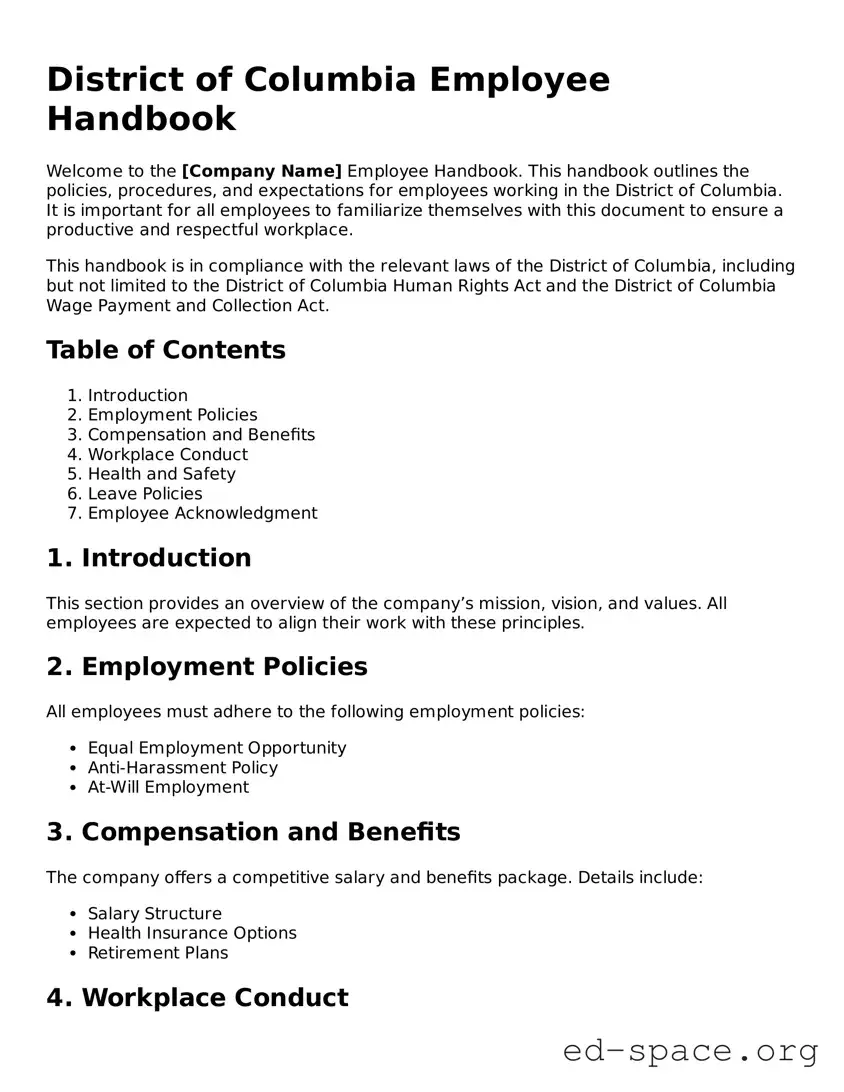
The District of Columbia Employee Handbook form serves as a vital resource for both employees and employers in navigating workplace policies and procedures. This comprehensive document outlines essential information regarding employee rights, responsibilities, and benefits. It covers topics such as workplace conduct, attendance policies, and guidelines for reporting grievances. Additionally, the handbook addresses benefits like health insurance, retirement plans, and leave entitlements, ensuring that employees understand their entitlements and obligations. By providing clear expectations and resources, this form helps foster a positive work environment and encourages open communication between staff and management. Overall, the Employee Handbook is an important tool for promoting a fair and informed workplace in the District of Columbia.
District of Columbia Employee Handbook
Welcome to the [Company Name] Employee Handbook. This handbook outlines the policies, procedures, and expectations for employees working in the District of Columbia. It is important for all employees to familiarize themselves with this document to ensure a productive and respectful workplace.
This handbook is in compliance with the relevant laws of the District of Columbia, including but not limited to the District of Columbia Human Rights Act and the District of Columbia Wage Payment and Collection Act.
Table of Contents
1. Introduction
This section provides an overview of the company’s mission, vision, and values. All employees are expected to align their work with these principles.
2. Employment Policies
All employees must adhere to the following employment policies:
3. Compensation and Benefits
The company offers a competitive salary and benefits package. Details include:
4. Workplace Conduct
Employees are expected to maintain a professional demeanor. Key conduct policies include:
5. Health and Safety
Safety in the workplace is a priority. Employees should be aware of:
6. Leave Policies
The company provides various leave options, including:
7. Employee Acknowledgment
All employees must sign an acknowledgment form indicating they have read and understood the handbook. Please complete the following:
Employee Name: [Employee Name]
Employee Signature: [Employee Signature]
Date: [Date]
| Fact Name | Description |
|---|---|
| Purpose | The District of Columbia Employee Handbook serves as a guide for employees regarding workplace policies and procedures. |
| Governing Law | The handbook is governed by the District of Columbia Code, Title 1, Chapter 6, which outlines employment regulations. |
| Employee Rights | It details the rights of employees, including anti-discrimination policies and workplace safety regulations. |
| Workplace Conduct | The handbook outlines expected behaviors and conduct standards for employees in the workplace. |
| Leave Policies | Information about various leave types, including sick leave and family leave, is included. |
| Benefits Overview | Employees can find details about health benefits, retirement plans, and other perks offered by the District. |
| Grievance Procedures | The handbook explains the steps employees should take if they have a complaint or grievance. |
| Updates and Revisions | Regular updates to the handbook are made to ensure compliance with new laws and regulations. |
Filling out the District of Columbia Employee Handbook form is a straightforward process. Completing this form accurately is essential for ensuring compliance with local employment guidelines and understanding your rights and responsibilities as an employee. Follow the steps below to navigate the form efficiently.
What is the purpose of the District of Columbia Employee Handbook form?
The District of Columbia Employee Handbook form serves as a comprehensive guide for employees working within the District government. It outlines essential policies, procedures, and benefits that govern the workplace. By providing clear information, the handbook helps employees understand their rights and responsibilities, ensuring a harmonious work environment. Additionally, it fosters consistency in how policies are applied across various departments.
Who is required to complete the Employee Handbook form?
All employees of the District of Columbia government are required to acknowledge receipt of the Employee Handbook form. This includes full-time, part-time, and temporary employees. Completing the form ensures that each employee has access to vital information regarding workplace policies and procedures. It is crucial for employees to familiarize themselves with the handbook to understand the expectations and resources available to them.
How often is the Employee Handbook updated?
The Employee Handbook is reviewed and updated regularly to reflect changes in laws, regulations, and workplace policies. Typically, updates occur annually or as needed, depending on significant changes in employment law or organizational policy. Employees are notified of any updates, and it is their responsibility to review the new version to stay informed about the latest guidelines and procedures.
What should I do if I have questions about the Employee Handbook?
If you have questions or need clarification about any aspect of the Employee Handbook, it is important to reach out to your supervisor or the Human Resources department. They are equipped to provide guidance and address any concerns you may have. Open communication is encouraged, as it helps ensure that all employees fully understand the policies and feel supported in their roles.
Incomplete Information: Many individuals fail to provide all required details. Missing sections can delay processing and create confusion.
Incorrect Contact Information: Providing outdated or incorrect phone numbers and addresses can hinder communication. Always double-check this information.
Neglecting to Read Instructions: Skipping over the instructions can lead to errors. Each section often has specific requirements that are crucial for proper completion.
Failure to Sign and Date: Some people forget to sign or date the form. This oversight can render the form invalid, requiring resubmission.
The District of Columbia Employee Handbook is a crucial document for understanding workplace policies and procedures. However, several other forms and documents complement this handbook, providing additional guidance and resources for both employees and employers. Below is a list of these essential documents.
These documents work together with the Employee Handbook to create a comprehensive framework for workplace operations. Understanding and utilizing these forms can lead to a more informed and engaged workforce, fostering a positive work environment.
When filling out the District of Columbia Employee Handbook form, following certain guidelines can ensure a smooth process. Here are some important dos and don'ts to consider:
Understanding the District of Columbia Employee Handbook form is essential for employees to navigate their rights and responsibilities. However, several misconceptions often arise regarding this important document. Here are nine common misconceptions, along with clarifications to help employees better comprehend the Employee Handbook.
Many employees believe that the handbook serves as a contract between them and the District. In reality, it is a guideline that outlines policies and procedures but does not constitute a binding agreement.
Some employees think that all policies in the handbook apply universally. However, certain policies may only apply to specific job roles or departments.
It is a common misconception that the handbook remains unchanged for long periods. In fact, the handbook is regularly updated to reflect new laws, regulations, and organizational changes.
Some assume that simply having the handbook means they understand all policies. Employees are encouraged to read the handbook thoroughly and seek clarification on any unclear points.
Contrary to this belief, violations of handbook policies can lead to disciplinary actions, including warnings or termination, depending on the severity of the infraction.
While the handbook provides valuable information about employee rights, it may not encompass every right or benefit. Employees should also refer to federal and local laws for comprehensive rights.
Some individuals think they can disregard the handbook if they disagree with certain policies. However, all employees are expected to adhere to the guidelines outlined within it.
It is a misconception that management does not need to provide explanations regarding the handbook. Management should be available to assist employees in understanding the contents and implications of the handbook.
Lastly, employees may believe that signing the acknowledgment form means they cannot question any part of the handbook. In reality, employees are encouraged to voice concerns and seek clarification whenever necessary.
By addressing these misconceptions, employees can engage more effectively with the Employee Handbook and ensure they are informed about their rights and responsibilities within the workplace.
Filling out and using the District of Columbia Employee Handbook form is a crucial step for employees to understand their rights and responsibilities. Here are some key takeaways to keep in mind: