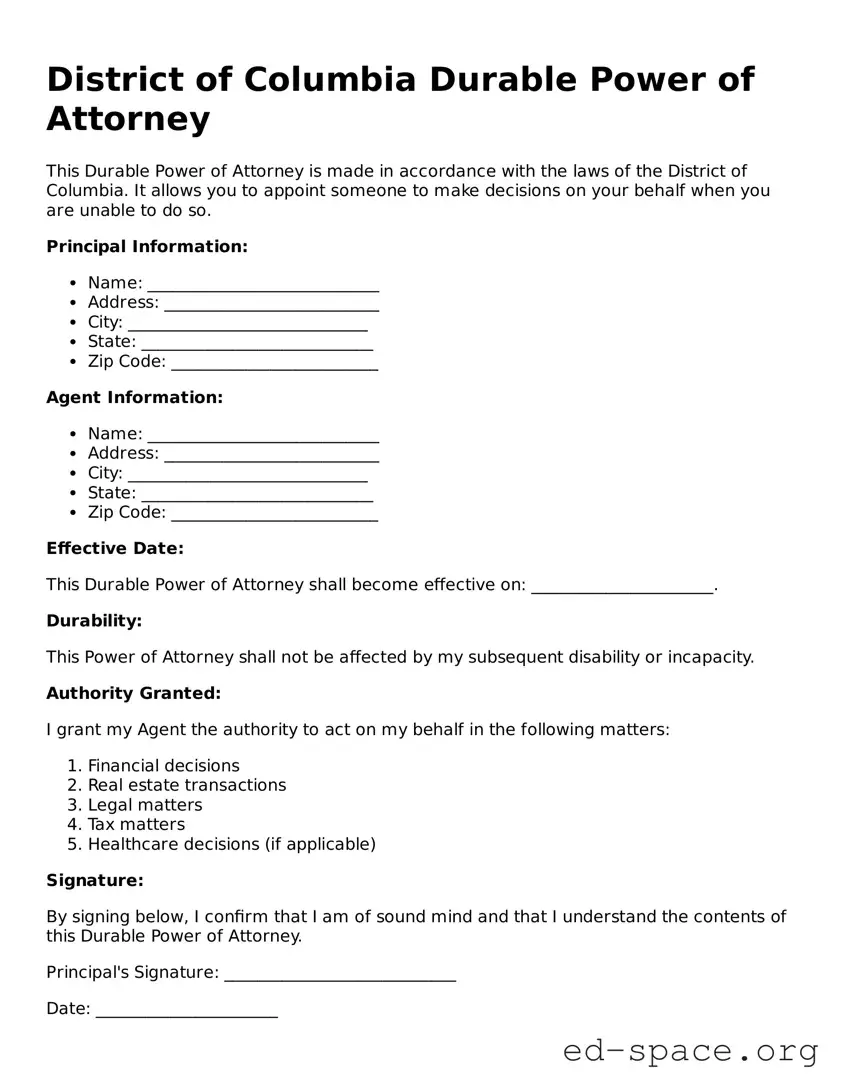
The District of Columbia Durable Power of Attorney form serves as a vital legal document that allows individuals to appoint a trusted person, known as an agent, to make decisions on their behalf when they are unable to do so. This form is particularly important for managing financial and legal matters, ensuring that personal affairs are handled according to the individual's wishes. Key features of the form include the ability to specify the scope of authority granted to the agent, which can range from managing bank accounts to making real estate decisions. Additionally, the durable nature of this power of attorney means that it remains effective even if the individual becomes incapacitated. It is crucial for individuals to consider their choices carefully, as the selected agent will have significant control over important aspects of their life. Furthermore, the form must be signed and witnessed to be legally valid, emphasizing the need for proper execution. Understanding these components is essential for anyone considering the establishment of a durable power of attorney in Washington, D.C.
District of Columbia Durable Power of Attorney
This Durable Power of Attorney is made in accordance with the laws of the District of Columbia. It allows you to appoint someone to make decisions on your behalf when you are unable to do so.
Principal Information:
Agent Information:
Effective Date:
This Durable Power of Attorney shall become effective on: ______________________.
Durability:
This Power of Attorney shall not be affected by my subsequent disability or incapacity.
Authority Granted:
I grant my Agent the authority to act on my behalf in the following matters:
Signature:
By signing below, I confirm that I am of sound mind and that I understand the contents of this Durable Power of Attorney.
Principal's Signature: ____________________________
Date: ______________________
Witness Information:
Witness Signature: ____________________________
Date: ______________________
Notarization:
State of ____________
County of ____________
Subscribed and sworn to before me on this _____ day of ____________, 20__.
Notary Public Signature: ____________________________
My commission expires: ____________________________
| Fact Name | Description |
|---|---|
| Definition | A Durable Power of Attorney allows an individual (the principal) to designate another person (the agent) to manage their financial and legal affairs, even if they become incapacitated. |
| Governing Law | The Durable Power of Attorney in the District of Columbia is governed by the District of Columbia Code, specifically Title 21, Chapter 20. |
| Durability | This form remains effective even if the principal becomes incapacitated, distinguishing it from a regular Power of Attorney. |
| Agent's Authority | The agent can perform a variety of tasks, such as managing bank accounts, paying bills, and making investment decisions on behalf of the principal. |
| Revocation | The principal can revoke the Durable Power of Attorney at any time as long as they are mentally competent to do so. |
| Notarization | While notarization is not always required, having the document notarized can help ensure its validity and acceptance by financial institutions. |
| Agent's Responsibilities | The agent has a fiduciary duty to act in the best interests of the principal, which includes managing finances responsibly and keeping accurate records. |
| Multiple Agents | The principal can appoint multiple agents, but it is crucial to specify whether they must act jointly or can act independently. |
| Limitations | Some actions, like making medical decisions, require a separate medical power of attorney, as the Durable Power of Attorney primarily covers financial matters. |
| Accessibility | The form can typically be obtained from legal websites, attorneys, or local government offices, ensuring it is readily available to those who need it. |
Completing the District of Columbia Durable Power of Attorney form is an important step in designating someone to manage your financial and legal affairs. Follow the steps below to ensure the form is filled out correctly.
After filling out the form, ensure that your agent understands their responsibilities. Keep the lines of communication open for any questions or updates regarding your wishes.
What is a Durable Power of Attorney in the District of Columbia?
A Durable Power of Attorney is a legal document that allows an individual, known as the principal, to designate another person, referred to as the agent or attorney-in-fact, to manage their financial and legal affairs. The term "durable" indicates that the authority granted to the agent continues even if the principal becomes incapacitated.
How do I create a Durable Power of Attorney in the District of Columbia?
To create a Durable Power of Attorney, the principal must complete a form that outlines the powers granted to the agent. The document must be signed by the principal in the presence of a notary public. It is advisable to keep copies of the signed document in a safe place and provide copies to the agent and relevant financial institutions.
What powers can be granted to the agent in a Durable Power of Attorney?
The principal can grant a wide range of powers to the agent, including the ability to manage bank accounts, pay bills, make investment decisions, and handle real estate transactions. The principal can specify limitations or conditions on the powers granted, ensuring that the agent acts in accordance with their wishes.
Does a Durable Power of Attorney need to be notarized?
Yes, in the District of Columbia, a Durable Power of Attorney must be notarized to be considered valid. The notarization process ensures that the principal's signature is authentic and that they signed the document voluntarily.
Can I revoke a Durable Power of Attorney?
Yes, a principal can revoke a Durable Power of Attorney at any time, as long as they are mentally competent. To revoke the document, the principal should create a written revocation notice and provide copies to the agent and any institutions that have relied on the original Durable Power of Attorney.
What happens if the principal becomes incapacitated?
If the principal becomes incapacitated, the Durable Power of Attorney remains in effect. The agent can then act on behalf of the principal, managing their affairs according to the powers granted in the document. This is one of the key features that distinguishes a Durable Power of Attorney from a regular Power of Attorney.
Is it necessary to have a lawyer to create a Durable Power of Attorney?
While it is not legally required to have a lawyer to create a Durable Power of Attorney, consulting with one can be beneficial. A lawyer can provide guidance on the specific powers to grant, ensure that the document complies with state laws, and help address any unique circumstances the principal may have.
Not selecting the right agent. Many people choose someone they trust but may not consider whether that person is capable of handling financial matters. It’s important to select someone who is not only trustworthy but also competent.
Failing to specify powers clearly. The form allows you to define what powers your agent will have. Leaving this section vague can lead to confusion and disputes later on.
Not signing the document properly. In the District of Columbia, your Durable Power of Attorney must be signed in front of a notary. Skipping this step can render the document invalid.
Ignoring witness requirements. Depending on the situation, you may need witnesses to your signature. Check the requirements to ensure your document is legally binding.
Not reviewing the document regularly. Circumstances change. It’s wise to review your Durable Power of Attorney periodically to ensure it still reflects your wishes and needs.
Neglecting to inform your agent. Once you’ve completed the form, make sure your agent knows they have been designated. This can help avoid confusion when the time comes to use the document.
Overlooking state-specific laws. Each state has its own requirements for Durable Power of Attorney forms. Make sure you are following the rules specific to the District of Columbia.
A Durable Power of Attorney (DPOA) is an important legal document that allows someone to make decisions on behalf of another person, especially in financial or medical matters. When creating or using a DPOA in the District of Columbia, several other forms and documents may be relevant to ensure comprehensive planning and protection. Below is a list of documents that are often used alongside a Durable Power of Attorney.
Understanding these documents can help individuals make informed decisions about their legal and financial planning. Each document serves a unique purpose, and together they can create a robust framework for managing personal affairs, especially during times of incapacity or uncertainty.
The Durable Power of Attorney (DPOA) is an important legal document that allows an individual to designate someone else to make decisions on their behalf, particularly in financial or health-related matters. Several other documents share similarities with the DPOA, each serving a specific purpose in the realm of legal authority and decision-making. Below is a list of nine documents that are similar to the Durable Power of Attorney:
Understanding these documents can help individuals make informed decisions about their legal and health care planning. Each serves a unique purpose but shares the common goal of ensuring that a person's wishes are respected and that their affairs are managed appropriately.
When filling out the District of Columbia Durable Power of Attorney form, it’s important to approach the process with care. Here are some essential dos and don’ts to keep in mind:
Many people hold misconceptions about the District of Columbia Durable Power of Attorney (DPOA) form. Understanding these misconceptions can help individuals make informed decisions about their legal and financial matters. Here are five common misconceptions:
While the DPOA is often associated with financial decisions, it can also grant authority over healthcare decisions if specified. This means that a DPOA can be tailored to cover both financial and medical issues, depending on the individual's needs.
Many believe that a DPOA only takes effect when the person who created it becomes incapacitated. However, a DPOA can be set up to be effective immediately upon signing, allowing the agent to act on behalf of the principal right away.
While it is advisable to revoke a DPOA in writing for clarity, it can also be revoked verbally, provided the principal is competent at the time of revocation. This flexibility is important for adapting to changing circumstances.
Although agents have significant authority under a DPOA, they are bound by a fiduciary duty to act in the best interest of the principal. This means they must manage assets responsibly and ethically, adhering to the principal's wishes.
Each DPOA can be customized to fit the specific needs and wishes of the principal. This means individuals can specify exactly what powers they want to grant their agent, making the DPOA a flexible tool for various situations.
When considering the District of Columbia Durable Power of Attorney form, it is important to understand several key aspects. Below are some essential takeaways to keep in mind:
Understanding these key points can help ensure that the Durable Power of Attorney serves its intended purpose effectively.