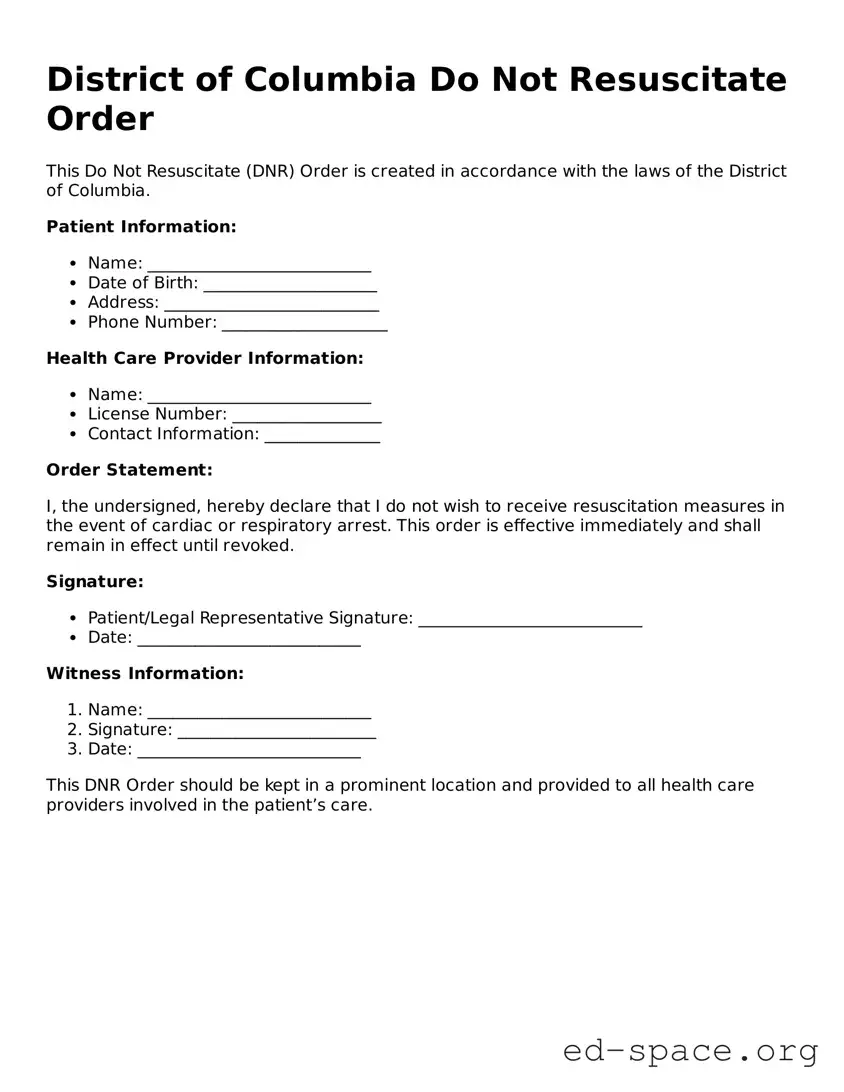
The District of Columbia Do Not Resuscitate (DNR) Order form serves as a critical document for individuals who wish to express their preferences regarding medical treatment in emergency situations. This form is designed to guide healthcare providers in understanding the wishes of patients who may be unable to communicate their desires during a medical crisis. It allows individuals to indicate their choice to forgo resuscitation efforts, such as cardiopulmonary resuscitation (CPR), in the event of cardiac or respiratory arrest. By completing the DNR Order, patients can ensure that their end-of-life care aligns with their personal values and beliefs. The form must be signed by a licensed physician and can be presented in various healthcare settings, including hospitals, nursing homes, and during home care. Importantly, the DNR Order is valid only when it is properly completed and signed, emphasizing the need for clarity and accuracy in documenting one's healthcare preferences. Understanding the implications of this form is essential for both patients and their families, as it plays a significant role in the decision-making process regarding life-sustaining treatments.
District of Columbia Do Not Resuscitate Order
This Do Not Resuscitate (DNR) Order is created in accordance with the laws of the District of Columbia.
Patient Information:
Health Care Provider Information:
Order Statement:
I, the undersigned, hereby declare that I do not wish to receive resuscitation measures in the event of cardiac or respiratory arrest. This order is effective immediately and shall remain in effect until revoked.
Signature:
Witness Information:
This DNR Order should be kept in a prominent location and provided to all health care providers involved in the patient’s care.
| Fact Name | Details |
|---|---|
| Purpose | The Do Not Resuscitate (DNR) Order form is used to indicate a patient's wish not to receive CPR or other resuscitation efforts in the event of cardiac arrest. |
| Governing Law | The DNR Order form in the District of Columbia is governed by the D.C. Code § 7-601 et seq. |
| Eligibility | Any adult who is capable of making their own medical decisions can complete a DNR Order form. |
| Signature Requirements | The form must be signed by the patient or their legal representative, and it should be witnessed by two individuals or notarized. |
| Revocation | A DNR Order can be revoked at any time by the patient or their legal representative, either verbally or in writing. |
Filling out the District of Columbia Do Not Resuscitate Order form is an important step for individuals who wish to express their preferences regarding medical treatment in emergency situations. Completing this form ensures that healthcare providers are aware of your wishes, and it can provide peace of mind for both you and your loved ones.
What is a Do Not Resuscitate (DNR) Order in the District of Columbia?
A Do Not Resuscitate Order is a legal document that allows a person to refuse certain life-saving medical treatments, specifically cardiopulmonary resuscitation (CPR), in the event of cardiac arrest. In the District of Columbia, this order is intended for individuals who have a terminal illness or are in a state where resuscitation may not improve their quality of life. It is important for individuals to discuss their wishes with their healthcare providers and loved ones before completing a DNR order.
How do I obtain a DNR Order form in the District of Columbia?
To obtain a DNR Order form, individuals can contact their healthcare provider or visit the District of Columbia Department of Health's website. The form is often available at hospitals, clinics, or through hospice care organizations. It is essential to fill out the form accurately and ensure it is signed by both the patient and their physician to make it legally binding.
What information is required on the DNR Order form?
The DNR Order form typically requires the patient's name, date of birth, and a statement indicating the patient's wishes regarding resuscitation. Additionally, it must include the signature of the patient or their legal representative, along with the signature of a physician. Some forms may also ask for specific details about the patient's medical condition to clarify the reasons for the DNR request.
Can a DNR Order be revoked or changed?
Yes, a DNR Order can be revoked or changed at any time by the patient or their legal representative. To revoke the order, the individual should inform their healthcare provider and may need to complete a new form to indicate their updated wishes. It is crucial to ensure that all healthcare providers involved are aware of any changes to avoid confusion during a medical emergency.
Will a DNR Order affect other medical treatments?
A DNR Order specifically addresses resuscitation efforts in the event of cardiac arrest. It does not affect other medical treatments or interventions that a patient may receive. Healthcare providers will continue to provide necessary medical care, including pain management and comfort measures, even if a DNR Order is in place. Patients should discuss their overall treatment preferences with their healthcare team to ensure their wishes are fully understood and respected.
Inaccurate Patient Information: Individuals often fail to provide complete and correct patient details, such as name, date of birth, and medical record number. This can lead to confusion and delays in honoring the order.
Signature Issues: Some people neglect to obtain the required signatures. Both the patient (or their legal representative) and the physician must sign the form for it to be valid.
Not Discussing with Healthcare Providers: Failing to have a thorough discussion with healthcare providers can result in misunderstandings about the patient's wishes and medical situation.
Incorrect Date: Individuals sometimes forget to date the form. An undated form may be considered invalid, causing potential complications in emergency situations.
Not Keeping Copies: After filling out the form, some forget to make copies for themselves and their healthcare team. This can hinder communication and enforcement of the order.
Ignoring State-Specific Requirements: People may overlook specific state requirements for the Do Not Resuscitate Order. Each jurisdiction can have different rules that must be followed.
A Do Not Resuscitate (DNR) Order is a critical document for individuals who wish to communicate their preferences regarding resuscitation in medical emergencies. In addition to the DNR Order, several other forms and documents are often used to ensure that a person's healthcare wishes are respected. Below is a list of these important documents, each serving a unique purpose in the realm of healthcare decision-making.
Understanding these documents is essential for ensuring that healthcare decisions align with personal values and preferences. Each form plays a vital role in facilitating communication between patients, families, and healthcare providers, ultimately leading to more informed and respectful care choices.
A Do Not Resuscitate (DNR) Order is an important document that outlines a person's wishes regarding medical treatment in case of a medical emergency. Several other documents serve similar purposes in guiding healthcare decisions. Here are seven documents that share similarities with a DNR Order:
Each of these documents plays a critical role in ensuring that an individual’s healthcare preferences are respected, particularly during emergencies when they may not be able to communicate their wishes directly.
When filling out the District of Columbia Do Not Resuscitate Order form, it is important to follow specific guidelines to ensure that the document is completed correctly. Here are four things to consider:
Understanding the Do Not Resuscitate (DNR) Order form in the District of Columbia is crucial for making informed healthcare decisions. However, there are several misconceptions surrounding this important document. Below are some common misunderstandings:
By clarifying these misconceptions, individuals can make more informed decisions about their healthcare preferences and ensure that their wishes are respected in critical situations.
When filling out and using the District of Columbia Do Not Resuscitate (DNR) Order form, consider the following key takeaways:
These steps are crucial for ensuring that your healthcare preferences are honored. Act promptly to avoid any misunderstandings in emergency situations.