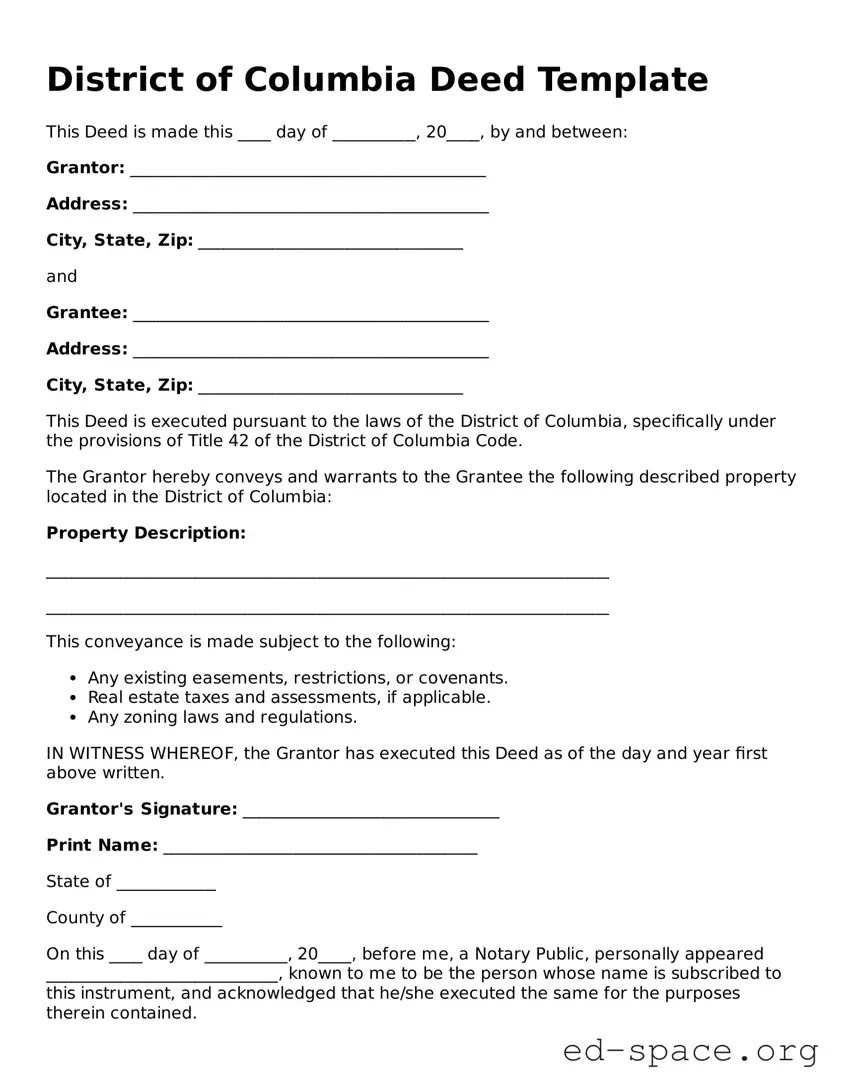
The District of Columbia Deed form serves as a crucial document in the process of transferring property ownership within the nation's capital. This form outlines the essential details of the transaction, including the names of the buyer and seller, a description of the property, and the terms of the transfer. It is important for both parties to accurately fill out this form to ensure a smooth transfer process. Additionally, the deed must be signed by the seller and, in some cases, notarized to validate the transaction. Understanding the requirements and components of the District of Columbia Deed form is vital for anyone involved in real estate transactions in this area. Proper completion of this form not only helps establish legal ownership but also protects the rights of both the buyer and the seller throughout the process.
District of Columbia Deed Template
This Deed is made this ____ day of __________, 20____, by and between:
Grantor: ___________________________________________
Address: ___________________________________________
City, State, Zip: ________________________________
and
Grantee: ___________________________________________
Address: ___________________________________________
City, State, Zip: ________________________________
This Deed is executed pursuant to the laws of the District of Columbia, specifically under the provisions of Title 42 of the District of Columbia Code.
The Grantor hereby conveys and warrants to the Grantee the following described property located in the District of Columbia:
Property Description:
____________________________________________________________________
____________________________________________________________________
This conveyance is made subject to the following:
IN WITNESS WHEREOF, the Grantor has executed this Deed as of the day and year first above written.
Grantor's Signature: _______________________________
Print Name: ______________________________________
State of ____________
County of ___________
On this ____ day of __________, 20____, before me, a Notary Public, personally appeared ____________________________, known to me to be the person whose name is subscribed to this instrument, and acknowledged that he/she executed the same for the purposes therein contained.
Notary Public Signature: ___________________________
My Commission Expires: ___________________________
| Fact Name | Description |
|---|---|
| Governing Law | The District of Columbia Deed form is governed by Title 42 of the District of Columbia Code. |
| Types of Deeds | Common types include warranty deeds, quitclaim deeds, and special purpose deeds. |
| Signature Requirements | All parties involved must sign the deed for it to be valid. |
| Notarization | A notary public must witness the signatures on the deed. |
| Recording | Deeds must be recorded with the District of Columbia Recorder of Deeds to provide public notice. |
| Property Description | A legal description of the property must be included in the deed. |
| Consideration | The deed should state the consideration, or value exchanged, for the property transfer. |
| Transfer Tax | A transfer tax may apply, calculated based on the sale price of the property. |
| Revocation | Once recorded, a deed cannot be unilaterally revoked; a new deed is required for changes. |
| Legal Assistance | While not mandatory, consulting a lawyer is advisable to ensure compliance with local laws. |
Filling out the District of Columbia Deed form is an important step in transferring property ownership. After completing the form, you will need to submit it to the appropriate office for recording. This ensures that the transfer is legally recognized and protects your interests in the property.
What is a District of Columbia Deed form?
The District of Columbia Deed form is a legal document used to transfer ownership of real property within Washington, D.C. It serves as evidence of the transfer and outlines the rights and obligations of the parties involved. This form must be properly filled out, signed, and recorded to be legally effective.
What types of deeds are available in the District of Columbia?
In Washington, D.C., there are several types of deeds, including warranty deeds, quitclaim deeds, and special warranty deeds. A warranty deed guarantees that the seller holds clear title to the property and has the right to sell it. A quitclaim deed transfers whatever interest the seller has in the property without any warranties. Special warranty deeds offer limited guarantees, covering only the time the seller owned the property.
How do I fill out a District of Columbia Deed form?
To fill out a District of Columbia Deed form, you must provide essential information such as the names of the grantor (seller) and grantee (buyer), the legal description of the property, and the consideration (purchase price). It is crucial to ensure that all information is accurate and complete. Any errors can lead to complications in the transfer process.
Do I need a notary public to execute a Deed form?
Yes, a notary public must witness the signing of the District of Columbia Deed form. The notary verifies the identities of the signers and confirms that they are signing voluntarily. This step is essential for the deed to be considered valid and enforceable.
Where do I file the District of Columbia Deed form?
The completed Deed form must be filed with the Recorder of Deeds in Washington, D.C. This office is responsible for maintaining public records of property transactions. Filing the deed ensures that the transfer of ownership is officially recorded and protects the rights of the new property owner.
Are there any fees associated with filing a Deed form in D.C.?
Yes, there are fees associated with filing a District of Columbia Deed form. These fees can vary based on the type of deed and the value of the property being transferred. It is advisable to check with the Recorder of Deeds for the most current fee schedule before filing.
What happens if I do not file the Deed form?
If you do not file the District of Columbia Deed form, the transfer of ownership may not be legally recognized. This can lead to disputes over property rights and complications in future transactions. Filing the deed is crucial for ensuring that the new owner's interest in the property is protected and acknowledged by the public record.
Incorrect Property Description: One common mistake is failing to provide a complete and accurate description of the property being transferred. This includes not specifying the correct lot number, square number, or address. Without precise details, the deed may not be valid.
Improper Signatures: All parties involved in the transaction must sign the deed. A frequent error occurs when one or more signatures are missing or when the signers do not match the names listed in the document. This can lead to delays or legal complications.
Not Including the Notary: A deed must be notarized to be legally binding. Some individuals forget to have the deed notarized or choose an unqualified notary, which can invalidate the document.
Failure to Record the Deed: After completing the deed, it is essential to record it with the appropriate government office. Neglecting this step means the transfer of ownership may not be recognized publicly, which can cause issues in the future.
When dealing with property transactions in the District of Columbia, several forms and documents are commonly used alongside the Deed form. These documents help clarify ownership, establish agreements, and ensure that all legal requirements are met. Below is a list of important forms that may accompany the Deed form.
Each of these documents plays a vital role in the property transfer process. They help protect the interests of both buyers and sellers, ensuring a smooth and legally sound transaction. Understanding these forms can facilitate better communication and reduce the likelihood of disputes in the future.
The Deed form is a crucial document in property law, serving to transfer ownership or rights in real estate. However, several other documents share similarities with the Deed form in purpose or function. Below is a list of ten such documents, along with a brief explanation of how each relates to the Deed form.
Understanding these documents can enhance one’s comprehension of property transactions and the legal frameworks surrounding them. Each plays a distinct role while sharing common themes with the Deed form.
When filling out the District of Columbia Deed form, it’s important to ensure accuracy and compliance with local regulations. Here’s a helpful list of things to do and avoid during this process.
Following these guidelines will help ensure a smoother process when completing the District of Columbia Deed form.
When it comes to real estate transactions in the District of Columbia, misunderstandings about the deed form can lead to confusion and complications. Here are eight common misconceptions about the District of Columbia deed form, along with clarifications to help you navigate the process more effectively.
Understanding these misconceptions can empower you to approach real estate transactions in the District of Columbia with greater confidence. Always consider seeking professional advice when dealing with property matters to ensure that your interests are fully protected.
Filling out and using the District of Columbia Deed form is an important step in property transactions. Here are some key takeaways to keep in mind:
By following these key takeaways, you can navigate the process of filling out and using the District of Columbia Deed form with greater confidence.