When establishing a business in the District of Columbia, one of the first steps you will encounter is the completion of the Articles of Incorporation form. This essential document serves as the foundation for your corporation, outlining key information necessary for its legal recognition. Among the major aspects covered in the form are the corporation's name, which must be unique and compliant with state regulations, and the purpose of the business, which provides clarity on its intended activities. Additionally, the form requires details about the registered agent, who will act as the point of contact for legal documents, as well as the names and addresses of the initial directors. Importantly, the Articles of Incorporation also include provisions related to the number of shares the corporation is authorized to issue, ensuring that you establish a clear structure for ownership. Completing this form accurately is crucial, as it not only facilitates the legal formation of your corporation but also sets the stage for future compliance with local laws and regulations.
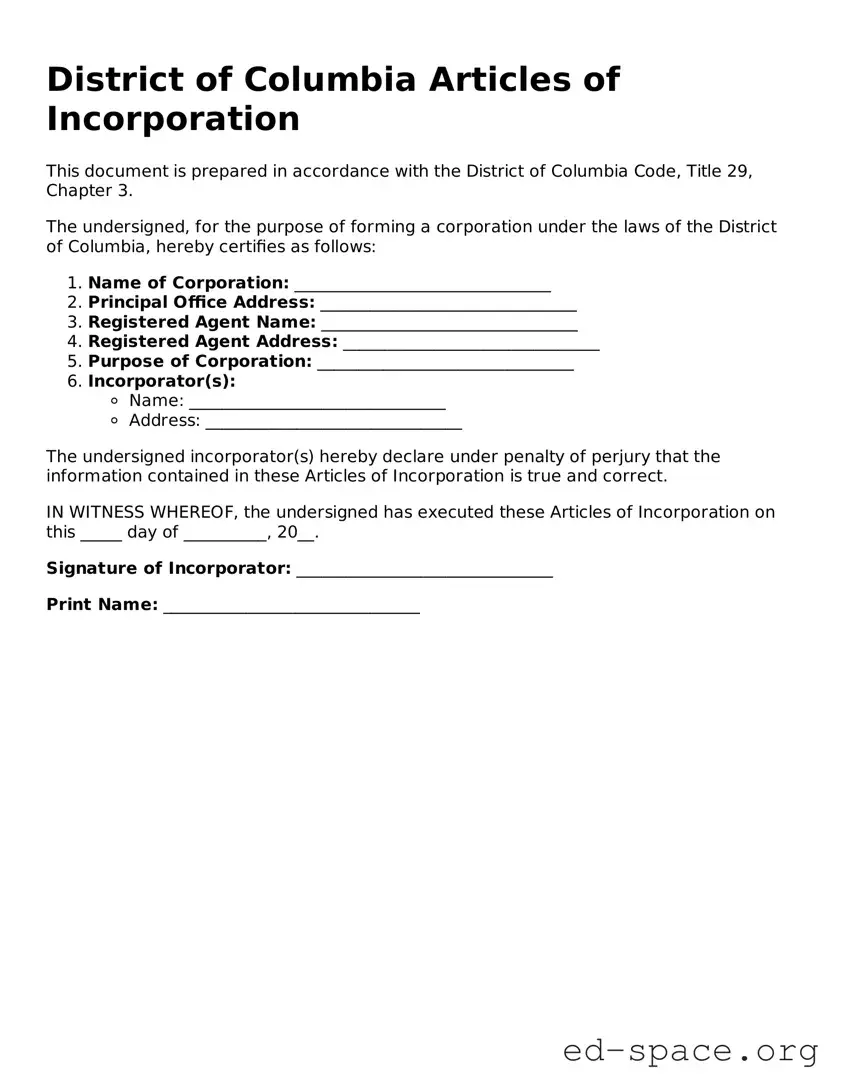
District of Columbia Articles of Incorporation
This document is prepared in accordance with the District of Columbia Code, Title 29, Chapter 3.
The undersigned, for the purpose of forming a corporation under the laws of the District of Columbia, hereby certifies as follows:
The undersigned incorporator(s) hereby declare under penalty of perjury that the information contained in these Articles of Incorporation is true and correct.
IN WITNESS WHEREOF, the undersigned has executed these Articles of Incorporation on this _____ day of __________, 20__.
Signature of Incorporator: _______________________________
Print Name: _______________________________
| Fact Name | Description |
|---|---|
| Governing Law | The District of Columbia's Articles of Incorporation are governed by the D.C. Code Title 29, Chapter 3. |
| Purpose | The form is used to officially create a corporation in the District of Columbia. |
| Filing Requirement | Filing the Articles of Incorporation is mandatory for all corporations wishing to operate in D.C. |
| Information Needed | Key details include the corporation's name, registered agent, and business address. |
| Filing Fee | A fee is required upon submission of the Articles of Incorporation, which varies based on the type of corporation. |
| Processing Time | Standard processing time can take several business days; expedited options may be available for an additional fee. |
| Amendments | Changes to the Articles of Incorporation can be made by filing an amendment form with the appropriate fee. |
After you have completed the District of Columbia Articles of Incorporation form, you will need to submit it to the appropriate state office. This step is crucial for officially establishing your business entity in Washington, D.C. Be prepared to pay any associated filing fees, which may vary based on the type of corporation you are forming.
What are the Articles of Incorporation?
The Articles of Incorporation are a legal document that establishes a corporation in the District of Columbia. This document outlines essential information about the corporation, including its name, purpose, registered agent, and the number of shares it is authorized to issue. Filing this document is a crucial first step in forming a corporation, as it provides the state with the necessary information to recognize the business as a separate legal entity.
Who needs to file Articles of Incorporation?
Any individual or group looking to start a corporation in the District of Columbia must file Articles of Incorporation. This includes for-profit corporations, non-profit organizations, and professional corporations. If you are planning to operate as a corporation, this filing is mandatory to ensure your business is legally recognized and protected under the law.
What information is required in the Articles of Incorporation?
The Articles of Incorporation must include specific details, such as the corporation's name, the purpose of the business, the address of the principal office, the name and address of the registered agent, and the number of shares the corporation is authorized to issue. Additionally, the names and addresses of the incorporators are also required. Providing accurate and complete information is essential to avoid delays in the approval process.
How do I file the Articles of Incorporation?
Filing the Articles of Incorporation can be done online or by submitting a paper form to the Department of Consumer and Regulatory Affairs (DCRA) in the District of Columbia. When filing online, you will need to create an account on the DCRA's website. If you choose to file by mail, ensure that you send the completed form along with the required filing fee. Always keep a copy of the submitted documents for your records.
What is the filing fee for the Articles of Incorporation?
The filing fee for the Articles of Incorporation in the District of Columbia varies depending on the type of corporation you are forming. As of the latest information, the fee for a standard for-profit corporation is typically around $220, while non-profit corporations may have a different fee structure. It's important to check the DCRA's website for the most current fee schedule before submitting your application.
How long does it take for the Articles of Incorporation to be processed?
Processing times for Articles of Incorporation can vary based on the volume of applications received by the DCRA. Generally, you can expect a turnaround time of a few business days to a couple of weeks. If you file online, you may receive confirmation more quickly than if you submit a paper application. For expedited processing, inquire about any available options that may reduce the wait time.
What happens after my Articles of Incorporation are approved?
Once the Articles of Incorporation are approved, the corporation is officially formed. You will receive a certificate of incorporation, which serves as proof of your corporation's existence. After incorporation, it is essential to comply with ongoing requirements, such as obtaining necessary business licenses, filing annual reports, and maintaining good standing with the state. Staying informed about these obligations is crucial for the long-term success of your corporation.
Incorrect Entity Name: One common mistake is failing to choose a unique name for the corporation. The name must not only be distinct but also include a designator like "Corporation," "Incorporated," or "Limited." Before submitting, it’s wise to check the availability of the name through the District of Columbia's business registry.
Missing Registered Agent Information: Every corporation in the District of Columbia must designate a registered agent. This agent is responsible for receiving legal documents. Omitting this information can lead to delays or even rejection of the application.
Inaccurate Business Purpose: The Articles of Incorporation require a statement of the corporation’s purpose. Some individuals either leave this section blank or provide vague descriptions. It’s important to be clear and specific about what the corporation will do.
Failure to Include Initial Directors: Many people forget to list the initial directors of the corporation. This information is crucial as it establishes who will be in charge at the outset. Ensure that the names and addresses of these directors are included.
Not Signing the Form: Lastly, a simple yet critical mistake is neglecting to sign the Articles of Incorporation. Without a signature, the form is incomplete and cannot be processed. Double-check that all required signatures are present before submission.
When forming a corporation in the District of Columbia, several other forms and documents may be required alongside the Articles of Incorporation. Each of these documents serves a specific purpose and helps ensure compliance with local regulations. Here’s a brief overview of some common forms you might encounter:
Understanding these documents and their purposes can simplify the incorporation process. Each plays a vital role in establishing a solid foundation for your corporation and ensuring compliance with legal requirements.
The Articles of Incorporation form is a crucial document for establishing a corporation. It shares similarities with several other legal documents. Here’s a list of documents that are comparable to the Articles of Incorporation:
When filling out the District of Columbia Articles of Incorporation form, there are important steps to follow. Here’s a list of what you should and shouldn’t do:
When considering the Articles of Incorporation for the District of Columbia, several misconceptions often arise. Understanding these misconceptions is crucial for individuals and businesses looking to incorporate in this unique jurisdiction. Below is a list of common misunderstandings.
By addressing these misconceptions, individuals and businesses can make informed decisions about the incorporation process in the District of Columbia. Understanding the true nature of Articles of Incorporation can empower entrepreneurs to take the necessary steps toward establishing their businesses legally and effectively.
Filling out the District of Columbia Articles of Incorporation form is an essential step for anyone looking to establish a corporation in the area. Here are some key takeaways to keep in mind:
By keeping these points in mind, you can navigate the process of incorporating in the District of Columbia more effectively.