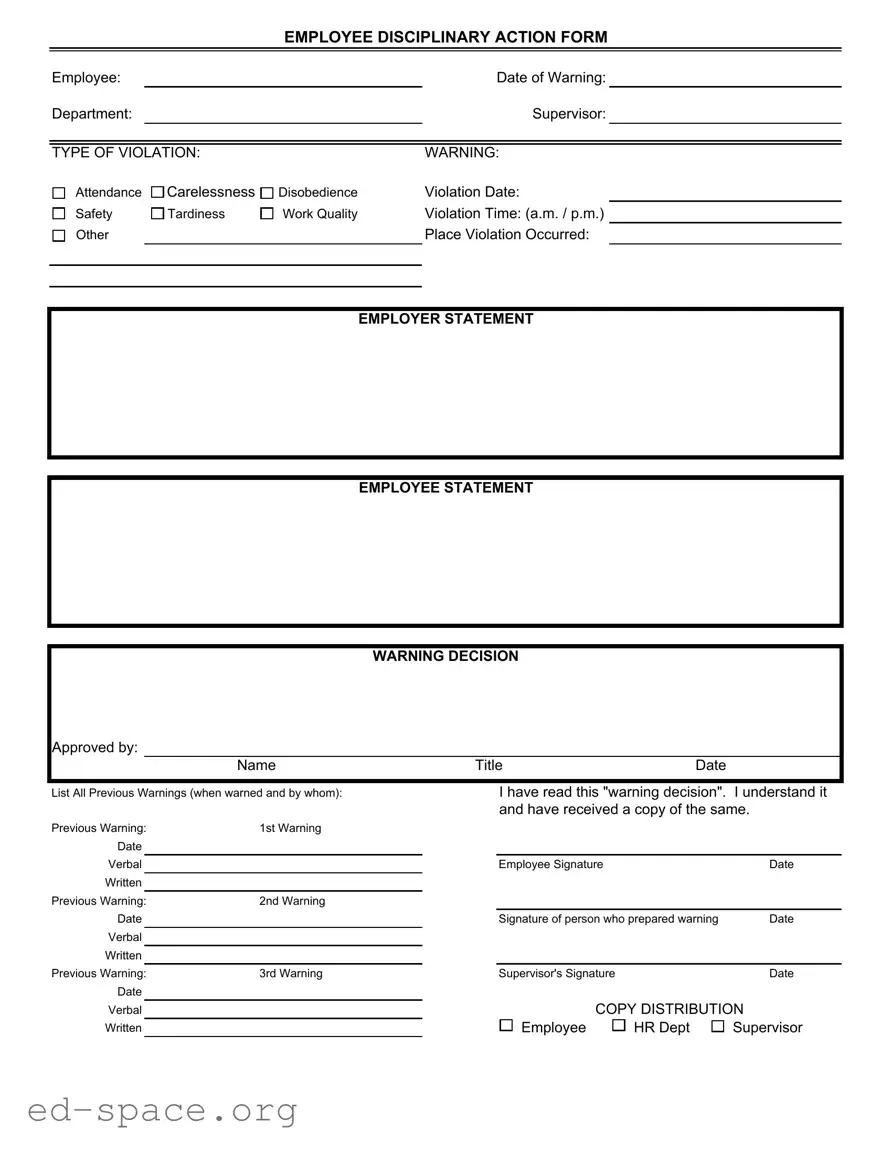
The Disciplinary Action form serves as a crucial tool for employers to address employee misconduct or performance issues in a structured manner. This form captures essential details, including the employee's name, the date of the warning, and the department in which the employee works. It outlines the type of violation, which may range from attendance issues to safety violations. Additionally, the form records the specific date and time of the violation, along with the location where it occurred. Both employer and employee statements are included, allowing for a comprehensive view of the situation. The form also tracks previous warnings, detailing when and by whom the employee was warned, ensuring a clear history of disciplinary actions. Finally, it requires signatures from the employee, the supervisor, and the person who prepared the warning, confirming that all parties understand the warning decision. Proper distribution of copies to the employee, HR department, and supervisor ensures transparency and accountability throughout the process.
EMPLOYEE DISCIPLINARY ACTION FORM
Employee: |
|
Date of Warning: |
Department:Supervisor:
TYPE OF VIOLATION:
Attendance Carelessness
Safety |
Tardiness |
Other
|
WARNING: |
Disobedience |
Violation Date: |
Work Quality |
Violation Time: (a.m. / p.m.) |
|
Place Violation Occurred: |
EMPLOYER STATEMENT
EMPLOYEE STATEMENT
WARNING DECISION
Approved by:
|
|
Name |
Title |
Date |
|
|
||
|
|
|
|
|
||||
List All Previous Warnings (when warned and by whom): |
|
I have read this "warning decision". I understand it |
||||||
|
|
|
|
and have received a copy of the same. |
||||
Previous Warning: |
1st Warning |
|
|
|
|
|
|
|
Date |
|
|
|
|
|
|
|
|
Verbal |
|
|
|
Employee Signature |
|
Date |
||
Written |
|
|
|
|
|
|
|
|
Previous Warning: |
2nd Warning |
|
|
|
|
|
|
|
Date |
|
|
|
Signature of person who prepared warning |
Date |
|||
Verbal |
|
|
|
|
|
|
|
|
Written |
|
|
|
|
|
|
|
|
Previous Warning: |
3rd Warning |
|
Supervisor's Signature |
|
Date |
|||
Date |
|
|
|
|
|
|
|
|
Verbal |
|
|
COPY DISTRIBUTION |
|||||
Written |
|
|
|
Employee |
|
HR Dept |
Supervisor |
|
|
|
|
||||||
| Fact Name | Details |
|---|---|
| Purpose | The Disciplinary Action form is used to document employee violations and the corresponding disciplinary actions taken. |
| Types of Violations | Common violations include attendance issues, carelessness, safety breaches, tardiness, and other infractions. |
| Warning Decision | The form includes a section for the employer's decision on the disciplinary action, which must be approved by a designated authority. |
| Employee Acknowledgment | Employees must sign the form to acknowledge that they have read and understood the warning decision. |
| Previous Warnings | The form requires documentation of all previous warnings, including dates and the individuals who issued them. |
| Distribution | Copies of the completed form are distributed to the employee, HR department, and the supervisor. |
| Governing Laws | State-specific forms may be governed by labor laws, such as the Fair Labor Standards Act (FLSA) or state employment laws. |
| Signature Requirements | Signatures from both the employee and the supervisor are required to validate the form and the actions taken. |
| Date and Time | The form captures the date and time of the violation, which is crucial for record-keeping and follow-up actions. |
| Importance of Documentation | Proper documentation through this form helps protect the employer in case of disputes regarding employee conduct. |
After completing the Disciplinary Action form, it will be used to document the details of the warning and the circumstances surrounding it. This record will be important for both the employee and the employer moving forward.
Once completed, ensure that copies are distributed to the Employee, HR Dept, and Supervisor.
What is the purpose of the Disciplinary Action form?
The Disciplinary Action form serves as a formal record of violations committed by an employee. It documents the details of the incident, including the type of violation and any previous warnings. This ensures transparency and provides a structured approach to addressing employee behavior within the workplace.
What information is required on the form?
The form requires specific information such as the employee's name, date of the warning, department, and supervisor's name. Additionally, it includes details about the type of violation, the date and time it occurred, and the location of the incident. Statements from both the employer and employee are also necessary, along with signatures to confirm understanding and receipt of the warning.
What types of violations can be documented?
The form allows for various types of violations to be recorded, including attendance issues, carelessness, safety violations, tardiness, and other specified concerns. Each violation type is categorized to streamline the disciplinary process and ensure appropriate actions are taken.
How does the warning process work?
When an employee commits a violation, the supervisor completes the Disciplinary Action form. After reviewing the incident, the supervisor discusses the warning with the employee. Both parties then sign the form, indicating that the employee understands the warning and has received a copy for their records.
What happens if an employee receives multiple warnings?
The form allows for the documentation of previous warnings. If an employee receives multiple warnings, each instance is recorded on the form, providing a clear history of disciplinary actions taken. This history can be critical for determining future actions, including potential termination if behavior does not improve.
Who has access to the completed form?
Access to the completed Disciplinary Action form is typically limited to relevant parties. The form is distributed to the employee, the HR department, and the supervisor. This controlled distribution helps maintain confidentiality while ensuring that those involved are informed of the disciplinary action taken.
What should an employee do if they disagree with the warning?
If an employee disagrees with the warning, they can provide their statement on the form. This statement allows the employee to express their perspective on the situation. It's essential for the employee to communicate their concerns to their supervisor or HR for further discussion and resolution.
Is the Disciplinary Action form a permanent record?
Yes, the Disciplinary Action form is considered a permanent record of the employee's conduct within the company. It may be referenced in future evaluations or disciplinary actions. Maintaining accurate records is vital for both the employee and employer to ensure fair treatment and compliance with company policies.
How can an employee improve after receiving a warning?
After receiving a warning, an employee should take the feedback seriously and work on the areas highlighted in the form. Engaging in open communication with supervisors, seeking additional training if necessary, and demonstrating a commitment to improvement can help rebuild trust and enhance performance.
Incomplete Information: Failing to fill out all required fields can lead to confusion and delays. Ensure that the employee's name, date of warning, department, and supervisor are all clearly stated.
Ambiguous Violation Type: Selecting "Other" without providing a clear explanation can create misunderstandings. Be specific about the type of violation to ensure clarity.
Missing Dates and Times: Omitting the date and time of the violation may weaken the case. Always include this information to establish a clear timeline.
Neglecting Previous Warnings: Failing to list prior warnings can undermine the current disciplinary action. Document all previous warnings, including dates and who issued them.
Ignoring Employee Statement: Not allowing the employee to provide their perspective may lead to incomplete documentation. Always include the employee's statement for a balanced view.
Signature Issues: Forgetting to obtain necessary signatures can invalidate the form. Ensure that both the supervisor and employee sign and date the document.
When addressing employee conduct issues, the Disciplinary Action form is just one piece of the puzzle. Several other documents complement this form, helping to ensure a comprehensive approach to employee management. Here are a few key forms often used alongside the Disciplinary Action form:
Each of these documents plays a crucial role in the disciplinary process, ensuring that both the employer and employee have a clear understanding of expectations and consequences. By utilizing these forms effectively, organizations can foster a fair and transparent workplace environment.
The Disciplinary Action form is a crucial document in managing employee behavior and performance. It shares similarities with several other documents used in the workplace. Here are five documents that are comparable:
When filling out the Disciplinary Action form, it’s important to approach the task with care and attention to detail. Here are some key do's and don'ts to keep in mind:
By following these guidelines, you can help ensure that the Disciplinary Action form is filled out correctly and serves its intended purpose effectively.
There are several misconceptions surrounding the Disciplinary Action form that can lead to confusion among employees and supervisors alike. Understanding these misconceptions can help clarify the purpose and use of the form.
Many believe that the Disciplinary Action form is reserved solely for serious offenses. In reality, it can be used for a range of violations, including attendance issues and minor infractions.
Some employees think that signing the form equates to an immediate dismissal. However, the form serves as a record of the warning and does not automatically lead to termination.
While supervisors typically initiate the form, employees can also provide their statements. This ensures that both sides of the issue are documented.
Some employees may feel that past warnings are irrelevant. In fact, the form tracks all previous warnings, which can influence future disciplinary actions.
When filling out and using the Disciplinary Action form, it is essential to keep a few key points in mind to ensure clarity and effectiveness.
By following these guidelines, the disciplinary process can be more effective and fair for everyone involved.