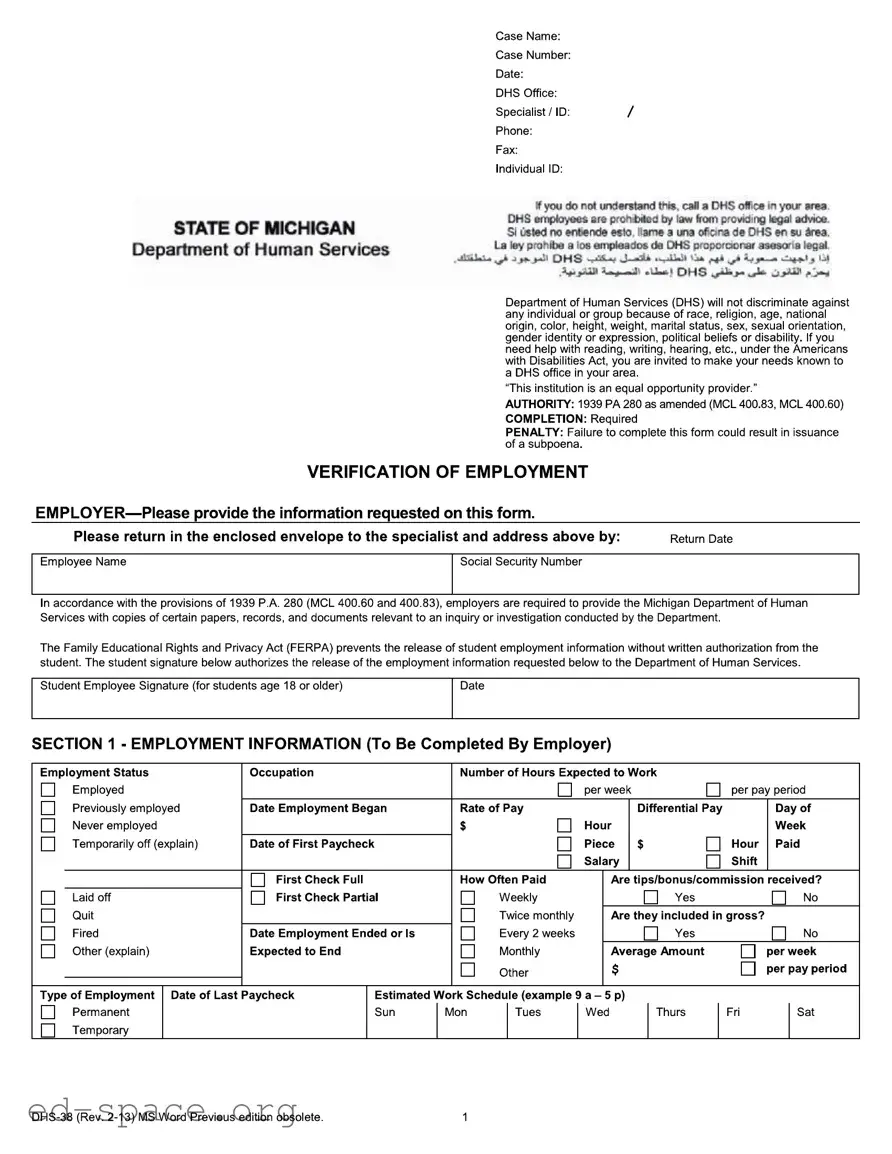
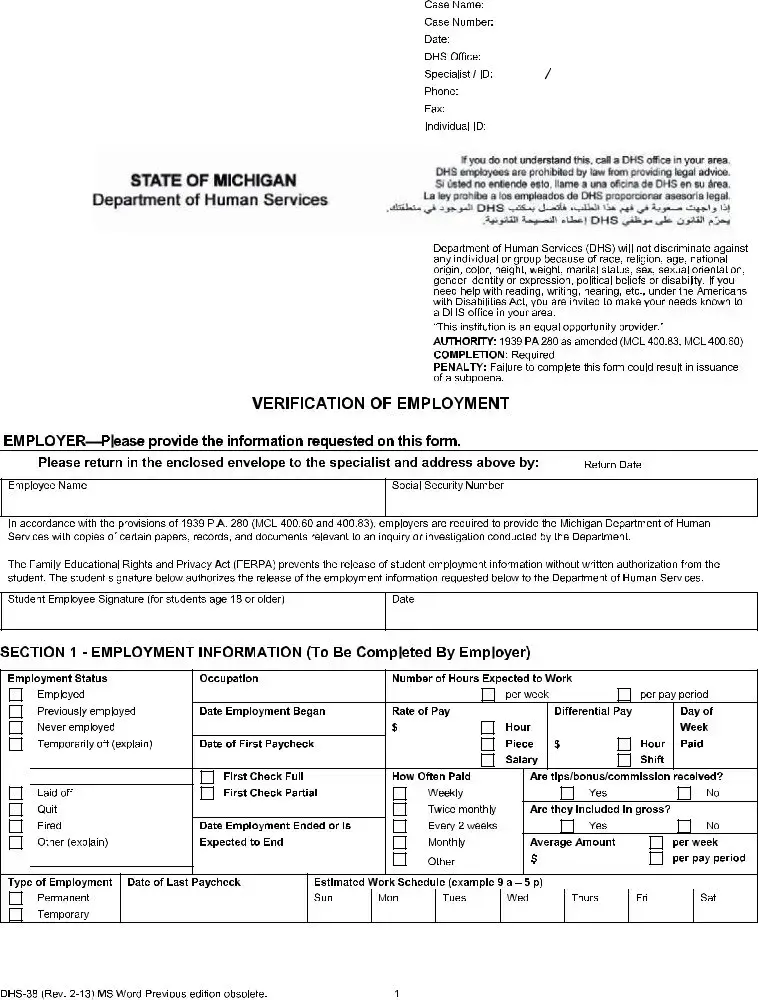
The DHS 38 form is an essential document utilized by the Michigan Department of Human Services to gather critical employment and income information from employers regarding individuals seeking assistance. This form serves multiple purposes, including verifying employment status, documenting income details, and collecting information about health insurance and retirement benefits. Employers are required to provide comprehensive details about their employees, including job title, pay rate, and hours worked. Additionally, the form mandates the disclosure of any disability or workers' compensation benefits received during a specified period. Importantly, the DHS 38 form emphasizes the protection of individual rights, ensuring that all information is handled without discrimination based on various personal characteristics. It also highlights the legal implications of providing false information, reminding employers of the serious consequences of misrepresentation. By facilitating a structured approach to information collection, the DHS 38 form plays a vital role in the assistance process, ensuring that eligible individuals receive the support they need.
| Fact Name | Description |
|---|---|
| Governing Law | The DHS 38 form is governed by the Michigan Public Act 280 of 1939, specifically MCL 400.60 and MCL 400.83. |
| Purpose | This form is used to verify employment and gather necessary information for inquiries or investigations conducted by the Michigan Department of Human Services. |
| Completion Requirement | Completing the DHS 38 form is mandatory. Failure to do so may lead to the issuance of a subpoena. |
| Non-Discrimination Policy | The Department of Human Services ensures that it does not discriminate against any individual or group based on various factors, including race, religion, and gender identity. |
Completing the DHS 38 form requires careful attention to detail. This form collects important information regarding employment, income, and benefits, which will be used for further processing. Ensure that all sections are filled out accurately to avoid any delays or issues.
What is the purpose of the DHS 38 form?
The DHS 38 form is designed for employers to provide essential employment and income information to the Michigan Department of Human Services (DHS). This information is crucial for various inquiries or investigations conducted by the department, particularly when determining eligibility for assistance programs. By completing this form, employers help ensure that individuals receive the benefits they are entitled to based on their employment status and income.
Who is required to complete the DHS 38 form?
Employers are mandated to complete the DHS 38 form when requested by the Michigan Department of Human Services. This requirement stems from the provisions of the 1939 Public Act 280, which obligates employers to provide specific records and documents relevant to the department's inquiries. Additionally, if an employee is a student aged 18 or older, their signature is required to authorize the release of their employment information.
What information must be provided on the DHS 38 form?
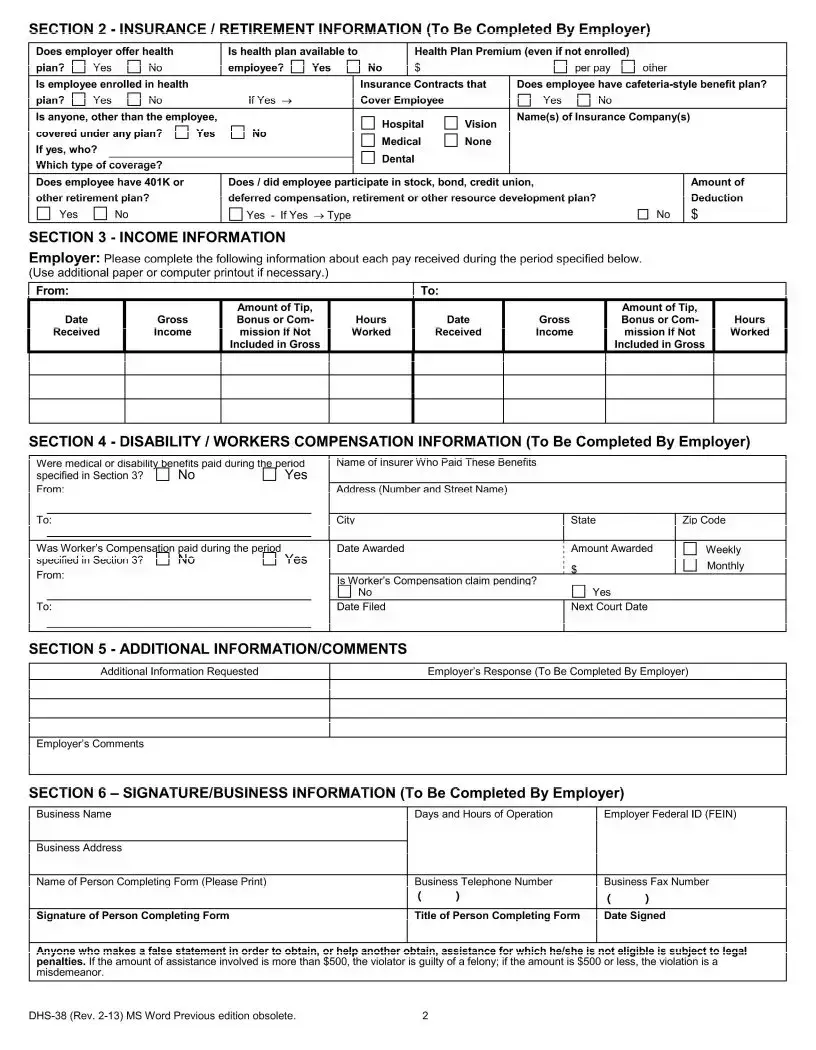
The form requires detailed information about the employee's employment status, including whether they are currently employed, previously employed, or never employed. Employers must provide the employee's name, Social Security number, occupation, employment dates, rate of pay, and details about any health or retirement plans offered. Furthermore, the form asks for income information, including bonuses and commissions, as well as any disability or workers' compensation benefits that may have been paid.
What happens if the DHS 38 form is not completed?
Failure to complete the DHS 38 form can lead to serious consequences. The form explicitly states that non-compliance may result in the issuance of a subpoena. This legal action can compel the employer to provide the necessary information, emphasizing the importance of timely and accurate completion of the form to avoid further legal complications.
How does the DHS ensure non-discrimination?
The Michigan Department of Human Services is committed to providing equal opportunities for all individuals, regardless of race, religion, age, national origin, color, height, weight, marital status, sex, sexual orientation, gender identity or expression, political beliefs, or disability. This commitment is outlined in the form, which assures individuals that they will not face discrimination in the services provided by DHS. If any individual requires assistance due to a disability, they are encouraged to inform their local DHS office.
What legal penalties are associated with false statements on the DHS 38 form?
Individuals who make false statements to obtain assistance for which they are not eligible face significant legal penalties. If the amount of assistance involved exceeds $500, the offender may be charged with a felony. Conversely, if the amount is $500 or less, the violation is classified as a misdemeanor. This provision underscores the importance of honesty and accuracy when completing the form to avoid serious legal repercussions.
Incomplete Information: Many people forget to fill out all required sections. Leaving out important details, such as the case name or case number, can lead to delays in processing.
Incorrect Dates: It's common to make mistakes with dates. Ensure that employment start and end dates are accurate. Errors can cause confusion and may require additional follow-up.
Missing Signatures: Failing to sign the form is a frequent oversight. Without the necessary signatures, the form cannot be processed. Always double-check for required signatures before submission.
Neglecting to Provide Supporting Documents: Some individuals forget to attach required documents, such as proof of income or employment verification. This can result in a request for additional information, slowing down the process.
The DHS 38 form is an important document used by the Michigan Department of Human Services to gather information regarding an individual's employment status and related benefits. Along with the DHS 38 form, there are several other forms and documents that may be required to support the information provided or to comply with various regulations. Here are five such documents:
These documents work in conjunction with the DHS 38 form to ensure that the Department of Human Services has a complete and accurate understanding of an individual's employment and financial situation. Providing accurate information is crucial for the proper evaluation of eligibility for assistance programs.
When filling out the DHS 38 form, it’s important to follow certain guidelines to ensure the process goes smoothly. Here are some dos and don’ts to keep in mind:
Following these guidelines can help ensure that your submission is processed efficiently and correctly. Remember, accuracy and honesty are key when dealing with official forms.
Understanding the Dhs 38 form can be challenging. Here are eight common misconceptions about this form, clarified for better comprehension:
This form is mandatory. Failing to complete it can lead to legal penalties, including the issuance of a subpoena.
DHS employees are prohibited by law from giving legal advice. If you have questions, seek assistance from a qualified legal professional.
While certain protections exist, the information provided can be shared with relevant authorities for inquiries or investigations.
Completing the Dhs 38 form requires accuracy. Any mistakes or omissions can delay processing or affect eligibility.
The Dhs 38 form also applies to individuals who were previously employed or are temporarily off work. Accurate employment history is essential.
A signature is necessary for validation. It ensures that the information provided is accurate and authorized.
This form is specific to Michigan. Other states may have different forms and requirements for similar purposes.
Under the Americans with Disabilities Act, individuals can request assistance with reading, writing, or other needs when completing the form.
When dealing with the DHS 38 form, it’s essential to keep a few key points in mind. This form is crucial for verifying employment and income information for individuals seeking assistance from the Michigan Department of Human Services. Here are some important takeaways:
By keeping these points in mind, you can navigate the DHS 38 form process more effectively and ensure that your application is handled smoothly.