In the realm of estate planning and administration, the Delaware Small Estate Affidavit form serves as a vital tool for individuals navigating the complexities of settling a deceased person's affairs. This form simplifies the process for heirs and beneficiaries when the total value of the decedent's estate falls below a certain threshold, allowing for a more efficient transfer of assets without the need for formal probate proceedings. By utilizing the Small Estate Affidavit, individuals can assert their rights to inherit property, bank accounts, and other assets, provided they meet specific eligibility criteria. The form requires the inclusion of essential information such as the decedent's details, the names of heirs, and a declaration of the estate's value. Additionally, it must be signed under oath, ensuring the accuracy and legitimacy of the claims made within. Understanding the nuances of this form can significantly ease the burden on families during a challenging time, providing a streamlined approach to estate resolution while honoring the wishes of the deceased.
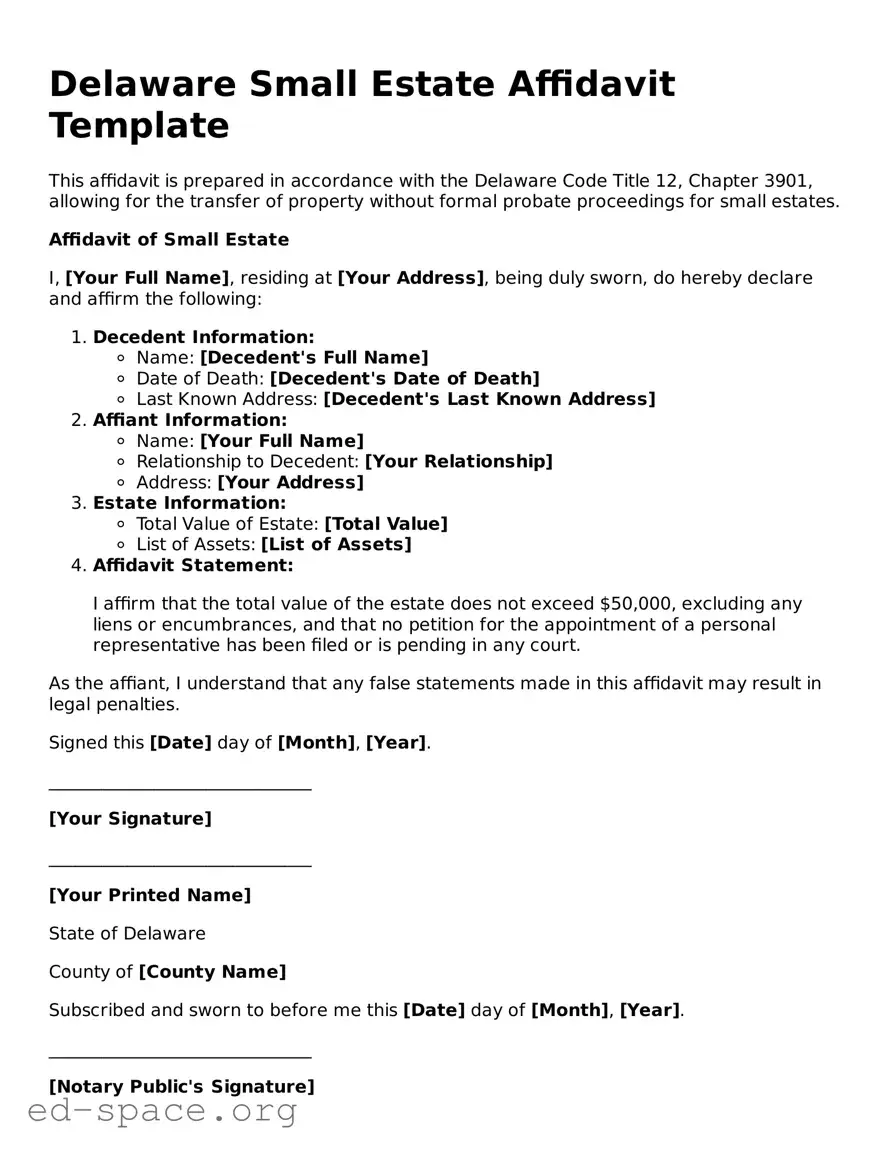
Delaware Small Estate Affidavit Template
This affidavit is prepared in accordance with the Delaware Code Title 12, Chapter 3901, allowing for the transfer of property without formal probate proceedings for small estates.
Affidavit of Small Estate
I, [Your Full Name], residing at [Your Address], being duly sworn, do hereby declare and affirm the following:
I affirm that the total value of the estate does not exceed $50,000, excluding any liens or encumbrances, and that no petition for the appointment of a personal representative has been filed or is pending in any court.
As the affiant, I understand that any false statements made in this affidavit may result in legal penalties.
Signed this [Date] day of [Month], [Year].
______________________________
[Your Signature]
______________________________
[Your Printed Name]
State of Delaware
County of [County Name]
Subscribed and sworn to before me this [Date] day of [Month], [Year].
______________________________
[Notary Public's Signature]
[Notary Public's Printed Name]
My Commission Expires: [Expiration Date]
| Fact Name | Details |
|---|---|
| Purpose | The Delaware Small Estate Affidavit is used to simplify the transfer of assets from a deceased person’s estate when the total value is below a certain threshold. |
| Threshold Amount | The estate must not exceed $50,000 in value for an individual or $100,000 for a couple to qualify for this affidavit. |
| Governing Law | The use of the Small Estate Affidavit in Delaware is governed by Title 12, Chapter 2306 of the Delaware Code. |
| Eligibility | Only certain individuals, such as immediate family members or designated heirs, can use the Small Estate Affidavit. |
| Filing Requirement | There is no need to file the affidavit with the court unless disputes arise or creditors need to be notified. |
| Asset Types | The affidavit can be used for various assets, including bank accounts, vehicles, and personal property. |
| Signature Requirement | The affidavit must be signed by the affiant, who is typically the person entitled to inherit the assets. |
| Witness Requirement | In Delaware, the affidavit must be signed in the presence of a notary public to be considered valid. |
| Tax Implications | Using a Small Estate Affidavit does not exempt the estate from taxes; all applicable taxes must still be addressed. |
| Limitations | The Small Estate Affidavit cannot be used for real estate or assets held in a trust. |
Once you have obtained the Delaware Small Estate Affidavit form, you are ready to begin filling it out. This process involves gathering the necessary information and completing the form accurately. Taking your time and ensuring that each section is filled out correctly will help facilitate the next steps in managing the estate.
After completing the form, you will need to submit it to the appropriate court or office, along with any required documentation. This will allow you to proceed with the distribution of the estate's assets according to the wishes of the decedent and the laws of Delaware.
What is a Delaware Small Estate Affidavit?
The Delaware Small Estate Affidavit is a legal document that allows individuals to claim the assets of a deceased person without going through the lengthy and often complicated probate process. This form is typically used when the total value of the deceased's estate is below a certain threshold, making it a more straightforward option for heirs or beneficiaries to access their inheritance quickly and efficiently.
Who is eligible to use the Small Estate Affidavit in Delaware?
To use the Small Estate Affidavit, the estate must meet specific criteria. Generally, the total value of the estate must be less than $50,000 for personal property or $100,000 for real property. Additionally, the person filing the affidavit must be a legal heir or beneficiary of the deceased. It's important to ensure that all debts and taxes owed by the estate have been settled before proceeding with this option.
How do I complete and file the Small Estate Affidavit?
Completing the Small Estate Affidavit involves filling out the form with accurate information about the deceased, their assets, and the heirs. The affidavit must be signed under oath, affirming that the information provided is true and complete. Once completed, the affidavit is filed with the Register of Wills in the county where the deceased lived. It's advisable to keep copies for personal records and provide copies to any institutions holding the deceased's assets.
What happens after I file the Small Estate Affidavit?
After filing the Small Estate Affidavit, the Register of Wills will review the document. If everything is in order, the affidavit will be accepted, allowing the heirs to claim the assets listed. Institutions such as banks or property management companies may require a copy of the affidavit to release assets. It's crucial to follow up with these institutions to ensure a smooth transfer of the deceased's property and funds.
Not verifying eligibility for the small estate procedure. Individuals must ensure that the estate qualifies under Delaware law, which typically requires that the total value of the estate does not exceed a certain threshold.
Failing to include all necessary information. The form requires specific details about the deceased, including their full name, date of death, and last known address. Omitting any of this information can lead to delays.
Incorrectly estimating the value of the estate. It is crucial to accurately assess the total value of the estate's assets. Overestimating or underestimating can result in complications.
Not listing all heirs. All individuals who have a claim to the estate must be identified on the affidavit. Missing an heir can lead to legal disputes later on.
Using outdated forms. Individuals should always ensure they are using the most current version of the Delaware Small Estate Affidavit form. Using an outdated form can result in rejection.
Neglecting to sign the affidavit. The affidavit must be signed by the person filing it. A missing signature will invalidate the document.
Failing to provide supporting documentation. It is often necessary to include copies of the death certificate and other relevant documents. Without these, the affidavit may not be accepted.
Not understanding the role of the notary. Many states, including Delaware, require that the affidavit be notarized. Failing to have it notarized can render the affidavit ineffective.
Ignoring deadlines. There may be specific timelines for submitting the affidavit. Missing these deadlines can complicate the estate settlement process.
The Delaware Small Estate Affidavit is a useful tool for settling the estate of a deceased person when the total value of the estate is below a certain threshold. Alongside this affidavit, several other forms and documents may be necessary to facilitate the process. Below is a list of documents commonly used in conjunction with the Small Estate Affidavit.
Utilizing the appropriate forms and documents is crucial in ensuring a smooth and efficient estate settlement process. Each of these documents plays a significant role in clarifying the intentions of the deceased and protecting the rights of the heirs and beneficiaries.
When filling out the Delaware Small Estate Affidavit form, it’s essential to approach the process with care. Below is a list of things you should and shouldn't do to ensure a smooth experience.
By following these guidelines, you can navigate the Small Estate Affidavit process more effectively.
Understanding the Delaware Small Estate Affidavit can be challenging due to common misconceptions. Here are six prevalent misunderstandings regarding this form:
By clarifying these misconceptions, individuals can better navigate the process of managing a small estate in Delaware.
Filling out and using the Delaware Small Estate Affidavit form is a straightforward process, but it is essential to understand the key points to ensure compliance and efficiency. Here are six important takeaways: