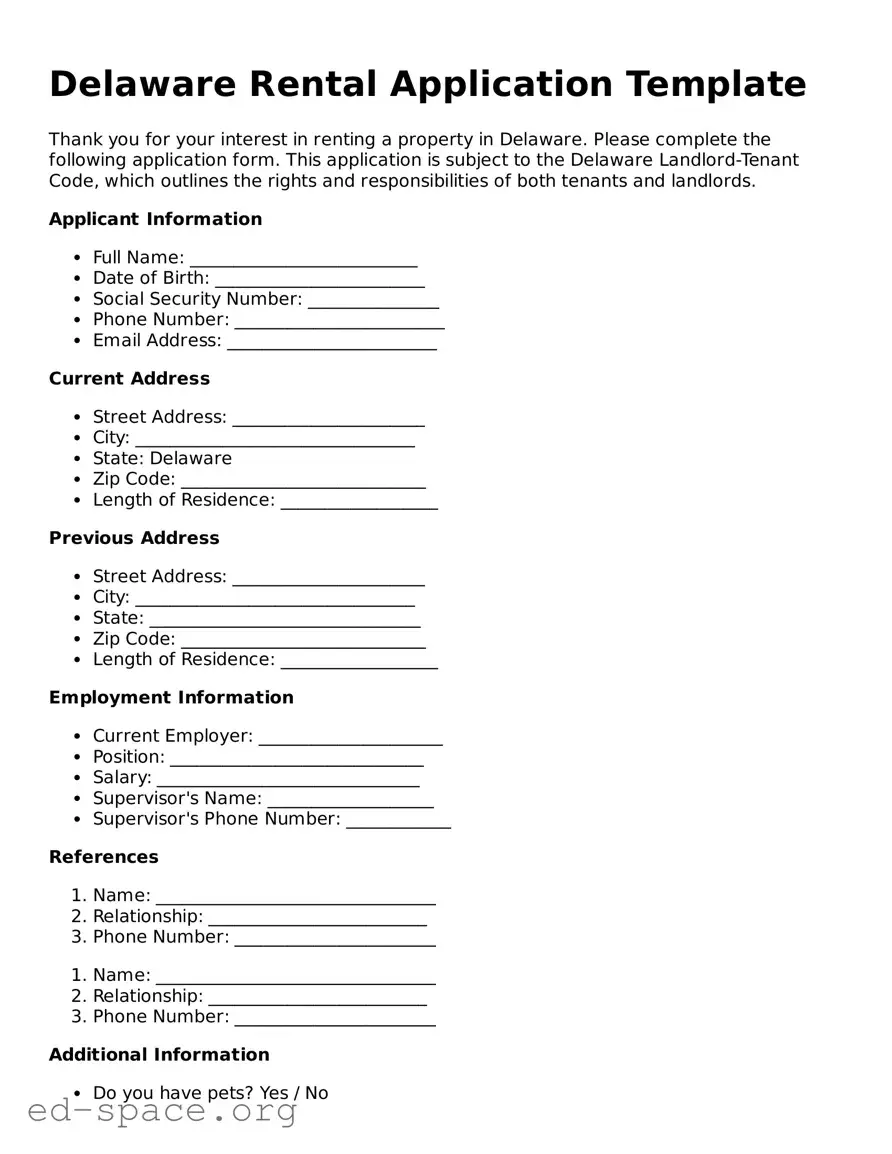
When seeking a new rental property in Delaware, prospective tenants often encounter the Delaware Rental Application form, a crucial document in the leasing process. This form serves multiple purposes, including gathering essential information about the applicant's background, financial stability, and rental history. Typically, it requires personal details such as name, contact information, and Social Security number, alongside employment and income verification. Landlords use this information to assess the suitability of applicants, ensuring they can meet rental obligations. Additionally, the form may include questions about previous residences, references, and consent for background checks. Understanding the components of the Delaware Rental Application form is vital for both tenants and landlords, as it sets the stage for a successful rental agreement and helps foster a transparent relationship between both parties.
Delaware Rental Application Template
Thank you for your interest in renting a property in Delaware. Please complete the following application form. This application is subject to the Delaware Landlord-Tenant Code, which outlines the rights and responsibilities of both tenants and landlords.
Applicant Information
Current Address
Previous Address
Employment Information
References
Additional Information
By signing below, I certify that the information provided in this application is true and complete to the best of my knowledge. I authorize the landlord to verify any information provided herein.
Signature: ____________________________
Date: _________________________________
| Fact Name | Description |
|---|---|
| Purpose | The Delaware Rental Application form is used by landlords to evaluate potential tenants. |
| Information Required | Applicants typically provide personal details, rental history, and employment information. |
| Background Checks | Landlords often conduct background checks based on the information provided in the application. |
| Application Fee | Landlords may charge an application fee to cover the costs of processing the application. |
| Fair Housing Laws | The application process must comply with the Fair Housing Act, prohibiting discrimination. |
| Privacy Considerations | Landlords must handle applicants' personal information with confidentiality and care. |
| Approval Process | Once submitted, landlords review applications and may approve or deny based on criteria. |
| State Regulations | The Delaware Code Title 25 governs rental agreements and tenant rights. |
| Signature Requirement | Applicants must sign the form, indicating their consent for background checks and verification. |
| Equal Opportunity | Landlords must ensure that the rental application process is fair and equal for all applicants. |
Filling out a Delaware Rental Application form is an essential step in securing a rental property. Once you have completed the application, it will be submitted to the landlord or property manager for review. They will evaluate your information to determine if you meet their criteria for tenancy.
What is a Delaware Rental Application form?
The Delaware Rental Application form is a document used by landlords to collect information from potential tenants. It typically includes sections for personal information, employment history, rental history, and references. This form helps landlords assess the suitability of applicants for renting a property.
Why is the Rental Application important?
The Rental Application is crucial for landlords to make informed decisions. It allows them to evaluate an applicant's creditworthiness, rental history, and overall reliability as a tenant. A well-completed application can streamline the tenant selection process and reduce the risk of future issues.
What information is typically required on the application?
Commonly required information includes the applicant's full name, contact details, Social Security number, employment information, income level, and previous rental history. Additionally, references from previous landlords may be requested to verify the applicant's rental behavior.
Is there a fee associated with the Rental Application?
Yes, many landlords charge an application fee to cover the costs of background and credit checks. This fee varies by property and can range from $25 to $75 or more. It's important for applicants to ask about the fee upfront to avoid surprises.
How long does it take to process a Rental Application?
The processing time for a Rental Application can vary. Typically, landlords will take anywhere from a few hours to several days to review applications. Factors influencing this timeline include the number of applications received and the thoroughness of background checks.
Can an applicant be denied based on the Rental Application?
Yes, landlords can deny an application based on various factors, such as poor credit history, insufficient income, or negative rental references. However, they must comply with fair housing laws, which prohibit discrimination based on race, color, religion, sex, national origin, familial status, or disability.
What should applicants do if they are denied?
If an applicant is denied, they should ask the landlord for the reasons behind the decision. Under the Fair Credit Reporting Act, landlords are required to provide this information if the denial is based on a credit report. Applicants can also request a copy of the report to check for inaccuracies.
Is it possible to appeal a denial?
While there is no formal appeal process for rental applications, applicants can address the issues that led to the denial. For example, if the denial was due to insufficient income, providing proof of a new job or additional income sources may strengthen their case. It's always worth discussing options with the landlord.
Failing to provide complete personal information. Many applicants neglect to fill in their full name, current address, and contact information. Incomplete details can delay the application process.
Omitting employment history. It is essential to include current and previous employers, job titles, and duration of employment. Landlords often use this information to assess financial stability.
Not disclosing rental history. Applicants sometimes forget to mention previous rental addresses or landlords. This information is crucial for landlords to evaluate past rental behavior.
Providing inaccurate financial information. Some individuals may misrepresent their income or fail to include additional sources of income. Accuracy in financial details is vital for approval.
Neglecting to include references. Many applicants overlook the importance of providing personal or professional references. These references can significantly influence a landlord's decision.
Ignoring background check consent. Failing to sign or initial the section that authorizes a background check can lead to automatic disqualification from the application process.
Not reviewing the application for errors. Applicants often submit the form without proofreading. Simple mistakes can create a negative impression and may result in delays or denial.
Overlooking the application fee. Some individuals forget to include the required fee or do not check if it is payable by check or online. Missing this step can hinder processing.
Failing to provide necessary documentation. Applicants may forget to attach required documents, such as pay stubs or identification. Missing documentation can lead to incomplete applications.
When applying for a rental property in Delaware, several forms and documents may accompany the Rental Application. These documents help landlords assess potential tenants and ensure a smooth leasing process. Below is a list of commonly used forms.
These documents, along with the Delaware Rental Application, create a comprehensive view of the applicant. They help landlords make informed decisions and establish clear expectations for the rental relationship.
Lease Agreement: This document outlines the terms and conditions of renting a property. Like a rental application, it requires personal information and details about the tenant's rental history. Both documents serve to establish a legal relationship between the landlord and tenant.
Background Check Authorization: This form is often used alongside a rental application. It allows landlords to verify a tenant's criminal history, credit score, and rental history. Both documents aim to provide the landlord with a comprehensive view of the applicant's suitability.
Employment Verification Form: Similar to a rental application, this document collects information about the applicant's employment status and income. It is used to assess the tenant's ability to pay rent consistently, which is a key concern for landlords.
Rental History Report: This report provides a detailed account of an applicant's previous rental experiences. Like the rental application, it helps landlords gauge the reliability and responsibility of potential tenants.
Credit Report Authorization: This document allows landlords to obtain the applicant's credit report. It is similar to a rental application in that it helps assess the financial stability of the tenant, which is crucial for making informed leasing decisions.
When filling out the Delaware Rental Application form, it's important to keep a few key points in mind. Here are ten things you should and shouldn't do:
Understanding the Delaware Rental Application form is crucial for both landlords and tenants. However, several misconceptions can lead to confusion. Here are nine common misunderstandings:
Many people assume that rental applications are standardized across states. In reality, each state, including Delaware, has its own specific requirements and forms.
Some believe that landlords are prohibited from charging application fees. In Delaware, landlords may charge a reasonable fee to cover the costs of processing the application.
While credit history is important, landlords in Delaware also consider rental history, income, and background checks when evaluating an application.
Some tenants think that filling out a rental application is not necessary. However, most landlords require a completed application to make informed decisions.
There is a misconception that the information provided on rental applications is not secure. In Delaware, landlords must handle personal information responsibly and comply with privacy laws.
Many believe that submitting an application guarantees approval. Each application undergoes a review process, and approval depends on various factors.
Some assume that only individuals with excellent credit can secure a rental. Landlords may consider other factors, such as income and rental history, when making decisions.
Not all properties follow the same application procedures. Different landlords may have unique requirements based on their policies or the type of property.
Some applicants think that they cannot make changes after submitting their application. In many cases, landlords allow updates if the applicant communicates changes promptly.
When filling out and using the Delaware Rental Application form, it is important to keep several key points in mind. This document serves as a crucial step in the rental process, ensuring both landlords and prospective tenants have the necessary information to make informed decisions.
By keeping these points in mind, you can navigate the rental application process with confidence and clarity. Good luck in your search for a new home.