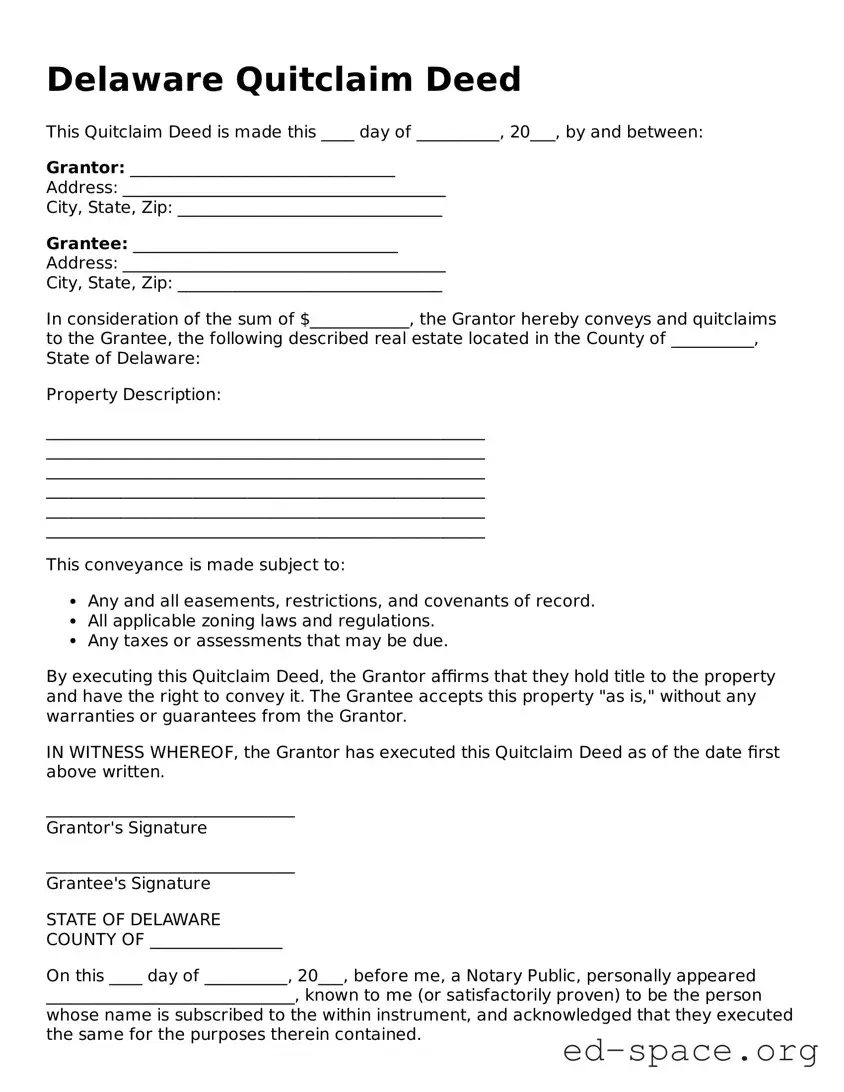
When it comes to transferring property in Delaware, the Quitclaim Deed form serves as a straightforward and efficient tool for property owners. This document allows one party to relinquish any claim they have to a property without guaranteeing the validity of that claim. Often used among family members, friends, or in situations involving divorce, the Quitclaim Deed simplifies the process of transferring ownership. It’s important to note that while this form does not provide any warranties or guarantees regarding the title, it can be a practical solution when the parties involved trust each other. Additionally, the Quitclaim Deed must be properly executed and recorded to ensure that the transfer is legally recognized. Understanding its components, such as the names of the grantor and grantee, the legal description of the property, and the signature requirements, is crucial for anyone considering this type of deed. Overall, the Delaware Quitclaim Deed can be a valuable asset in facilitating property transfers with minimal complications.
Delaware Quitclaim Deed
This Quitclaim Deed is made this ____ day of __________, 20___, by and between:
Grantor: ________________________________
Address: _______________________________________
City, State, Zip: ________________________________
Grantee: ________________________________
Address: _______________________________________
City, State, Zip: ________________________________
In consideration of the sum of $____________, the Grantor hereby conveys and quitclaims to the Grantee, the following described real estate located in the County of __________, State of Delaware:
Property Description:
_____________________________________________________
_____________________________________________________
_____________________________________________________
_____________________________________________________
_____________________________________________________
_____________________________________________________
This conveyance is made subject to:
By executing this Quitclaim Deed, the Grantor affirms that they hold title to the property and have the right to convey it. The Grantee accepts this property "as is," without any warranties or guarantees from the Grantor.
IN WITNESS WHEREOF, the Grantor has executed this Quitclaim Deed as of the date first above written.
______________________________
Grantor's Signature
______________________________
Grantee's Signature
STATE OF DELAWARE
COUNTY OF ________________
On this ____ day of __________, 20___, before me, a Notary Public, personally appeared ______________________________, known to me (or satisfactorily proven) to be the person whose name is subscribed to the within instrument, and acknowledged that they executed the same for the purposes therein contained.
In witness whereof, I hereunto set my hand and official seal.
______________________________
Notary Public
My Commission Expires: ____________
| Fact Name | Description |
|---|---|
| Definition | A quitclaim deed is a legal document used to transfer ownership of real estate without any warranties. |
| Governing Law | The Delaware Quitclaim Deed is governed by Title 25, Chapter 500 of the Delaware Code. |
| Parties Involved | The form involves two parties: the grantor (the person transferring the property) and the grantee (the person receiving the property). |
| No Guarantees | With a quitclaim deed, the grantor does not guarantee that they own the property or that it is free of liens. |
| Common Uses | It is often used in divorce settlements, transferring property between family members, or clearing up title issues. |
| Filing Requirements | The completed quitclaim deed must be filed with the Recorder of Deeds in the county where the property is located. |
| Consideration | While a quitclaim deed can be executed for little or no consideration, it is advisable to document any exchange to avoid future disputes. |
| Notarization | The deed must be signed by the grantor in the presence of a notary public to be valid. |
Once you have the Delaware Quitclaim Deed form in hand, it's time to fill it out accurately. Completing this form is essential for transferring property ownership. After filling it out, the next steps typically involve signing the document in the presence of a notary and then recording it with the appropriate county office.
What is a Delaware Quitclaim Deed?
A Delaware Quitclaim Deed is a legal document used to transfer ownership of real estate from one party to another. Unlike other types of deeds, a quitclaim deed does not guarantee that the property title is clear or free of liens. It simply conveys whatever interest the grantor has in the property at the time of the transfer.
When should I use a Quitclaim Deed?
This type of deed is often used in situations where the parties know each other well, such as between family members or friends. It is commonly employed in divorce settlements, property transfers between spouses, or when adding or removing someone from the title. However, it is important to ensure that both parties understand the implications of using a quitclaim deed.
How do I complete a Quitclaim Deed in Delaware?
To complete a Quitclaim Deed in Delaware, you will need to gather the necessary information, including the names of the grantor (the person transferring the property) and the grantee (the person receiving the property), a legal description of the property, and the date of the transfer. The deed must be signed by the grantor in the presence of a notary public. After signing, the deed should be recorded with the county recorder’s office where the property is located to ensure it is legally recognized.
Are there any fees associated with filing a Quitclaim Deed in Delaware?
Yes, there are fees involved when filing a Quitclaim Deed in Delaware. These fees vary by county, so it is advisable to check with the local recorder’s office for specific amounts. Additionally, there may be costs associated with notarization and obtaining a certified copy of the deed after it has been recorded.
What are the risks of using a Quitclaim Deed?
One significant risk of using a Quitclaim Deed is that it does not provide any warranties regarding the title. If there are existing liens, encumbrances, or other claims against the property, the grantee assumes these risks. Therefore, it is crucial to conduct a title search before proceeding with a quitclaim deed to understand any potential issues that may affect ownership.
Can a Quitclaim Deed be revoked?
Once a Quitclaim Deed has been executed and recorded, it generally cannot be revoked unilaterally. The transfer of ownership is considered final. However, the parties involved may agree to execute a new deed to reverse the transaction, or the grantee may choose to transfer the property back to the original grantor using a new deed. Legal advice may be beneficial in such cases to ensure compliance with state laws.
Incomplete information: Failing to provide all required details can lead to issues. Ensure that the names of both the grantor and grantee are fully spelled out, along with their addresses.
Incorrect property description: The property must be accurately described. Omitting important details or using vague terms can create confusion about what is being transferred.
Not notarizing the document: A quitclaim deed must be notarized to be legally valid. Skipping this step can render the deed unenforceable.
Failure to check for existing liens: Before executing the deed, it is crucial to check for any liens or encumbrances on the property. Ignoring this can lead to unexpected financial obligations.
Improper signatures: All parties involved must sign the document. Ensure that the signatures are legible and match the names provided in the deed.
Not filing the deed: After completing the quitclaim deed, it must be filed with the appropriate county office. Neglecting this step means the transfer may not be recognized legally.
Ignoring state-specific requirements: Each state may have unique rules regarding quitclaim deeds. Familiarize yourself with Delaware's specific requirements to avoid complications.
When transferring property ownership, a Delaware Quitclaim Deed is a common document used. However, it is often accompanied by several other forms and documents to ensure the transfer is legally sound and properly recorded. Here’s a brief overview of some of these essential documents.
Understanding these accompanying documents is vital for anyone involved in a property transaction. Each plays a unique role in ensuring that the transfer is executed smoothly and legally. Whether you are a buyer, seller, or legal representative, familiarity with these forms can help navigate the complexities of real estate transactions in Delaware.
When filling out the Delaware Quitclaim Deed form, it's essential to follow certain guidelines to ensure the process goes smoothly. Here are seven things to keep in mind:
Following these steps can help prevent delays and ensure that the deed is processed correctly.
The Delaware Quitclaim Deed is a legal document used to transfer property ownership. However, several misconceptions surround its use. Here are six common misconceptions:
Many believe that a quitclaim deed guarantees full ownership rights. In reality, it transfers whatever interest the grantor has in the property, which may be none at all.
While often used in family situations, quitclaim deeds can be used for any transfer of property between parties, including sales and gifts.
This is false. A quitclaim deed does not remove any existing liens or mortgages on the property. The new owner may still be responsible for these debts.
While notarization is a good practice, it is not strictly required for a quitclaim deed to be valid in Delaware. However, it is recommended for added legal protection.
Quitclaim deeds are recognized in many states, not just Delaware. However, the specific laws and requirements can vary by state.
Some think that once a quitclaim deed is executed, it cannot be undone. In fact, the grantor may still have options to challenge or revoke the deed under certain circumstances.
Understanding these misconceptions can help ensure proper use of the Delaware Quitclaim Deed in property transactions.
When filling out and using the Delaware Quitclaim Deed form, it is important to understand the following key points:
Understanding these points can help ensure a smooth transfer of property ownership in Delaware.