When it comes to ensuring the well-being of a child, parents often seek ways to delegate authority in a responsible manner. The Delaware Power of Attorney for a Child form provides a legal mechanism for parents or guardians to grant temporary decision-making authority to another trusted adult. This form is particularly useful in situations where a parent may be unavailable due to travel, medical emergencies, or other circumstances that prevent them from being present. By completing this document, parents can authorize another individual to make important decisions regarding the child’s education, healthcare, and general welfare. It is essential to understand the specific powers granted, the duration of the authority, and the rights retained by the parent. This form not only helps in maintaining continuity in a child's care but also provides peace of mind to parents, knowing that their child will be looked after by someone they trust during their absence.
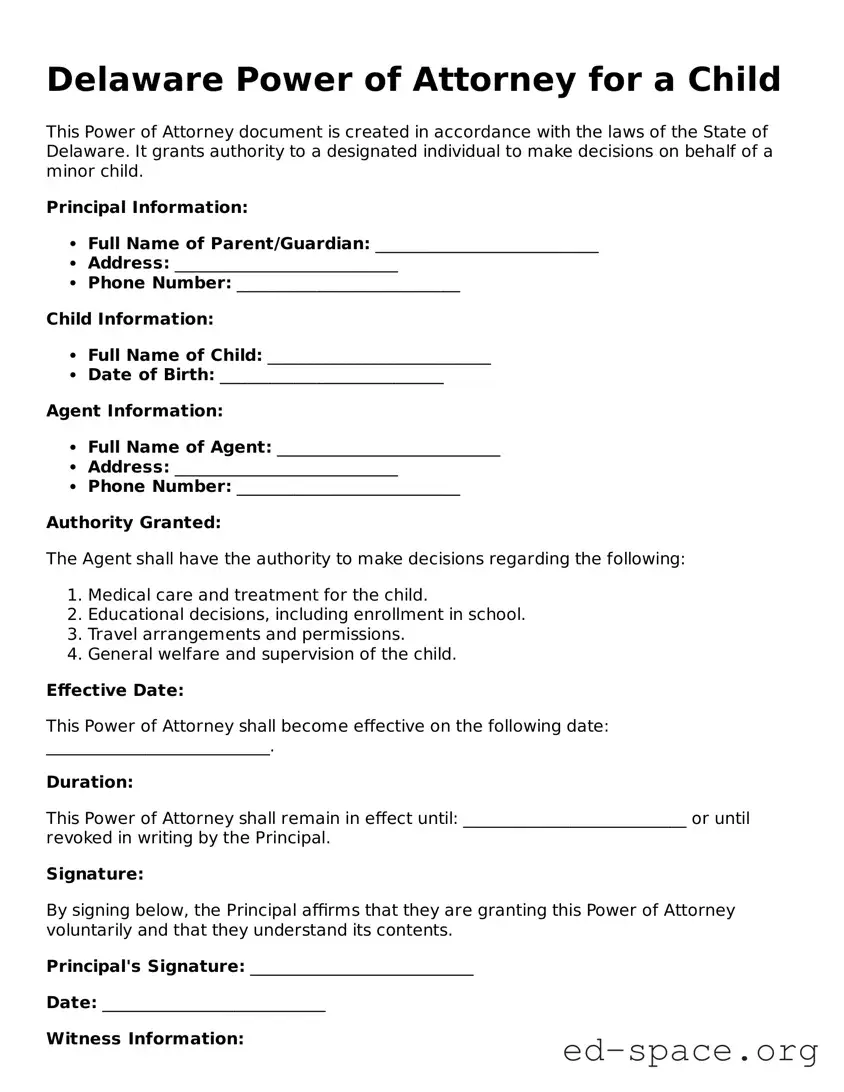
Delaware Power of Attorney for a Child
This Power of Attorney document is created in accordance with the laws of the State of Delaware. It grants authority to a designated individual to make decisions on behalf of a minor child.
Principal Information:
Child Information:
Agent Information:
Authority Granted:
The Agent shall have the authority to make decisions regarding the following:
Effective Date:
This Power of Attorney shall become effective on the following date: ___________________________.
Duration:
This Power of Attorney shall remain in effect until: ___________________________ or until revoked in writing by the Principal.
Signature:
By signing below, the Principal affirms that they are granting this Power of Attorney voluntarily and that they understand its contents.
Principal's Signature: ___________________________
Date: ___________________________
Witness Information:
Witness Name: ___________________________
Witness Signature: ___________________________
Date: ___________________________
This document should be kept in a safe place and a copy should be provided to the Agent.
| Fact Name | Description |
|---|---|
| Purpose | The Delaware Power of Attorney for a Child form allows a parent or legal guardian to designate another adult to make decisions on behalf of their child. |
| Governing Law | This form is governed by Delaware Code, Title 13, Chapter 708, which outlines the laws regarding powers of attorney for minors. |
| Duration | The authority granted by this form can be limited to a specific period or until revoked by the parent or guardian. |
| Notarization Requirement | The form must be signed in the presence of a notary public to be legally valid. |
| Revocation | A parent or guardian can revoke the Power of Attorney at any time, provided they notify the designated adult in writing. |
Filling out the Delaware Power of Attorney for a Child form requires careful attention to detail. Once completed, you will need to submit the form to ensure that the designated agent can act on behalf of your child in specific matters. Below are the steps to guide you through the process.
What is a Power of Attorney for a Child in Delaware?
A Power of Attorney for a Child in Delaware is a legal document that allows a parent or guardian to grant another adult the authority to make decisions on behalf of their child. This can include decisions about medical care, education, and other important aspects of the child’s life. It is particularly useful when parents are unavailable due to travel, work commitments, or other reasons.
Who can be designated as an agent in the Power of Attorney for a Child?
The agent, or attorney-in-fact, can be any responsible adult that the parent or guardian trusts. This could be a relative, friend, or neighbor. It is important to choose someone who is reliable and capable of making decisions in the best interest of the child.
How long does the Power of Attorney for a Child remain in effect?
The Power of Attorney for a Child remains in effect until the specified expiration date stated in the document, or until the parent or guardian revokes it. If no expiration date is mentioned, it generally lasts until the child reaches the age of 18 or the parent decides to terminate it.
Do I need to have the Power of Attorney for a Child notarized?
Yes, in Delaware, the Power of Attorney for a Child must be signed in the presence of a notary public to be considered valid. This adds an extra layer of authenticity and ensures that the document is legally recognized.
Can I revoke the Power of Attorney for a Child once it is created?
Absolutely. A parent or guardian can revoke the Power of Attorney at any time, as long as they are of sound mind. It is recommended to do this in writing and to notify the agent and any relevant parties to avoid confusion.
What if the child needs medical care while the Power of Attorney is in effect?
With the Power of Attorney for a Child in place, the designated agent has the authority to make medical decisions on behalf of the child. This includes consenting to treatments or procedures. It is advisable for the agent to carry a copy of the document when seeking medical care.
Are there any limitations on the authority granted in the Power of Attorney for a Child?
Yes, parents or guardians can specify limitations within the document. For instance, they may restrict the agent from making certain types of decisions, such as those related to education or specific medical treatments. Clearly outlining these limitations can help avoid misunderstandings.
Where can I obtain a Power of Attorney for a Child form in Delaware?
Power of Attorney for a Child forms can often be found online through state government websites or legal resource platforms. Additionally, local attorneys can provide guidance and may have templates available. It’s essential to ensure that the form complies with Delaware law.
Failing to include the child's full name. It is essential to provide the complete legal name of the child for identification purposes.
Not specifying the powers granted. Clearly outline what decisions the agent can make on behalf of the child to avoid confusion.
Omitting the start and end dates. Indicate when the Power of Attorney takes effect and when it will expire, if applicable.
Neglecting to sign and date the form. The document must be signed by the parent or guardian and dated to be valid.
Forgetting to have the form notarized. In Delaware, notarization is typically required for the Power of Attorney to be legally recognized.
Not providing the agent's contact information. Include the agent's address and phone number to ensure they can be reached easily.
Using outdated forms. Always ensure that the most current version of the Power of Attorney for a Child form is being used.
Failing to discuss the arrangement with the agent. Communication is key. Ensure the agent understands their responsibilities and agrees to the role.
When preparing a Delaware Power of Attorney for a Child form, it's often helpful to consider additional documents that can support the caregiving arrangement. Below are some commonly used forms that may accompany the Power of Attorney.
Having these documents prepared alongside the Power of Attorney can create a comprehensive plan for the child's care. This ensures that all parties are clear on their roles and responsibilities, providing peace of mind in various situations.
The Power of Attorney for a Child form is a crucial document that allows a designated individual to make decisions on behalf of a minor. It is important to understand how this form relates to other similar legal documents. Here are eight documents that share similarities with the Power of Attorney for a Child form:
Understanding these documents can help ensure that the appropriate legal authority is in place for the care and decision-making regarding a child. Each serves a unique purpose but shares the common goal of providing someone the authority to act in the best interest of another.
When filling out the Delaware Power of Attorney for a Child form, it's essential to approach the task with care. Here’s a helpful list of things to do and avoid:
Many people have misconceptions about the Delaware Power of Attorney for a Child form. Understanding the facts can help clarify its purpose and use. Here are eight common misconceptions:
Being informed about these misconceptions can help parents make better decisions regarding their child's care and the use of a Power of Attorney.
When considering the Delaware Power of Attorney for a Child form, it’s essential to understand its purpose and how to fill it out correctly. Here are some key takeaways to keep in mind:
By understanding these key points, parents can ensure they are well-prepared to use the Delaware Power of Attorney for a Child form effectively.