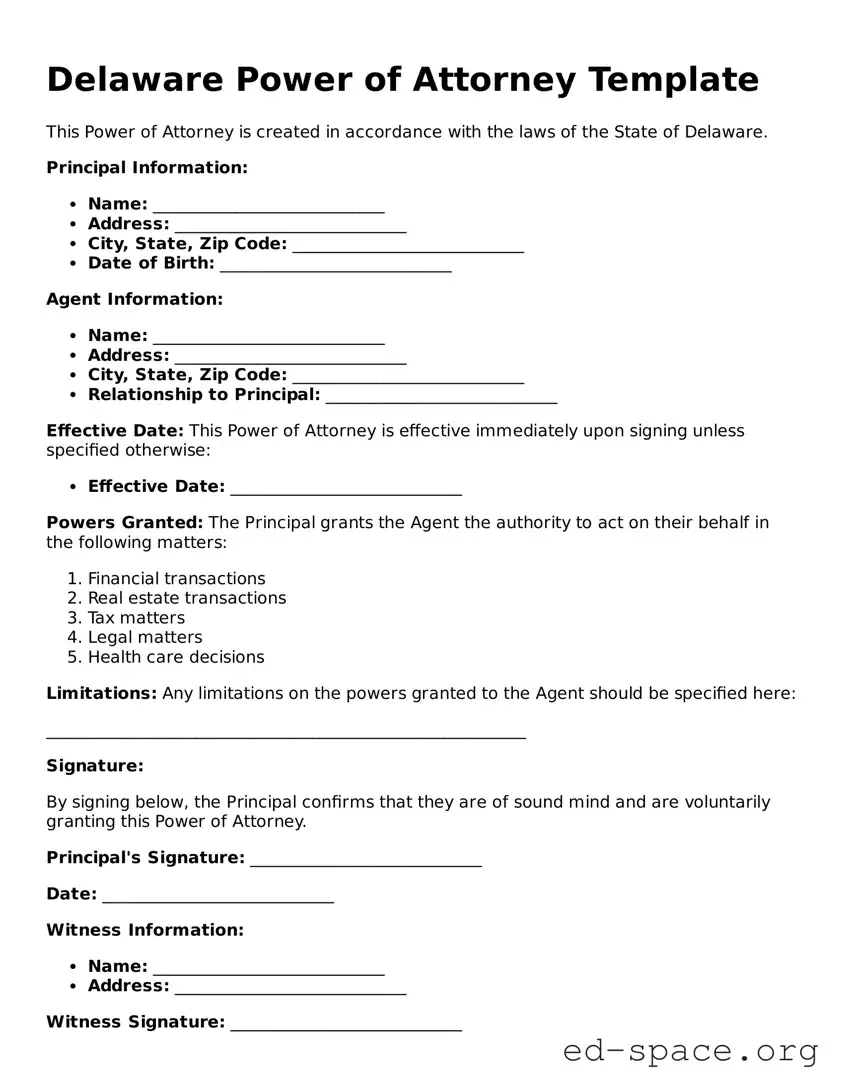
The Delaware Power of Attorney form serves as an important legal document that allows one person, known as the principal, to grant authority to another individual, referred to as the agent or attorney-in-fact, to make decisions on their behalf. This form can cover a wide range of powers, including financial decisions, property management, and healthcare choices. It is crucial for individuals to understand the different types of powers they can grant, as well as any limitations they may wish to impose. The form can be tailored to fit specific needs, ensuring that the principal's wishes are respected. Additionally, the Delaware Power of Attorney includes provisions for durability, meaning it can remain effective even if the principal becomes incapacitated. This feature is particularly significant for individuals planning for potential future health issues. Understanding these aspects can help individuals make informed decisions about their legal rights and responsibilities.
Delaware Power of Attorney Template
This Power of Attorney is created in accordance with the laws of the State of Delaware.
Principal Information:
Agent Information:
Effective Date: This Power of Attorney is effective immediately upon signing unless specified otherwise:
Powers Granted: The Principal grants the Agent the authority to act on their behalf in the following matters:
Limitations: Any limitations on the powers granted to the Agent should be specified here:
__________________________________________________________
Signature:
By signing below, the Principal confirms that they are of sound mind and are voluntarily granting this Power of Attorney.
Principal's Signature: ____________________________
Date: ____________________________
Witness Information:
Witness Signature: ____________________________
Date: ____________________________
Notary Public:
State of Delaware
County of ____________________________
Subscribed and sworn to before me this ____ day of __________, 20__.
Notary Public Signature: ____________________________
My Commission Expires: ____________________________
| Fact Name | Description |
|---|---|
| Purpose | The Delaware Power of Attorney form allows an individual (the principal) to designate another person (the agent) to make decisions on their behalf, particularly in financial or legal matters. |
| Governing Law | This form is governed by the Delaware Uniform Power of Attorney Act, specifically Title 12, Chapter 49 of the Delaware Code. |
| Durability | The Delaware Power of Attorney can be durable, meaning it remains effective even if the principal becomes incapacitated, provided that this is explicitly stated in the document. |
| Revocation | The principal can revoke the Power of Attorney at any time, as long as they are mentally competent to do so. A written notice must be provided to the agent and any relevant third parties. |
Filling out the Delaware Power of Attorney form is an important step in designating someone to act on your behalf in financial or legal matters. After completing the form, ensure that it is signed and dated in accordance with state requirements. This will help ensure that your designated agent can effectively represent your interests.
What is a Power of Attorney in Delaware?
A Power of Attorney (POA) is a legal document that allows one person to act on behalf of another in legal or financial matters. In Delaware, this document grants authority to an agent, often called an attorney-in-fact, to make decisions for the principal (the person who creates the POA). This can include managing finances, handling property, or making healthcare decisions, depending on the type of POA established.
What types of Power of Attorney are available in Delaware?
Delaware offers several types of Power of Attorney forms. The most common are the General Power of Attorney, which gives broad authority to the agent, and the Limited Power of Attorney, which restricts the agent's authority to specific tasks or time periods. There is also a Durable Power of Attorney, which remains effective even if the principal becomes incapacitated. Each type serves different needs, so it’s important to choose the one that fits your situation best.
How do I create a Power of Attorney in Delaware?
To create a Power of Attorney in Delaware, you need to fill out the appropriate form. You can find these forms online or through legal offices. After completing the form, it must be signed in the presence of a notary public. This step is crucial, as it helps to ensure that the document is valid and recognized by financial institutions and other entities. Once signed and notarized, you should give copies to your agent and any relevant parties.
Can I revoke a Power of Attorney in Delaware?
Yes, you can revoke a Power of Attorney in Delaware at any time, as long as you are mentally competent. To do this, you should create a written revocation document. This document should clearly state that you are revoking the previous Power of Attorney. It’s advisable to notify your agent and any institutions that were relying on the original POA. Keeping a record of the revocation is also important for your own protection.
Failing to specify the powers granted. It is crucial to clearly outline what authority the agent will have. Leaving this section vague can lead to confusion and potential disputes.
Not signing the document in the presence of a notary. Delaware law requires that the Power of Attorney be notarized. Without this step, the form may not be considered valid.
Choosing an unsuitable agent. Selecting someone who lacks the necessary skills or trustworthiness can result in mismanagement of your affairs.
Neglecting to date the form. A date is essential for establishing the timeline of authority. Without it, questions may arise about when the powers take effect.
Not keeping copies of the completed form. It is important to retain copies for personal records and to provide to the agent. This ensures everyone is aware of the authority granted.
Overlooking state-specific requirements. Each state may have unique regulations regarding Power of Attorney forms. Familiarizing oneself with Delaware's specific requirements is necessary to avoid invalidation.
The Delaware Power of Attorney form is a crucial document that allows an individual to designate another person to act on their behalf in various matters. Along with this form, several other documents are often used to ensure comprehensive legal coverage. Below is a list of these documents, each serving a specific purpose.
These documents, when used alongside the Delaware Power of Attorney form, provide a robust framework for managing personal, financial, and healthcare decisions. It is essential to understand the purpose of each document to ensure that all legal needs are adequately addressed.
The Power of Attorney (POA) form is a crucial legal document that allows one person to act on behalf of another. However, there are several other documents that share similarities with the POA in terms of purpose and function. Here’s a look at nine such documents:
Understanding these documents can help you make informed decisions about your legal needs and ensure that your wishes are respected, whether in health, finances, or family matters.
When completing the Delaware Power of Attorney form, it is crucial to approach the task with care and attention. Below are seven essential dos and don’ts to keep in mind.
By following these guidelines, you can help ensure that your Power of Attorney form is completed correctly and serves its intended purpose effectively.
Understanding the Delaware Power of Attorney form is essential for anyone considering using it. Here are nine common misconceptions about this important legal document:
Many people believe that a Power of Attorney is limited to financial decisions. In reality, it can also cover healthcare decisions, real estate transactions, and other personal matters.
While having a lawyer involved can provide guidance, it is not a requirement for the validity of a Power of Attorney in Delaware. As long as the document is properly signed and witnessed, it is valid.
This is not true. A Power of Attorney can be revoked or modified at any time, as long as the person who created it is still mentally competent.
In Delaware, a Power of Attorney can be durable, meaning it remains effective even if the principal becomes incapacitated. This is an important feature for many individuals.
While you can choose anyone you trust, it is advisable to select someone who is responsible and capable of handling your affairs. It's also important to ensure that the person is willing to take on this responsibility.
The Power of Attorney must also be signed by a witness or notarized to ensure its validity in Delaware. This adds an extra layer of protection against potential disputes.
A Power of Attorney ceases to be effective upon the death of the principal. After that point, a will or trust would govern the distribution of the deceased's assets.
Power of Attorney forms can vary significantly in terms of the powers granted. It's crucial to customize the document to meet specific needs and circumstances.
While older adults often use Powers of Attorney, anyone can benefit from having one. Unexpected events can happen at any age, making it wise to prepare in advance.
By addressing these misconceptions, individuals can make more informed decisions about using the Delaware Power of Attorney form effectively.
When filling out and using the Delaware Power of Attorney form, there are several important points to consider. These takeaways will help ensure that the document is completed correctly and serves its intended purpose.