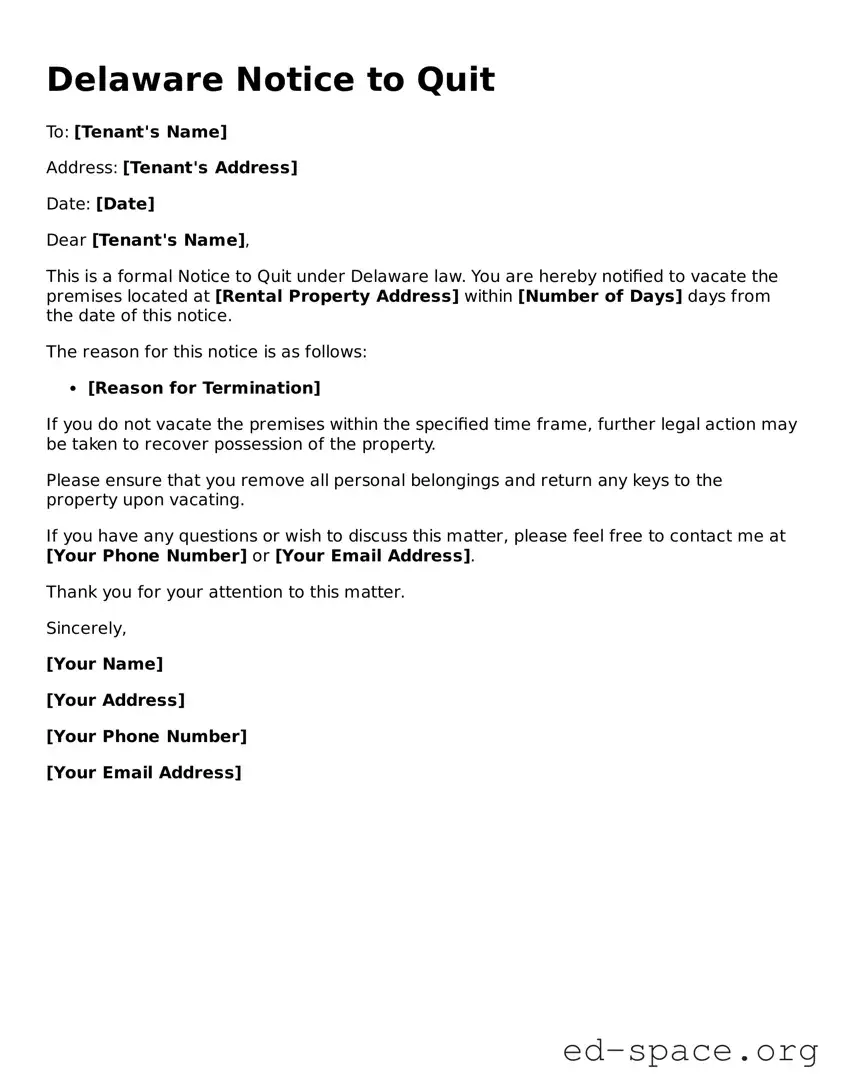
The Delaware Notice to Quit form is a crucial document in the landlord-tenant relationship, serving as a formal notification that a tenant must vacate the rental property. This form is often utilized when a tenant has violated the terms of their lease agreement or has failed to pay rent on time. It outlines the reasons for the eviction and specifies a timeframe within which the tenant must respond or leave the premises. The notice must be delivered in accordance with Delaware law, ensuring that tenants are given proper notice before any legal action can be taken. Understanding the requirements and implications of this form is essential for both landlords and tenants, as it establishes the groundwork for potential eviction proceedings. The Notice to Quit must include specific information, such as the address of the rental property, the reason for termination, and the date by which the tenant must vacate. By adhering to these guidelines, landlords can protect their rights while tenants can better understand their obligations and options in the event of a dispute.
Delaware Notice to Quit
To: [Tenant's Name]
Address: [Tenant's Address]
Date: [Date]
Dear [Tenant's Name],
This is a formal Notice to Quit under Delaware law. You are hereby notified to vacate the premises located at [Rental Property Address] within [Number of Days] days from the date of this notice.
The reason for this notice is as follows:
If you do not vacate the premises within the specified time frame, further legal action may be taken to recover possession of the property.
Please ensure that you remove all personal belongings and return any keys to the property upon vacating.
If you have any questions or wish to discuss this matter, please feel free to contact me at [Your Phone Number] or [Your Email Address].
Thank you for your attention to this matter.
Sincerely,
[Your Name]
[Your Address]
[Your Phone Number]
[Your Email Address]
| Fact Name | Description |
|---|---|
| Purpose | The Delaware Notice to Quit form is used by landlords to inform tenants that they must vacate the rental property. |
| Governing Law | This form is governed by Delaware Code Title 25, Chapter 5501. |
| Delivery Method | The notice can be delivered in person, via certified mail, or posted on the property. |
| Notice Period | Typically, a 5-day notice is required for non-payment of rent, while other violations may require a longer notice period. |
| Tenant Rights | Tenants have the right to contest the eviction in court after receiving the notice. |
| Form Requirements | The form must include specific details such as the tenant's name, address, and reason for eviction. |
| Signature | The landlord or their representative must sign the Notice to Quit for it to be valid. |
| Response Options | Tenants can either comply with the notice or respond to the eviction in court. |
| Legal Consequences | Failure to comply with the notice may lead to formal eviction proceedings. |
| Additional Resources | Tenants may seek assistance from local housing authorities or legal aid organizations for guidance. |
After you have gathered the necessary information, you are ready to fill out the Delaware Notice to Quit form. This form is an important step in the process of addressing lease violations or non-payment of rent. Ensure that you complete it accurately to avoid any delays or complications in your case.
Once the form is filled out, you will need to serve it to the tenant according to Delaware law. This may involve personal delivery, mailing, or posting the notice on the property. Be sure to follow the correct procedure to ensure that the notice is legally valid.
What is a Delaware Notice to Quit form?
The Delaware Notice to Quit form is a legal document that a landlord uses to inform a tenant that they must vacate the rental property. This notice is typically issued when a tenant has not paid rent or has violated terms of the lease agreement. It serves as a formal request to leave the property by a specified date.
When should a landlord use a Notice to Quit?
A landlord should use a Notice to Quit when a tenant fails to pay rent or breaches the lease terms. This document is an important step before taking further legal action, such as filing for eviction. It gives the tenant a chance to correct the issue or prepare to move out.
How much notice is required?
In Delaware, the amount of notice required depends on the reason for the eviction. For non-payment of rent, a landlord must provide a 5-day notice. For other lease violations, the notice period is typically 10 days. Always check the specific circumstances to ensure compliance with state laws.
Can a tenant respond to a Notice to Quit?
Yes, a tenant can respond to a Notice to Quit. They may choose to pay the overdue rent or address any lease violations within the notice period. If the tenant believes the notice is unjust, they may also communicate with the landlord to discuss the situation.
What happens if a tenant does not leave after receiving a Notice to Quit?
If a tenant does not vacate the property after the notice period expires, the landlord may begin eviction proceedings. This involves filing a complaint with the court. It is important for landlords to follow the legal process to avoid potential issues.
Is a Notice to Quit the same as an eviction notice?
No, a Notice to Quit is not the same as an eviction notice. The Notice to Quit is a preliminary step that informs the tenant to leave the property. An eviction notice is issued after the Notice to Quit period has passed and legal action has been initiated.
Do I need to provide a reason for the Notice to Quit?
Yes, it is important to provide a reason for the Notice to Quit. This helps clarify the situation for the tenant and is necessary if the case goes to court. Clearly stating the reason also shows that the landlord is following proper procedures.
Can a Notice to Quit be delivered electronically?
In Delaware, a Notice to Quit must be delivered in person or sent via certified mail. While electronic delivery may be convenient, it is not legally recognized for this type of notice. Ensure that the delivery method complies with state requirements.
What should I do if I have more questions about the Notice to Quit?
If you have more questions about the Notice to Quit or the eviction process, consider consulting a legal professional. They can provide guidance tailored to your specific situation and ensure that you understand your rights and responsibilities.
Incomplete Information: Many individuals fail to provide all necessary details. This includes the names of both the tenant and the landlord, as well as the correct address of the rental property. Missing this information can lead to delays or complications in the eviction process.
Incorrect Dates: It is crucial to specify the correct date when the notice is served. Some people mistakenly use the date they intend to file for eviction rather than the date the tenant is being notified. This can create confusion and undermine the validity of the notice.
Failure to Specify the Reason: The form requires a clear reason for the eviction. Many individuals overlook this requirement, leading to vague or unclear statements. A precise explanation is essential for the notice to be legally effective.
Not Following Proper Delivery Methods: The law outlines specific methods for delivering the Notice to Quit. Some people neglect to follow these guidelines, opting for informal delivery methods instead. This can result in the notice being deemed invalid.
Ignoring Local Laws: Each jurisdiction may have unique requirements regarding eviction notices. Failing to research and comply with local laws can lead to significant issues. It is important to ensure that the form meets all local regulations.
The Delaware Notice to Quit form is an important document used in the eviction process. However, several other forms and documents may accompany it to ensure compliance with state laws and to facilitate the eviction process. Below is a list of commonly used forms that may be relevant in conjunction with the Notice to Quit.
Understanding these forms and their purposes can help both landlords and tenants navigate the eviction process more effectively. Each document plays a role in ensuring that the rights of all parties are respected throughout the legal proceedings.
The Notice to Quit form is a critical document in landlord-tenant relationships, serving as a formal notice to a tenant to vacate a rental property. There are several other documents that share similarities with the Notice to Quit form. Here are four of them:
When filling out the Delaware Notice to Quit form, it’s important to follow specific guidelines to ensure clarity and compliance. Here’s a straightforward list of dos and don’ts.
By following these guidelines, you can ensure that your Notice to Quit is effective and legally sound.
Understanding the Delaware Notice to Quit form is essential for both landlords and tenants. However, several misconceptions can lead to confusion. Here are six common misunderstandings:
Being aware of these misconceptions can help ensure that both landlords and tenants navigate the process correctly and avoid unnecessary complications.
Understanding the Delaware Notice to Quit form is essential for landlords and tenants alike. Here are some key takeaways to keep in mind:
By keeping these points in mind, both landlords and tenants can navigate the eviction process more smoothly and with a clearer understanding of their rights and responsibilities.