In the world of legal documentation, a notary acknowledgment serves a vital role in ensuring the authenticity and integrity of signatures on important papers. In Delaware, this specific form is designed to confirm that a person willingly signed a document in the presence of a notary public. The Delaware Notary Acknowledgment form is essential for various transactions, including real estate deals, powers of attorney, and other legal agreements. It typically includes the notary's name, the signer's name, and a statement affirming that the signer appeared before the notary and acknowledged their signature. This simple yet powerful tool provides a layer of protection against fraud and misrepresentation, reinforcing the trustworthiness of the documents involved. Understanding the nuances of this form can help individuals navigate their legal obligations more effectively and ensure that their important agreements are recognized by courts and institutions alike.
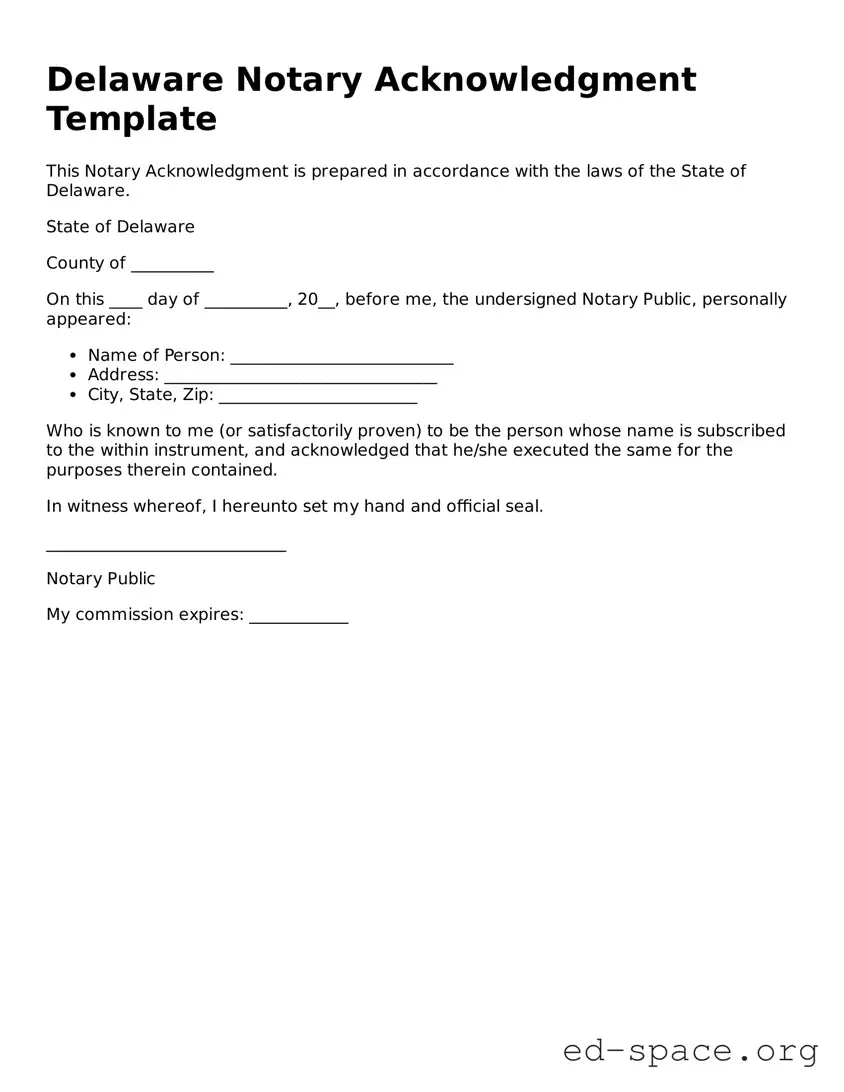
Delaware Notary Acknowledgment Template
This Notary Acknowledgment is prepared in accordance with the laws of the State of Delaware.
State of Delaware
County of __________
On this ____ day of __________, 20__, before me, the undersigned Notary Public, personally appeared:
Who is known to me (or satisfactorily proven) to be the person whose name is subscribed to the within instrument, and acknowledged that he/she executed the same for the purposes therein contained.
In witness whereof, I hereunto set my hand and official seal.
_____________________________
Notary Public
My commission expires: ____________
| Fact Name | Details |
|---|---|
| Purpose | The Delaware Notary Acknowledgment form is used to confirm that a signer has willingly signed a document in the presence of a notary public. |
| Governing Law | The use of the Notary Acknowledgment form in Delaware is governed by Title 29, Chapter 4321 of the Delaware Code. |
| Signer's Presence | The signer must be physically present before the notary at the time of signing the document. |
| Identification | Notaries are required to verify the identity of the signer, typically through a government-issued photo ID. |
| Notary Signature | The notary must sign the acknowledgment form, affirming that the signer appeared before them. |
| Date Requirement | The acknowledgment must include the date when the notarization took place. |
| Record Keeping | Notaries in Delaware are encouraged to keep a detailed log of all acknowledgments performed, which serves as a record for future reference. |
| Legal Effect | Documents with a completed acknowledgment are generally accepted as valid in legal proceedings, provided they meet all requirements. |
| Limitations | Notaries cannot provide legal advice or assist in the preparation of documents; their role is strictly to witness signatures. |
Once you have the Delaware Notary Acknowledgement form in hand, it's time to fill it out carefully. This form is essential for confirming the identity of the signer and ensuring that the signature is made voluntarily. Following the steps below will help you complete the form accurately.
After completing these steps, the form will be ready for submission or filing as required. Ensure that all information is accurate to avoid any complications in the future.
What is a Delaware Notary Acknowledgement form?
The Delaware Notary Acknowledgement form is a legal document used to verify the identity of a signer. It confirms that the individual has willingly signed a document in the presence of a notary public. This form is often required for various legal transactions, such as real estate deals and other formal agreements.
When do I need to use this form?
You will need to use the Delaware Notary Acknowledgement form whenever a document requires notarization. This typically includes contracts, deeds, and powers of attorney. Always check the specific requirements of the document you are working with to ensure compliance.
Who can act as a notary public in Delaware?
In Delaware, a notary public must be at least 18 years old, a resident of the state, and have a clean criminal record. Notaries are appointed by the Governor and must complete a training course. They are authorized to perform notarizations in the state.
What information is required on the Notary Acknowledgement form?
The form typically requires the name of the signer, the date of signing, the name of the notary, and the notary’s official seal. It may also include the details of the document being acknowledged. Ensure all fields are accurately filled out to avoid any issues.
Can I sign the document before the notary arrives?
No, you should not sign the document before the notary is present. The purpose of the notary is to witness your signature. Signing beforehand can invalidate the notarization process.
Is there a fee for notarization in Delaware?
Yes, notaries in Delaware are allowed to charge a fee for their services. The maximum fee is set by state law, but it can vary depending on the notary. Always confirm the fee beforehand to avoid surprises.
How long does a notarization take?
The notarization process is typically quick, often taking just a few minutes. However, the time may vary depending on the notary’s availability and the complexity of the documents. Arriving prepared can help expedite the process.
What if I need a notarization outside of Delaware?
If you need a notarization outside of Delaware, you will generally need to find a notary public in that specific state. Each state has its own notary laws and requirements, so it’s important to familiarize yourself with those before proceeding.
What should I do if my notary makes a mistake?
If a mistake is made on the Notary Acknowledgement form, it is essential to address it immediately. The notary should correct the error and initial the change. If the error is significant, you may need to redo the notarization to ensure the document is valid.
Failing to include the date of the acknowledgment. The date is crucial as it indicates when the notary performed the acknowledgment. Without it, the document may be considered incomplete.
Not providing the name of the signer clearly. The signer’s name must be legible and match the name on the identification presented to the notary. Ambiguities can lead to legal complications.
Omitting the notary’s signature. The notary must sign the acknowledgment to validate it. Without the signature, the document lacks authenticity.
Neglecting to include the notary's seal. The seal serves as an official mark of the notary's authority. An acknowledgment without a seal may not be recognized as valid.
Using an incorrect format for the acknowledgment. Each state has specific requirements for how the acknowledgment should be worded. Deviating from this can render the acknowledgment ineffective.
Failing to verify the identity of the signer. The notary must confirm that the person signing the document is who they claim to be, typically through a government-issued ID. Skipping this step can lead to fraud.
Not completing the form in the presence of the signer. The notary must witness the signing of the document. If the notary is not present, the acknowledgment may be invalid.
When engaging in legal transactions or formal agreements in Delaware, various forms and documents often accompany the Notary Acknowledgement form. Each of these documents serves a specific purpose, ensuring that the intentions of the parties involved are clearly articulated and legally recognized. Below is a list of commonly used forms that may be utilized alongside the Notary Acknowledgement.
In summary, the Notary Acknowledgement form is just one piece of the puzzle in many legal transactions. Understanding the various documents that may accompany it can help individuals navigate the complexities of legal agreements more effectively. Each document plays a critical role in ensuring clarity, legality, and mutual understanding among the parties involved.
The Notary Acknowledgment form serves a specific purpose in verifying the identity of individuals signing a document. However, there are several other documents that share similar functions or features. Here’s a look at four of them:
Each of these documents involves a process of verification, ensuring that all parties are who they claim to be and are entering into agreements with full understanding and consent.
When filling out the Delaware Notary Acknowledgement form, it’s important to follow certain guidelines to ensure accuracy and compliance. Here’s a list of things you should and shouldn’t do:
By following these guidelines, you can help ensure that your Notary Acknowledgement form is processed smoothly and without issues.
Many individuals encounter the Delaware Notary Acknowledgement form and may develop misconceptions about its purpose and use. It is important to clarify these misunderstandings to ensure that everyone can navigate the notarial process with confidence.
This is not true. The notary's role is to verify the identity of the signer and witness the signing of the document. They do not assess the validity or legality of the document's content.
Notaries are not authorized to give legal advice. Their function is strictly to perform notarial acts, such as witnessing signatures and administering oaths.
Not every document requires notarization. Only certain legal documents, such as deeds and powers of attorney, may need a notary acknowledgement to be valid.
While personal knowledge can be helpful, it is not a requirement. A notary can verify identity through proper identification, such as a driver's license or passport.
In Delaware, the notary must be present when the signer is signing the document. Remote notarization is not generally permitted unless specific provisions are in place.
Notarization does not guarantee the legality of the document. It simply confirms that the signer appeared before the notary and signed the document willingly.
While notaries have discretion, they cannot refuse to notarize based on personal biases. They may refuse if the signer cannot provide adequate identification or if they suspect fraud.
When using the Delaware Notary Acknowledgement form, it’s essential to understand the key elements involved in the process. Here are seven important takeaways to keep in mind:
Understanding these key points can help ensure a smooth and effective notarization process. Always approach the task with care and attention to detail.