In today’s competitive business landscape, protecting your company’s interests is more crucial than ever. One effective tool for safeguarding sensitive information and trade secrets is the Delaware Non-compete Agreement. This legally binding document outlines the terms under which an employee agrees not to engage in activities that could directly compete with their employer after leaving the company. Key aspects of the agreement include the duration of the non-compete period, the geographical scope of the restriction, and the specific activities that are prohibited. Employers must carefully draft these agreements to ensure they are reasonable and enforceable under Delaware law, while employees should fully understand their rights and obligations before signing. Given the potential implications for both parties, it is essential to approach the creation and execution of a Non-compete Agreement with diligence and clarity.
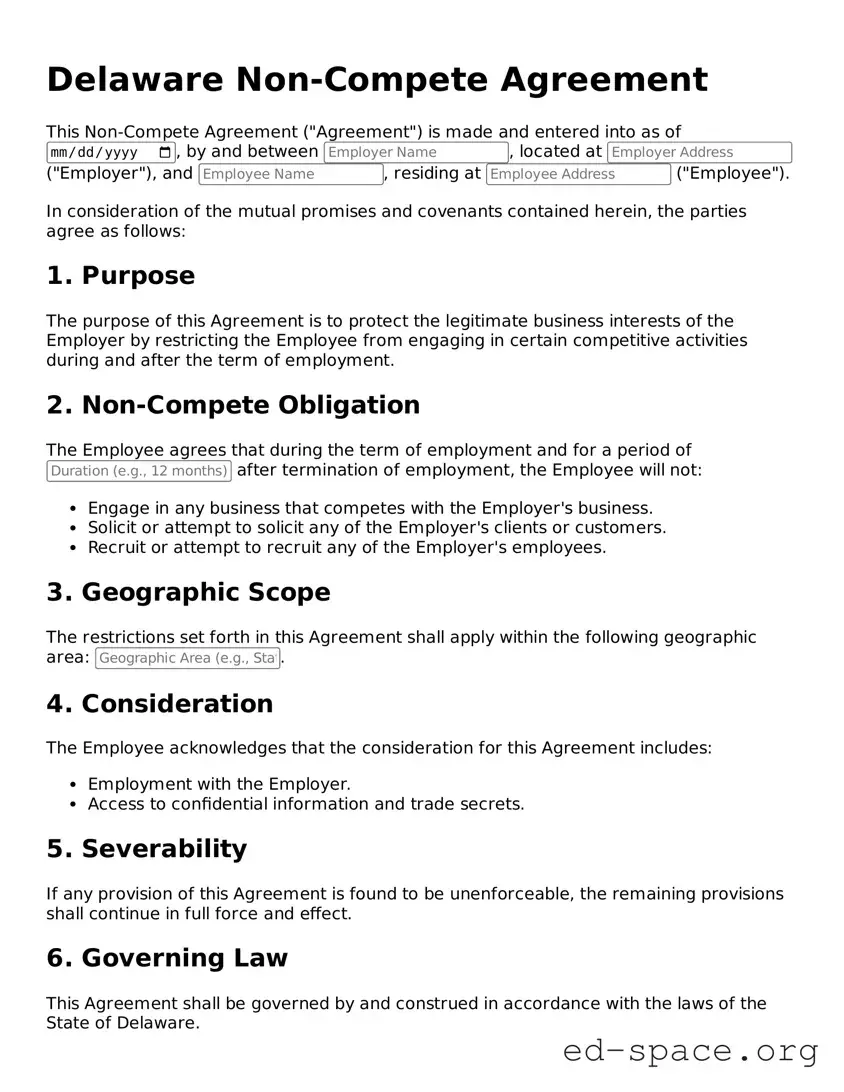
Delaware Non-Compete Agreement
This Non-Compete Agreement ("Agreement") is made and entered into as of , by and between , located at ("Employer"), and , residing at ("Employee").
In consideration of the mutual promises and covenants contained herein, the parties agree as follows:
1. Purpose
The purpose of this Agreement is to protect the legitimate business interests of the Employer by restricting the Employee from engaging in certain competitive activities during and after the term of employment.
2. Non-Compete Obligation
The Employee agrees that during the term of employment and for a period of after termination of employment, the Employee will not:
3. Geographic Scope
The restrictions set forth in this Agreement shall apply within the following geographic area: .
4. Consideration
The Employee acknowledges that the consideration for this Agreement includes:
5. Severability
If any provision of this Agreement is found to be unenforceable, the remaining provisions shall continue in full force and effect.
6. Governing Law
This Agreement shall be governed by and construed in accordance with the laws of the State of Delaware.
7. Entire Agreement
This Agreement constitutes the entire understanding between the parties and supersedes all prior agreements, whether written or oral, relating to the subject matter herein.
IN WITNESS WHEREOF, the parties have executed this Non-Compete Agreement as of the date first above written.
__________________________
Employer Signature
__________________________
Employee Signature
| Fact Name | Details |
|---|---|
| Definition | A Delaware Non-compete Agreement restricts an employee from working for competitors after leaving a job. |
| Governing Law | The agreement is governed by Delaware law, specifically Title 19, Chapter 703. |
| Duration | Delaware courts generally favor reasonable time limits, typically ranging from six months to two years. |
| Geographic Scope | The agreement must specify a reasonable geographic area where the restrictions apply. |
| Enforceability | Delaware courts will enforce non-compete agreements if they are reasonable and protect legitimate business interests. |
| Consideration | For a non-compete to be valid, there must be adequate consideration, such as a job offer or a promotion. |
After obtaining the Delaware Non-compete Agreement form, it’s important to fill it out carefully to ensure that all necessary information is provided. This will help in creating a clear understanding between the parties involved. Following the steps below will guide you through the process of completing the form accurately.
Once the form is completed, it should be kept in a safe place for future reference. Both parties should retain a copy for their records. This helps ensure that everyone is aware of the terms and conditions agreed upon.
What is a Delaware Non-compete Agreement?
A Delaware Non-compete Agreement is a legal contract between an employer and an employee. This agreement restricts the employee from engaging in activities that compete with the employer’s business after leaving the company. The purpose is to protect the employer's trade secrets, proprietary information, and customer relationships. It is important for both parties to understand the terms and implications of such an agreement before signing.
Are non-compete agreements enforceable in Delaware?
Yes, non-compete agreements can be enforceable in Delaware, but they must meet certain criteria. The agreement should be reasonable in terms of duration, geographic scope, and the type of activities restricted. Courts in Delaware will assess whether the agreement protects legitimate business interests without imposing undue hardship on the employee. If the terms are overly broad or unfair, a court may refuse to enforce the agreement.
What factors do Delaware courts consider when evaluating a non-compete agreement?
Delaware courts consider several factors when evaluating a non-compete agreement. These include the duration of the restriction, the geographic area covered, and the specific activities that are restricted. Additionally, the court will look at whether the agreement protects a legitimate business interest, such as trade secrets or customer relationships, and whether it imposes an unreasonable burden on the employee’s ability to find work.
How long can a non-compete agreement last in Delaware?
The duration of a non-compete agreement in Delaware varies, but it should generally be reasonable. Typically, agreements lasting between six months to two years are more likely to be enforced. However, the specific duration should align with the nature of the business and the role of the employee. An excessively long duration may lead to the agreement being deemed unenforceable.
Can I negotiate the terms of a non-compete agreement?
Yes, employees can negotiate the terms of a non-compete agreement. It is advisable to discuss any concerns or desired changes with the employer before signing. This may include adjusting the duration, geographic scope, or specific activities covered. Open communication can lead to a more balanced agreement that protects both the employer's interests and the employee's career opportunities.
What happens if I violate a non-compete agreement?
If you violate a non-compete agreement, your former employer may take legal action against you. This could include seeking an injunction to prevent you from continuing the competitive activity or filing a lawsuit for damages. The consequences can vary based on the terms of the agreement and the specific circumstances of the violation. It is essential to understand the potential risks before engaging in any activities that may breach the agreement.
Can a non-compete agreement be terminated or modified?
A non-compete agreement can be terminated or modified, but this typically requires mutual consent from both parties. If circumstances change, such as a significant shift in the employee's role or the nature of the business, it may be reasonable to revisit the agreement. Documenting any changes in writing is crucial to ensure clarity and avoid future disputes.
Not Clearly Defining the Scope of the Agreement: One common mistake is failing to specify what activities are restricted. A vague description can lead to misunderstandings later. It’s essential to clearly outline what constitutes competition to avoid confusion.
Ignoring Geographic Limitations: Another frequent error is not setting appropriate geographic boundaries. If the agreement covers too broad an area, it may be deemed unenforceable. It’s important to tailor the geographic scope to where the business operates.
Overlooking Duration of the Agreement: Many individuals forget to specify how long the non-compete will last. A duration that is too lengthy may be challenged in court. Consider what is reasonable for both parties to ensure enforceability.
Failing to Consider State Laws: Lastly, people often neglect to check how Delaware law treats non-compete agreements. Different states have varying standards for enforceability. Understanding these nuances is crucial for creating a valid agreement.
When entering into a Delaware Non-compete Agreement, several other documents may be necessary to ensure a comprehensive understanding of the terms and conditions involved. Each of these documents serves a specific purpose and can help clarify the obligations and rights of all parties involved.
Understanding these documents can help individuals and businesses navigate their legal responsibilities more effectively. Each plays a vital role in protecting both the employer's interests and the employee's rights within the framework of the Delaware Non-compete Agreement.
When filling out the Delaware Non-compete Agreement form, it's important to approach the process thoughtfully. Here are some essential do's and don'ts to consider:
Non-compete agreements are often misunderstood, leading to confusion among employers and employees alike. Here are six common misconceptions about the Delaware Non-compete Agreement form:
This is not true. Delaware courts evaluate non-compete agreements on a case-by-case basis, considering factors such as reasonableness in scope, duration, and geographic area. An overly broad agreement may be deemed unenforceable.
While some agreements may have longer durations, Delaware law requires that the time limit be reasonable. Typically, agreements lasting more than one to two years may face scrutiny.
This misconception overlooks the fact that non-compete agreements should only restrict specific competitive activities. Employees may still pursue other opportunities that do not directly compete with their former employer.
Employees have the right to negotiate the terms of a non-compete agreement. It is advisable to seek modifications that make the agreement more reasonable or to consult legal counsel before signing.
This is a common belief, but non-compete agreements can apply to employees at various levels, depending on the nature of the business and the role of the employee.
Employees can challenge the enforceability of a non-compete agreement in court. Factors such as lack of consideration or unconscionability can be grounds for a challenge.
Understanding these misconceptions can help both employers and employees navigate the complexities of non-compete agreements in Delaware.
When dealing with the Delaware Non-compete Agreement form, it’s important to understand several key aspects. Here are some takeaways to consider: