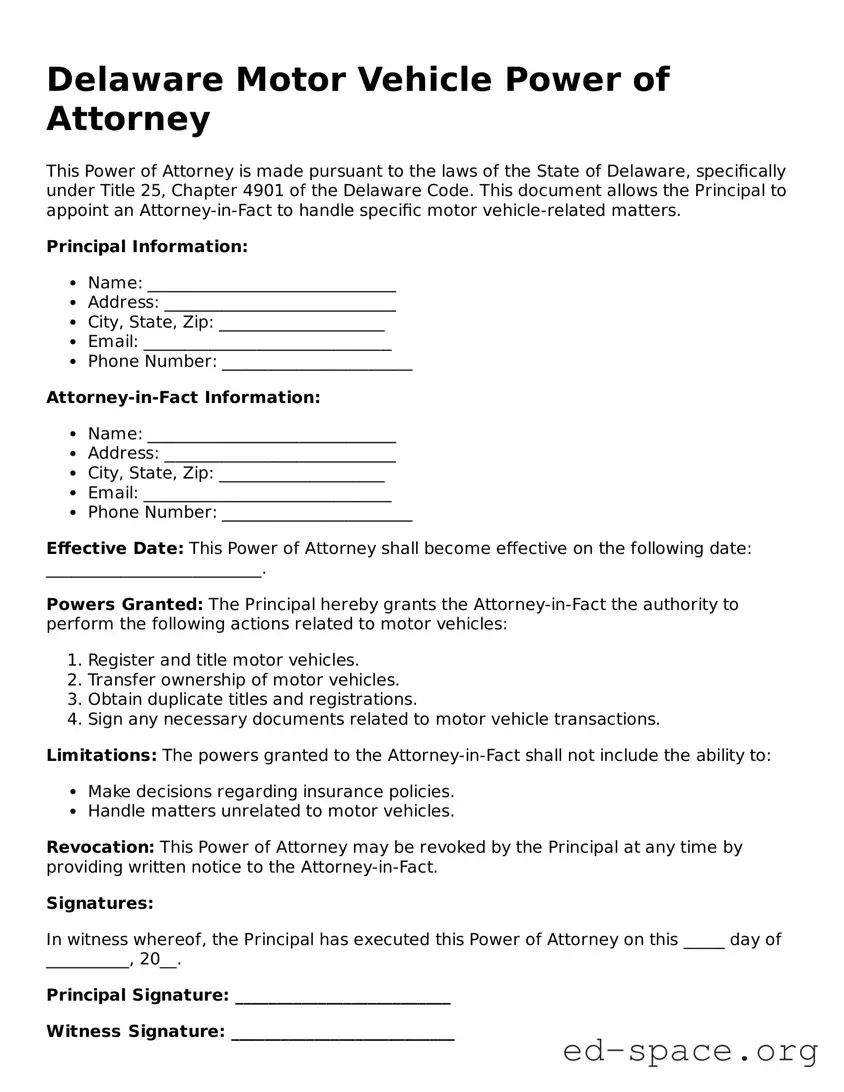
The Delaware Motor Vehicle Power of Attorney form serves as a crucial document for individuals needing to delegate authority regarding their vehicle-related matters. This form allows a designated person, often referred to as an agent, to act on behalf of the vehicle owner in various transactions. These transactions can include registering a vehicle, transferring ownership, or obtaining necessary titles. By using this form, the vehicle owner can ensure that their interests are protected while granting someone else the ability to handle these important tasks. It’s important to note that the authority granted can be limited or broad, depending on the owner's preferences. Additionally, the form must be signed and may require notarization to be legally binding. Understanding the nuances of this form can help streamline the process of managing vehicle affairs, especially when the owner is unavailable or unable to handle these responsibilities personally.
Delaware Motor Vehicle Power of Attorney
This Power of Attorney is made pursuant to the laws of the State of Delaware, specifically under Title 25, Chapter 4901 of the Delaware Code. This document allows the Principal to appoint an Attorney-in-Fact to handle specific motor vehicle-related matters.
Principal Information:
Attorney-in-Fact Information:
Effective Date: This Power of Attorney shall become effective on the following date: __________________________.
Powers Granted: The Principal hereby grants the Attorney-in-Fact the authority to perform the following actions related to motor vehicles:
Limitations: The powers granted to the Attorney-in-Fact shall not include the ability to:
Revocation: This Power of Attorney may be revoked by the Principal at any time by providing written notice to the Attorney-in-Fact.
Signatures:
In witness whereof, the Principal has executed this Power of Attorney on this _____ day of __________, 20__.
Principal Signature: __________________________
Witness Signature: ___________________________
Notary Public Signature: _____________________
| Fact Name | Details |
|---|---|
| Definition | The Delaware Motor Vehicle Power of Attorney form allows an individual to designate another person to act on their behalf regarding motor vehicle transactions. |
| Governing Law | This form is governed by Title 21 of the Delaware Code, specifically related to motor vehicle regulations. |
| Purpose | The primary purpose is to facilitate the transfer of ownership, registration, or title of a motor vehicle. |
| Eligibility | Any adult resident of Delaware can create a Motor Vehicle Power of Attorney. |
| Signature Requirements | The form must be signed by the principal (the person granting authority) and may require notarization for certain transactions. |
| Duration | The authority granted by this form remains effective until revoked or until the specified transaction is completed. |
| Revocation | The principal can revoke the Power of Attorney at any time, provided they notify the agent and any relevant parties. |
| Usage | This form is commonly used when the principal cannot be present to complete a vehicle transaction, such as selling or transferring a car. |
After obtaining the Delaware Motor Vehicle Power of Attorney form, you will need to complete it accurately to ensure it serves its intended purpose. Follow the steps below to fill out the form correctly.
Once you have completed the form, ensure that both you and the appointed agent retain a copy for your records. This will help in any future transactions involving the vehicle.
What is a Delaware Motor Vehicle Power of Attorney form?
The Delaware Motor Vehicle Power of Attorney form is a legal document that allows one person (the principal) to authorize another person (the agent) to act on their behalf in matters related to motor vehicles. This could include tasks like transferring title, registering a vehicle, or handling other vehicle-related transactions.
Who can be an agent in a Power of Attorney?
In Delaware, anyone who is at least 18 years old and has the legal capacity to act can be appointed as an agent. This can be a family member, friend, or even a professional such as a lawyer or a title company representative.
What powers does the agent have?
The agent can perform various tasks related to motor vehicles, such as signing documents, transferring ownership, and dealing with the Department of Motor Vehicles (DMV). However, the specific powers granted can be tailored to the needs of the principal.
Do I need to have the form notarized?
Yes, the Delaware Motor Vehicle Power of Attorney form must be signed in the presence of a notary public. This helps ensure that the document is valid and that the principal is granting these powers willingly.
Is there a specific format for the Power of Attorney form?
While there is no official state form, it is essential to include all necessary information such as the names of the principal and agent, the powers being granted, and the signatures. Many templates are available online to guide you in creating a compliant document.
How long is the Power of Attorney valid?
The validity of a Power of Attorney can vary. Generally, it remains in effect until the principal revokes it, the principal passes away, or a specific expiration date is reached if one is included in the document. It’s important to review and update it as needed.
Can I revoke a Power of Attorney once it’s been created?
Yes, the principal can revoke the Power of Attorney at any time as long as they are mentally competent. To do this, a written notice of revocation should be provided to the agent and any relevant institutions, such as the DMV.
What if the principal becomes incapacitated?
If the principal becomes incapacitated, the Power of Attorney may still be valid, depending on the type of Power of Attorney created. A durable Power of Attorney remains effective even if the principal loses mental capacity, while a non-durable Power of Attorney does not.
Are there any limitations on what the agent can do?
Yes, the agent's powers can be limited based on what the principal specifies in the Power of Attorney document. The principal should clearly outline any restrictions or specific tasks the agent is not authorized to perform.
Where can I find the Delaware Motor Vehicle Power of Attorney form?
You can find templates for the Delaware Motor Vehicle Power of Attorney form online, often on legal websites or state government resources. It's advisable to ensure that any template used complies with Delaware laws and includes all necessary information.
Not providing complete information. Ensure that all required fields are filled out accurately. Missing information can lead to delays or rejections.
Failing to sign the form. The Power of Attorney is not valid without the proper signatures. Double-check that the principal's signature is present.
Incorrectly identifying the attorney-in-fact. Make sure to use the full legal name of the person you are granting authority to. Any errors can cause confusion.
Not specifying the powers granted. Clearly outline what powers you are giving to the attorney-in-fact. Vague language may lead to misunderstandings.
Ignoring the date. The form should include the date it was signed. Without it, the validity of the document may be questioned.
Overlooking notarization requirements. Depending on the situation, the form may need to be notarized. Check local regulations to ensure compliance.
When dealing with the Delaware Motor Vehicle Power of Attorney form, you may find that several other documents are often necessary to complete various transactions related to vehicle ownership and registration. Understanding these documents can help streamline your process and ensure that you have everything needed for your specific situation.
Having these documents on hand can facilitate a smoother experience when dealing with vehicle transactions in Delaware. Each form plays a crucial role in ensuring that ownership and registration processes are handled correctly and legally.
When filling out the Delaware Motor Vehicle Power of Attorney form, it's essential to approach the process with care. Here are some important dos and don'ts to keep in mind:
By following these guidelines, you can help ensure that the Power of Attorney form is filled out correctly, minimizing potential complications down the line.
Understanding the Delaware Motor Vehicle Power of Attorney form can be challenging. Many people hold misconceptions about this document. Here are eight common misunderstandings:
It is only for car dealerships. Many believe that this form is exclusively for use by car dealerships. In reality, any individual can use it to appoint someone else to handle motor vehicle transactions on their behalf.
It must be notarized to be valid. While notarization can provide an extra layer of authenticity, it is not always required for the Power of Attorney form in Delaware. The key is to ensure it meets the state's requirements.
It can be used for any type of vehicle. Some think that the Power of Attorney form applies to all vehicles, including boats and motorcycles. However, it is specifically designed for motor vehicles as defined by Delaware law.
Once signed, it cannot be revoked. This is not true. A Power of Attorney can be revoked at any time, as long as the person who created it is mentally competent to do so.
It only lasts for a limited time. Many people assume that this form expires after a certain period. In fact, it remains valid until the person revokes it or passes away, unless a specific expiration date is stated.
It is the same as a general Power of Attorney. While both documents allow someone to act on behalf of another, the Motor Vehicle Power of Attorney is specific to motor vehicle transactions, unlike a general Power of Attorney, which can cover a wider range of actions.
Only one person can be appointed. Some believe that only one individual can be designated in the Power of Attorney. However, you can appoint multiple agents to act together or separately.
It is not necessary if you are present. Some think that if they are available, they do not need this form. However, having a Power of Attorney can still be beneficial in situations where you may be unable to complete a transaction due to time constraints or emergencies.
By clarifying these misconceptions, individuals can better understand how to use the Delaware Motor Vehicle Power of Attorney form effectively.
Filling out and using the Delaware Motor Vehicle Power of Attorney form can seem daunting, but it is a straightforward process. Here are some key takeaways to help you navigate it effectively:
By following these guidelines, you can ensure that your use of the Delaware Motor Vehicle Power of Attorney form is both effective and secure.